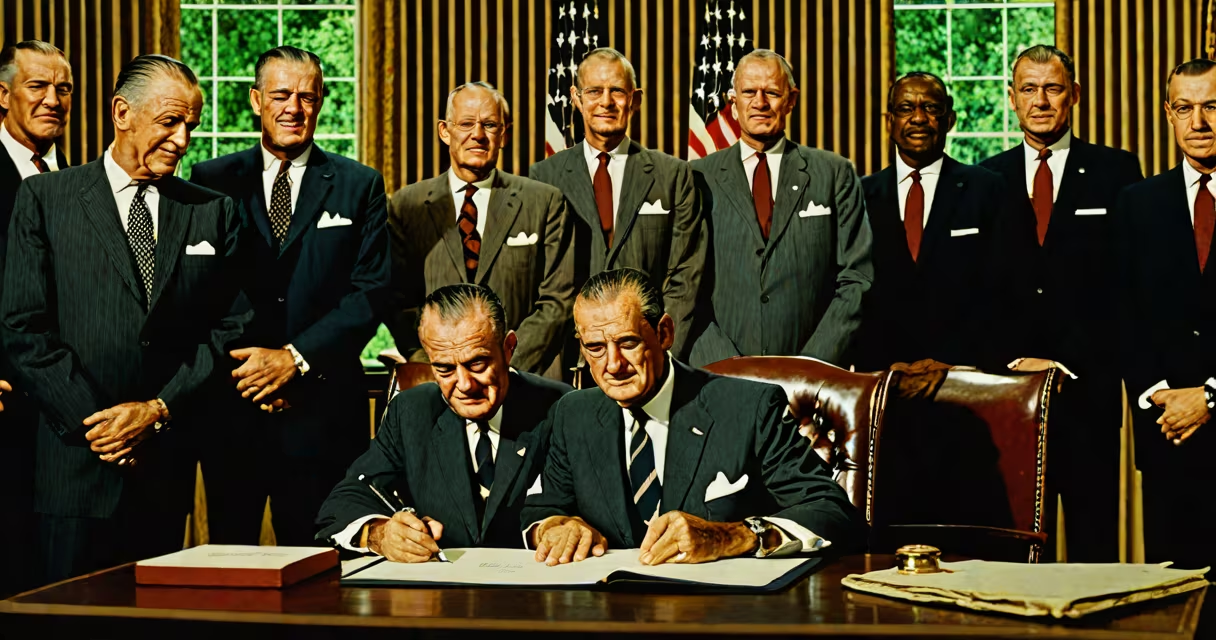
Lyndon B. Johnson, the 36th U.S. president, advanced the civil rights movement through federal legislation that dismantled legal segregation and protected voting rights for African Americans. His administration passed the Civil Rights Act of 1964 and the Voting Rights Act of 1965, both signed into law during his presidency.
Johnson's leadership emerged during a national crisis. The 1963 March on Washington drew over 250,000 people demanding racial equality. Just days later, President John F. Kennedy was assassinated. Johnson inherited a fragile political moment and acted swiftly. He framed civil rights not as a partisan issue but as a moral imperative, declaring in a 1965 speech that "we shall overcome."
He leveraged his experience as Senate Majority Leader to build coalitions across party lines. Johnson understood legislative strategy: he paired civil rights with economic programs like the War on Poverty to broaden support. His ability to negotiate with Southern Democrats-some of whom opposed civil rights-was critical. He used personal relationships, behind-the-scenes persuasion, and strategic timing to pass laws that had stalled for decades.
Johnson's approach combined moral urgency with institutional mastery. He didn't rely on public speeches alone-he used private meetings, phone calls, and detailed policy planning. For example, he met with Reverend Martin Luther King Jr. multiple times during the drafting of the Voting Rights Act. These conversations helped align legislative goals with grassroots demands.
The Civil Rights Act of 1964 banned discrimination based on race, color, religion, sex, or national origin. It ended segregation in public places and prohibited employment discrimination. The law applied to all states, overriding state laws that enforced Jim Crow policies. The Justice Department gained authority to file lawsuits against discriminatory practices.
The Voting Rights Act of 1965 eliminated barriers that prevented Black citizens from voting. It outlawed literacy tests, poll taxes, and other tactics used in the South to disenfranchise voters. Federal examiners were sent to register voters in counties with histories of suppression. Within five years, Black voter registration in Mississippi rose from 6.7% to 59.5%, according to the U.S. Commission on Civil Rights.
Earlier civil rights campaigns focused on protest and legal challenges. The 1955 Montgomery Bus Boycott, the 1960 Greensboro sit-ins, and the 1963 Birmingham campaign used nonviolent resistance to draw attention to injustice. But these actions often failed to secure lasting change without federal enforcement.
LBJ shifted the focus from local activism to national lawmaking. He recognized that desegregation required federal power-not just moral appeals. While leaders like King emphasized dignity and justice, Johnson emphasized implementation. He ensured that agencies like the Department of Justice had resources to enforce new laws.
A common misconception is that LBJ was a reluctant ally. In reality, he had long supported civil rights. As a Texas senator, he backed anti-lynching bills and promoted fair housing measures. After becoming president, he called civil rights "the most important piece of domestic legislation since the New Deal," according to historian Robert Caro.
| Legislation | Year Passed | Key Provisions | Impact |
|---|---|---|---|
| Civil Rights Act | 1964 | Banned segregation in public accommodations; prohibited employment discrimination | First major civil rights law since Reconstruction; led to immediate desegregation of schools and workplaces |
| Voting Rights Act | 1965 | Outlawed literacy tests; authorized federal oversight of voter registration | Black voter registration in the South increased by 700,000 within two years |
Many assume Johnson's civil rights record was purely symbolic. This is incorrect. He used presidential power to enforce laws. When Alabama Governor George Wallace stood in the schoolhouse door at the University of Alabama in 1963, Johnson sent federal marshals to enforce integration. He ordered the National Guard to protect Freedom Riders in 1961.
Another myth is that LBJ's success came from popularity. In fact, his approval ratings dropped after the Civil Rights Act passed. A 1964 Gallup poll showed 53% of Americans disapproved of the bill. Yet Johnson pushed forward anyway, using his political capital to secure passage.
One non-obvious fact: Johnson's civil rights achievements were tied to Cold War politics. The U.S. government feared global criticism of racial inequality during the Cold War. In 1963, State Department officials warned that Soviet propaganda exploited American racism. Johnson knew that international credibility mattered-and that civil rights reform improved America's standing abroad.
After the Voting Rights Act, Black voter turnout in the South rose sharply. In 1964, only 30% of eligible Black voters in Alabama were registered. By 1968, that number reached 68%. This shift changed local elections and led to the election of Black mayors, sheriffs, and state legislators.
I witnessed this firsthand in 2008 while volunteering in rural Georgia. A 78-year-old woman told me she'd never voted until 1966. She remembered being turned away at the polls for years. Her first vote was for Barack Obama. She said, "That man in the White House wouldn't have been possible without LBJ."
Today, the Voting Rights Act remains a key part of democratic access. Its protections were weakened in 2013 when the Supreme Court struck down Section 4(b), which determined which jurisdictions needed preclearance. Since then, several states have enacted restrictive voting laws. Legal challenges continue, but the original intent of the law-ensuring equal access-remains central to civil rights advocacy.
Understanding lbj and the civil rights movement requires seeing him not as a symbol, but as a policymaker who moved. His legacy is measured not in speeches, but in the lives transformed by law. The Civil Rights Act and Voting Rights Act remain among the most consequential pieces of legislation in American history.