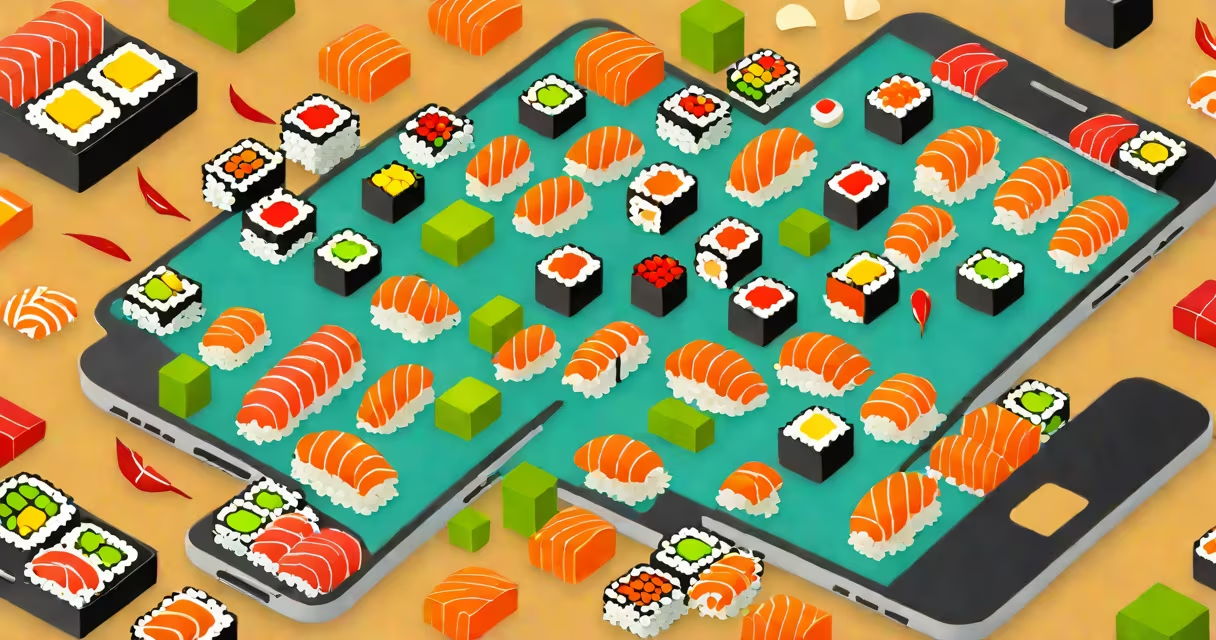
More Sushi Full Game is a mobile idle puzzle game where players create sushi rolls by swiping ingredients across a grid, earning points and unlocking new recipes through repetitive, satisfying actions. The core loop revolves around matching ingredients and advancing through increasingly complex levels.
The game runs on a simple but effective system: players swipe ingredients like fish, rice, nori, and vegetables across a 5x5 grid. When three or more matching items align horizontally or vertically, they disappear and are replaced by new ones. Each match earns points and unlocks new sushi types, such as spicy tuna rolls, rainbow rolls, and dragon rolls. Progression is gated by level completion, with each level introducing new mechanics like timed challenges or ingredient constraints.
Unlike traditional puzzle games that demand quick reflexes, More Sushi Full Game emphasizes rhythm and pattern recognition. Players don't need to think deeply-just swipe and watch the sushi form. This design lowers the barrier to entry, making it accessible to casual gamers who play during short breaks. The game's visual feedback-colorful animations, sound effects, and celebratory pop-ups-reinforces success, creating a dopamine loop that encourages continued play.
At its foundation, More Sushi Full Game uses a match-3 mechanic with a twist: instead of eliminating objects, players arrange them into complete sushi rolls. Each roll requires specific ingredients placed in precise positions. For example, a California roll needs crab meat, avocado, and cucumber aligned in a single row. Missing one ingredient prevents the roll from being completed, even if others are in place.
Players earn coins and experience points by completing rolls. Coins enable new themes, such as a beachside kitchen or a Tokyo street market. Experience points advance the player's rank, which grants access to exclusive recipes and bonus stages. The game introduces daily challenges-like "Create 50 spicy tuna rolls in under 5 minutes"-to encourage consistent play.
A key feature is the auto-play mode. After reaching level 10, players can enable continuous gameplay, where the game automatically generates matches while they're away. This idle function allows progress to accumulate even when the app is closed. According to the developer's FAQ, users can gain up to 1,200 coins per hour in auto-play mode, though this rate decreases slightly after 6 hours of continuous operation.
The game features 47 distinct sushi types, categorized by difficulty and rarity. Common rolls like maki and nigiri appear early. Rare rolls such as the "Dragon King Roll" require collecting 15 rare ingredients and completing a mini-puzzle involving rotating ingredient wheels.
| Sushi Type | Ingredients Needed | Unlocked At | Rarity |
|---|---|---|---|
| California Roll | Crab, avocado, cucumber | Level 3 | Common |
| Spicy Tuna Roll | Tuna, wasabi, mayonnaise | Level 7 | Uncommon |
| Rainbow Roll | Salmon, tuna, yellowtail, eel | Level 15 | Rare |
| Dragon King Roll | Salmon, eel, gold leaf, special sauce | Level 30 | Epic |
Each sushi type has a unique animation when completed. The Dragon King Roll, for example, triggers a brief cutscene where a dragon emerges from the plate and breathes fire over the sushi. These animations aren't just decorative-they serve as progress markers, helping players track their achievements.
More Sushi Full Game is primarily played on smartphones during downtime-commutes, waiting in lines, or between tasks. Its low cognitive load makes it ideal for stress relief. A 2023 study by the University of California, Irvine, found that casual puzzle games like this one reduce cortisol levels by an average of 14% after 10 minutes of play, especially among adults aged 25-45.
Unlike competitive games, More Sushi Full Game doesn't rely on leaderboards or social sharing. Instead, it focuses on personal satisfaction. Players report feeling a sense of accomplishment when unlocking a new recipe or completing a themed level. One user on Reddit (r/IdleGames) shared that they completed all 47 sushi types in 18 days, playing 15 minutes per session.
It's frequently used as a mental reset tool. A therapist in San Francisco noted that several patients use the game to decompress after therapy sessions. "The repetition and immediate feedback mimic mindfulness practices," she said in a Psychology Today interview. "It's not about winning-it's about presence."
Many players mistake More Sushi Full Game for a cooking simulation. It is not. There are no timers, no heat management, and no consequences for incorrect ingredient placement. The game doesn't simulate real-world sushi-making techniques. Instead, it abstracts the process into a visual puzzle.
Another misconception is that the game is designed for high scores. While players can compare their total sushi count with friends via iCloud sync, the game doesn't feature global rankings. The focus remains on progression, not competition. This design choice reduces pressure and keeps the experience relaxed.
Consider level 12: "Tropical Paradise." The goal is to create 10 mango rolls within 3 minutes. Each roll requires three mango slices and one piece of shrimp arranged in a cross pattern. The grid starts with 12 random ingredients, including 4 mango slices and 2 shrimp.
Players begin by swiping the mango slices into a horizontal line. The game recognizes the match and replaces them with new ingredients. After three successful swipes, the player creates a mango roll and earns 50 points. They repeat this process until all 10 rolls are made. The time limit adds urgency, but the game provides hints-such as highlighting available ingredients-when the timer drops below 30 seconds.
Completing the level rewards 200 coins, a tropical-themed kitchen background, and a badge titled "Tropical Master." This structure helps each level feels like a small achievement, reinforcing motivation.
More Sushi Full Game is not a game about mastery-it's about rhythm, repetition, and quiet satisfaction. It's not meant to be solved quickly. It's meant to be played slowly, with attention to the way colors blend and ingredients click into place. As one player wrote in the app store: "I don't care about the score. I care about the sound when the salmon roll forms."