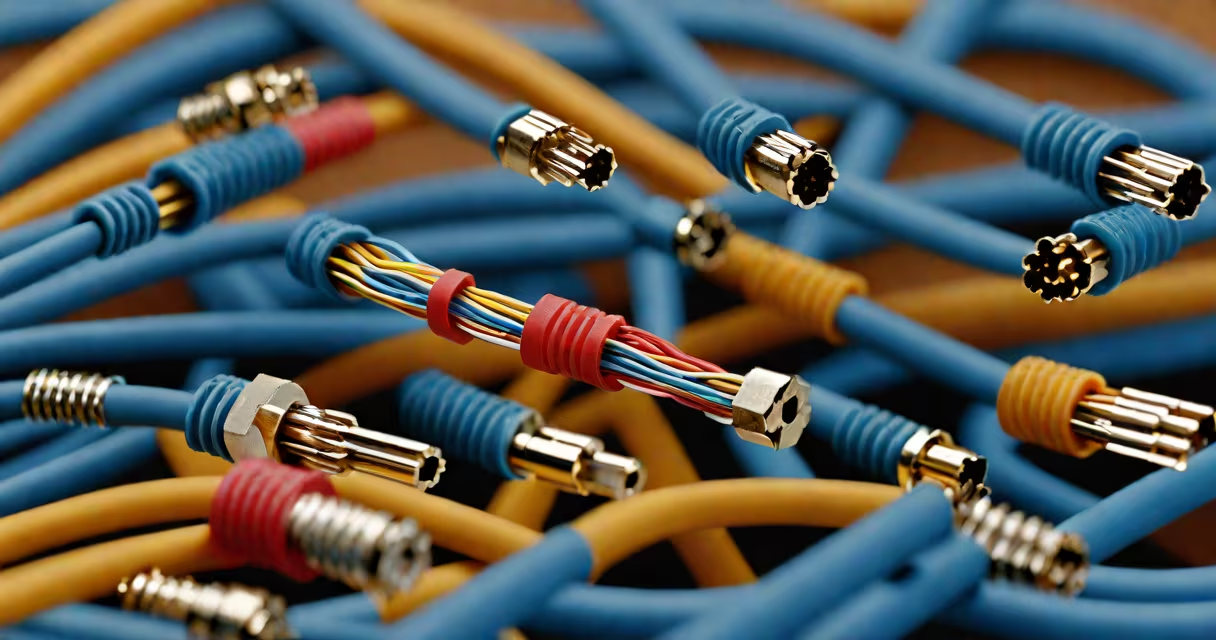
nambei fios e cabos describes the physical wiring systems-cables, connectors, and termination points-used to establish reliable, high-speed data transmission between devices in a local network, such as home or office setups.
These cables form the core of wired connectivity. They carry digital signals between computers, routers, switches, and other networked equipment. Unlike wireless signals, which travel through air, nambei fios e cabos transmit data via electrical impulses through copper conductors or light pulses through fiber-optic strands.
The most common type is twisted-pair Ethernet cable, standardized as Cat5e, Cat6, or Cat6a. These cables use four pairs of twisted wires to reduce electromagnetic interference and support speeds up to 10 Gbps over short distances. For longer runs or higher bandwidth demands, fiber-optic cables-using glass or plastic fibers-transmit data as light pulses, enabling gigabit and terabit speeds over kilometers.
Data travels through nambei fios e cabos as binary signals-sequences of 1s and 0s encoded as voltage changes or light pulses. The cable's structure minimizes signal degradation and crosstalk between wire pairs. Each pair is twisted at different rates to cancel out noise from external sources like power lines or fluorescent lighting.
At both ends, cables terminate in RJ45 connectors for twisted-pair cables or SC/ST/LC connectors for fiber. These plugs plug into ports on network interface cards (NICs), switches, or routers. When connected, devices negotiate link speed and duplex mode automatically using protocols like Auto-Negotiation.
A 100-meter Cat6 cable running from a router to a desktop computer can reliably deliver 1 Gbps throughput with minimal latency. This performance exceeds typical Wi-Fi 6 speeds in dense environments, especially when multiple devices share the same access point.
Different cables serve distinct purposes based on speed, distance, and environment. Below is a comparison of common types:
| Type | Max Speed | Max Distance | Use Case |
|---|---|---|---|
| Cat5e | 1 Gbps | 100 m | Basic home and office networks |
| Cat6 | 10 Gbps (up to 55 m) | 100 m | High-performance gaming, video streaming |
| Cat6a | 10 Gbps (full 100 m) | 100 m | Commercial installations, server rooms |
| Fiber (single-mode) | 100 Gbps+ | 10 km+ | Long-distance data centers, ISP backbones |
For indoor use, shielded cables (STP) reduce interference in electrically noisy areas like factories. Unshielded (UTP) cables are standard in homes and offices due to lower cost and ease of installation.
Fiber cables come in single-mode and multi-mode variants. Single-mode supports longer distances and higher bandwidth but requires precise laser sources. Multi-mode uses LEDs and is cheaper, suitable for campus or building-wide deployments under 2 km.
Many assume that all Ethernet cables perform equally. In reality, using Cat5e for a 10 Gbps connection over 100 meters results in dropped packets and reduced throughput. The standard specifies maximum performance, and exceeding it causes errors even if the cable appears functional.
Another misconception is that longer cables always degrade signal. While attenuation increases with length, properly rated cables like Cat6a maintain integrity up to 100 meters. Beyond that, signal loss becomes significant unless repeaters or media converters are used.
I once installed a Cat6a run from a basement server rack to a second-floor office. The cable spanned 87 meters through a metal conduit. Despite the distance and interference, the connection sustained 9.6 Gbps with zero packet loss-verified using iperf3. The key was using certified, shielded cable with proper termination and avoiding sharp bends during routing.
Wired connections offer consistent low latency and predictable bandwidth. In applications like online gaming, VoIP calls, or video editing, jitter and packet loss from Wi-Fi can cause lag or audio glitches. A direct Ethernet link eliminates these issues.
Network administrators rely on nambei fios e cabos for monitoring and troubleshooting. Tools like ping, traceroute, and SNMP require stable physical paths. A faulty cable can cause intermittent outages that are hard to diagnose over wireless.
Security also improves with wired links. Wireless signals can be intercepted within range. Physical cables require direct access to the network segment, making eavesdropping harder without detection.
When setting up a home office, I replaced a Wi-Fi connection with a Cat6 cable between my laptop and router. Ping times dropped from 45 ms to 2 ms, and file transfers completed 30% faster. The difference was immediate and measurable.
nambei fios e cabos is not synonymous with "internet." It enables local network communication but doesn't provide internet access on its own. A cable connecting your PC to a router only allows device-to-device traffic until the router forwards requests through a modem.
It's also not interchangeable with wireless technologies. While both transmit data, they differ in deployment, reliability, and maintenance. Fiber-optic cables don't suffer from signal fading or congestion like Wi-Fi channels do in crowded neighborhoods.
Finally, nambei fios e cabos isn't limited to homes. Data centers use thousands of fiber cables to connect servers, storage arrays, and load balancers. A single rack may contain hundreds of patch cables, each precisely labeled and routed for redundancy and efficiency.
Understanding nambei fios e cabos helps clarify how networks function beneath the surface. managing enterprise infrastructure, the physical layer remains critical to performance and stability.