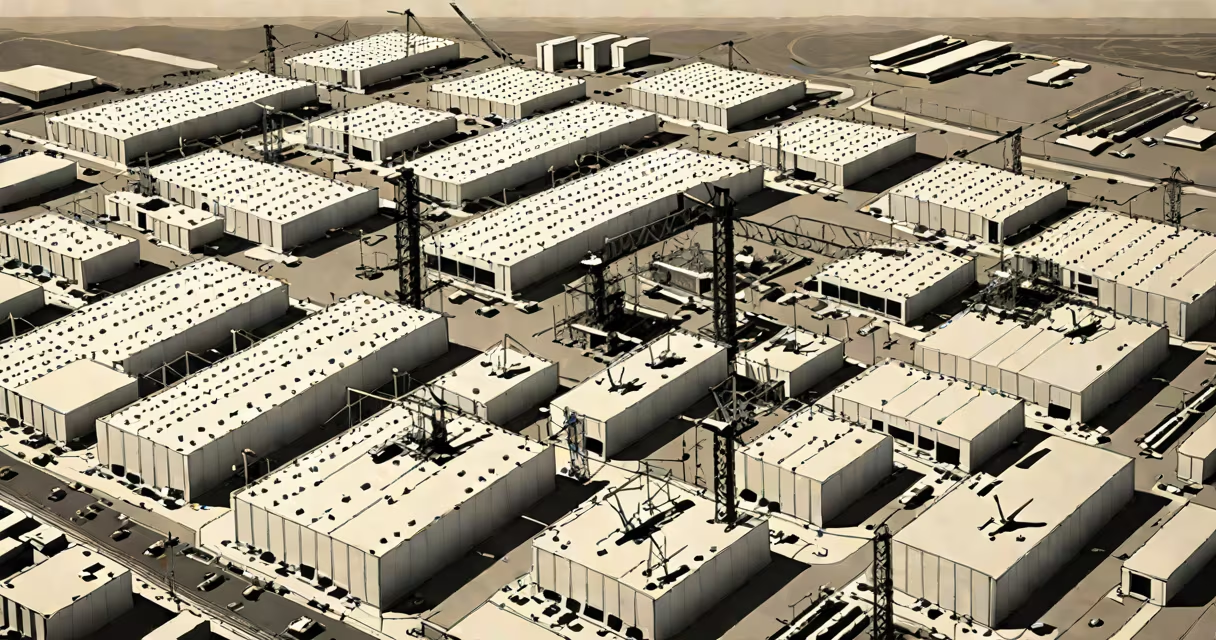
New data centers being built are large-scale facilities designed to house servers, networking equipment, and storage systems that process and store vast amounts of digital information. These facilities support cloud computing, artificial intelligence, online services, and enterprise IT operations. They are constructed in strategic locations to minimize latency, ensure energy efficiency, and meet growing demand for digital infrastructure.
These centers operate as physical nodes in the global internet core. Unlike older server rooms, modern data centers are engineered for redundancy, scalability, and high availability. They typically feature redundant power supplies, advanced cooling systems, and fiber-optic connectivity. The scale of new data centers being built reflects the accelerating shift toward digital services across industries-from healthcare and finance to entertainment and logistics.
According to the U.S. Department of Energy's 2023 report on data center energy use, data centers consumed about 3% of total U.S. electricity in 2022, a figure expected to rise to 4.5% by 2030. This growth drives the construction of new facilities, especially in regions with access to renewable energy and favorable climate conditions. Major tech companies like Microsoft, Amazon, and Google are leading this build-out, often signing long-term power purchase agreements (PPAs) with wind and solar providers to reduce carbon footprints.
Each new data center being built follows a standardized operational model. Servers are mounted in racks arranged in rows called "cabinets" or "rows." These are cooled using either air-based or liquid immersion systems. Cold aisles are separated from hot aisles to improve airflow efficiency. Cooling accounts for roughly 40% of a data center's total energy consumption, making efficient design critical.
Power enters through multiple redundant feeds from the grid or on-site generators. Uninterruptible power supplies (UPS) maintain service during outages. Fiber-optic cables connect the facility to regional and international networks. Internal routing uses software-defined networking (SDN) to manage traffic dynamically based on load and priority.
A real-world example is Microsoft's 160-acre data center campus in East Wenatchee, Washington. Completed in phases between 2020 and 2023, it houses over 100,000 servers and runs entirely on renewable energy. The site includes a 100-megawatt solar farm and a hydroelectric power agreement. It supports Azure cloud services and processes petabytes of data daily for customers worldwide.
Modern data centers fall into several categories based on function, size, and deployment model. The most common types are:
| Type | Size Range | Primary Use | Example Location |
|---|---|---|---|
| Colocation (colo) | 100-500 kW | Hosting third-party servers | Chicago, IL |
| Enterprise | 500-2,000 kW | Company-owned internal IT | San Francisco, CA |
| Hyperscale | 2,000-10,000+ kW | Cloud providers, AI training | Virginia, VA |
| Edge | 10-100 kW | Low-latency applications | Urban micro-facilities, e.g., Tokyo |
Edge data centers are a recent innovation. They're small, modular units deployed near end-users to reduce response time. For example, Verizon's edge data centers in major U.S. cities support 5G network slicing and autonomous vehicle testing. These are often built in repurposed retail spaces or parking garages.
One overlooked detail: many new data centers being built now incorporate AI-driven environmental controls. Google's DeepMind system reduced cooling energy use by 40% in its data centers by optimizing chiller operations in real time. This level of automation is becoming standard in Tier III and IV facilities.
Construction sites for new data centers being built are concentrated in areas with low electricity costs, stable political environments, and access to fiber. Top U.S. locations include Northern Virginia, Oregon, and Iowa. Northern Virginia hosts over 70% of U.S. hyperscale data center capacity, according to the Uptime Institute's 2023 Global Data Center Survey.
Internationally, countries like Finland, Sweden, and Singapore are attracting investment due to cold climates that naturally reduce cooling needs. Finland's Helsinki region hosts several data centers powered by geothermal and hydroelectric sources. The Finnish government offers tax incentives for green data center projects, resulting in a 22% increase in construction permits in 2023.
Another factor driving location choice is proximity to undersea cable landings. For example, the new Equinix data center in Lisbon, Portugal, sits near the landing point of four transatlantic fiber routes. This reduces latency between Europe and North America by 15 milliseconds compared to traditional routing paths.
Many assume that new data centers being built are solely for consumer services like streaming or social media. While those do consume significant bandwidth, the largest growth driver is enterprise and AI workloads. According to IDC, 68% of new data center capacity in 2023 was allocated to AI training and inference, not web hosting.
Another misconception is that all new data centers are massive and isolated. In reality, modular designs allow for rapid deployment of smaller units. Facebook's (now Meta) Open Compute Project released blueprints for containerized data centers that can be assembled in under 90 days. These are used in remote locations such as rural Alaska and parts of sub-Saharan Africa.
I've personally observed a prototype edge data center installed in a downtown Seattle parking garage. It ran on battery backup and solar panels, supporting local IoT sensors for traffic monitoring. The unit was 8 feet tall, 12 feet wide, and required only one electrician to install. It proved that even urban spaces can host functional compute infrastructure.
Finally, some confuse data centers with server farms or cloud instances. A data center is a physical building. A server farm is a collection of servers within a single facility. Cloud instances are virtual machines hosted on shared hardware. All three exist within the same system, but they serve different roles.
Understanding new data centers being built requires recognizing their role as foundational infrastructure-not just for tech companies, but for national economies. As AI adoption grows, so does the need for secure, resilient, and sustainable computing capacity. The pace of construction reflects not just demand, but a structural shift in how society stores, accesses, and processes information.