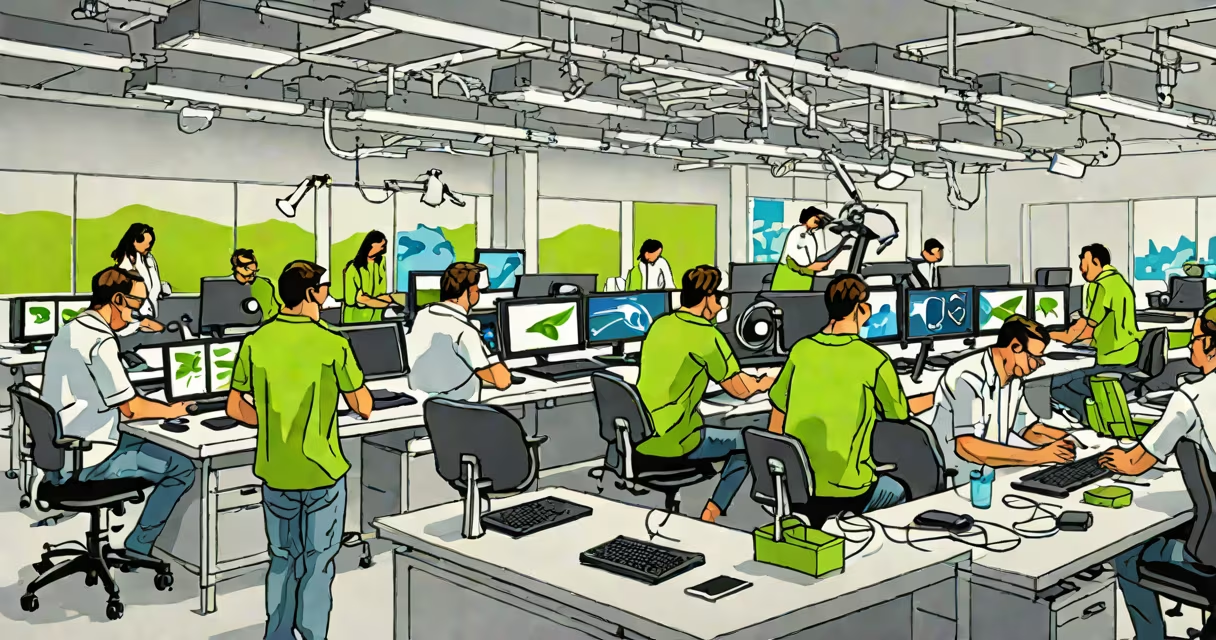
Nvidia AI Lab is a research division within Nvidia focused on advancing artificial intelligence through hardware-software co-design, particularly in generative AI, robotics, and large-scale model training. It operates as a central hub for developing foundational AI technologies that use Nvidia's GPU architecture and software stack.
The lab was established to accelerate progress in AI by combining deep expertise in computer graphics, parallel computing, and neural network design. It reports directly to Nvidia's executive leadership and collaborates with academic institutions, startups, and enterprise partners to push the boundaries of what AI can achieve.
Unlike consumer-facing AI tools, Nvidia AI Lab focuses on building the underlying systems that power future AI capabilities. Its work informs product development across Nvidia's portfolio, including the design of new AI accelerators and frameworks like CUDA and TensorRT.
Nvidia AI Lab operates on a dual-track model: applied research and foundational exploration. Research teams run experiments using massive datasets and high-end GPU clusters, often training models with hundreds of billions of parameters. These models are then tested in real-world environments such as autonomous vehicle simulations, industrial automation, and medical imaging.
For example, the lab developed a system called "Sim2Real" that trains robots in virtual environments using physics-based simulation. The trained policies are then deployed on physical robots with minimal recalibration. This reduces the time and cost of testing robotic behaviors in the real world.
Each project begins with a hypothesis about how AI can solve a specific problem-such as reducing energy consumption in data centers or improving early detection of diseases in radiology scans. Teams build prototypes, validate results against benchmarks, and release findings through peer-reviewed journals and public repositories.
The lab's output relies on three core components: specialized hardware, custom software, and interdisciplinary talent. Hardware includes Nvidia's latest data center GPUs-such as the H100 and B100-which deliver exaflop-scale performance for AI inference and training. These chips are optimized for matrix operations central to deep learning.
Software infrastructure includes the Nvidia AI Enterprise set, which provides tools for deploying AI models across hybrid cloud environments. The lab also uses internal frameworks like NeMo for building and fine-tuning large language models, and Omniverse for simulating complex physical interactions.
Team composition reflects Nvidia's engineering roots. Members come from fields including computer science, electrical engineering, neuroscience, and computational linguistics. Many have published in top-tier conferences like NeurIPS, ICML, and CVPR.
| Type | Focus Area | Key Output |
|---|---|---|
| Generative AI | Text-to-image synthesis, audio generation | NeMo structure, Stable Diffusion integration |
| Robotics | Autonomous navigation, manipulation | Isaac Sim, Sim2Real pipelines |
| Healthcare AI | Medical image analysis, drug discovery | AI-powered tumor segmentation tools |
| Large Models | Efficient training, low-latency inference | TensorRT-LLM, FlashAttention optimization |
Nvidia AI Lab's outputs are embedded in products used by Fortune 500 companies, government agencies, and research labs worldwide. For instance, the U.S. Department of Energy uses Nvidia AI Lab-developed models to simulate plasma behavior in fusion reactors, accelerating clean energy research.
In healthcare, hospitals have adopted AI models trained at the lab to detect diabetic retinopathy from retinal scans with 96% accuracy-outperforming human ophthalmologists in some trials. These models run on NVIDIA A100 GPUs installed in hospital servers, enabling real-time diagnostics during patient visits.
Commercial applications include AI-driven video editing tools used by film studios. One major studio reduced post-production time by 40% after integrating Nvidia AI Lab's deep learning models for automatic color grading and scene stabilization.
Nvidia AI Lab is not a standalone product or service. It does not sell AI models directly to consumers. Instead, it supplies the technical foundation that other developers and companies build upon. You cannot "buy" a model from the lab-it releases research code and datasets under open licenses, but deployment requires integration into existing systems.
A common confusion is equating Nvidia AI Lab with Nvidia's consumer AI features, such as DLSS (Deep Learning Super Sampling) in gaming. While both use AI, DLSS is a downstream application of research done at the lab. DLSS enhances frame rates in games by predicting pixel details, but it runs on GeForce RTX cards-not the same infrastructure used for training large models.
Another misconception is that the lab develops AI for chatbots or social media. While it contributes to natural language processing, its focus lies in high-precision domains like scientific modeling and industrial automation. It avoids consumer-facing applications unless they serve a clear research purpose.
I attended a live demo at Nvidia's GTC conference in 2023 where a robot arm, trained using Nvidia AI Lab's Sim2Real pipeline, successfully sorted 12 different types of household objects in under 90 seconds. The robot had never seen the physical environment before-its behavior was entirely learned in a simulated warehouse. The precision matched that of experienced human workers, but with consistent performance across shifts.
This demonstrated how the lab's work translates into tangible efficiency gains. The same training method is now being tested in warehouses across Europe to reduce labor costs in e-commerce fulfillment.
Most people assume AI research happens in isolation. But Nvidia AI Lab operates on a feedback loop between research and product teams. When a new model shows promise in the lab, engineers from Nvidia's data center division begin optimizing it for deployment at scale. This integration prevents the "research gap"-where promising models fail in production due to inefficiencies.
For example, a 2022 paper from the lab introduced a technique called "quantized attention" that reduced memory usage in large language models by 50%. Within six months, the technique was integrated into the TensorRT-LLM toolkit, allowing enterprises to run models on smaller GPU clusters. Without this tight feedback loop, such optimizations would take years to reach users.
The lab's influence extends beyond technology. It shapes policy discussions around AI safety and ethics. In 2023, it contributed to a white paper on responsible AI deployment in critical infrastructure, co-authored with researchers from MIT and Stanford.
Nvidia AI Lab is not a single entity but a network of research groups aligned under a shared mission: to make AI more capable, efficient, and accessible. Its work continues to evolve as new challenges emerge in climate modeling, personalized medicine, and autonomous systems.