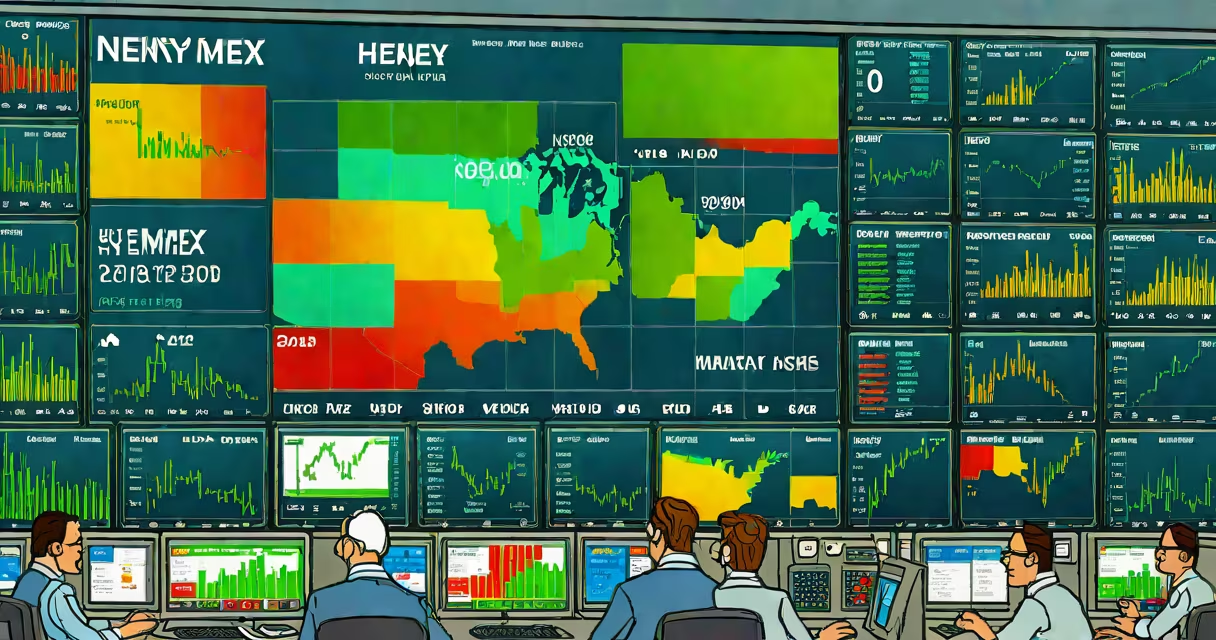
The Nymex Henry Hub is the primary U.S. natural gas price benchmark, establishing daily settlement values for natural gas futures contracts traded on the New York Mercantile Exchange (NYMEX). It reflects the spot price of natural gas delivered at the Henry Hub in Louisiana, a major pipeline interchange point connecting major North American gas supply and demand regions.
Nymex Henry Hub futures are standardized contracts traded in units of 10,000 million British thermal units (MMBtu), with delivery scheduled for specific months. These contracts are physically settled, meaning the buyer receives actual natural gas at the Henry Hub location on the contract's expiration date. The settlement price is determined by the volume-weighted average of trades during the last hour of trading on the expiration day.
Henry Hub itself is located in Erath, Louisiana, where multiple interstate pipelines converge. This strategic position allows it to serve as a central node for gas flows from the Gulf Coast, the Rocky Mountains, and the Appalachian Basin. As a result, its price reflects supply and demand dynamics across a vast geographic area, making it a trusted reference point for producers, consumers, and traders.
Each Nymex Henry Hub futures contract specifies a delivery month and a fixed quantity of 10,000 MMBtu. Traders buy and sell these contracts based on expectations of future supply and demand. When a contract expires, the final settlement price is calculated using the volume-weighted average of trades during the last 60 minutes of trading.
For example, the August 2024 contract settles at $2.85 per MMBtu. This price becomes the official settlement value used to close out positions. Traders who hold long positions receive physical gas at Henry Hub, while short positions deliver gas. Most participants close their positions before expiry through offsetting trades, avoiding physical delivery.
Prices fluctuate daily based on weather forecasts, storage levels, production data, and macroeconomic indicators. A cold winter forecast can push prices higher due to increased heating demand, while a warm season with abundant supply may cause prices to drop. The U.S. Energy Information Administration (EIA) releases weekly reports on natural gas storage levels, which often trigger immediate market reactions.
Nymex Henry Hub is one of several natural gas benchmarks globally, but it dominates U.S. pricing. Other regional benchmarks include the UK's National Balancing Point (NBP), Germany's TTF (Title Transfer Facility), and Japan's JKM (Japan-Korea Marker). However, Nymex Henry Hub remains the most liquid and widely referenced benchmark for North American natural gas.
| Benchmark | Region | Trading Venue | Contract Size | Settlement Method |
|---|---|---|---|---|
| Nymex Henry Hub | U.S. (Louisiana) | NYMEX | 10,000 MMBtu | Physical delivery at Henry Hub |
| TTF | Europe (Netherlands) | EEX | 10,000 MWh | Financial settlement |
| JKM | Asia-Pacific (Japan/Korea) | Platts | 10,000 MMBtu | Price index-based |
A key distinction is that while TTF and JKM are primarily financial benchmarks, Nymex Henry Hub supports physical delivery. This makes it particularly valuable for utilities, industrial users, and gas suppliers who need to manage actual supply obligations.
Many assume the Nymex Henry Hub price is set by the NYMEX exchange itself. In reality, the price emerges from market activity-the aggregation of buy and sell orders during trading hours. The exchange provides the infrastructure and rules, but the price is determined by supply and demand.
Another misconception is that Henry Hub represents national average U.S. prices. It does not. While it influences regional rates, local prices can deviate due to transportation costs, pipeline constraints, or regional weather patterns. For example, during the 2021 Texas freeze, local Houston-area prices spiked above $10 per MMBtu, even as Henry Hub remained below $4.
A lesser-known fact: Henry Hub is not the only delivery point for NYMEX natural gas contracts. The exchange also offers contracts tied to other hubs like Mont Belvieu (Texas) and Chicago. However, Henry Hub remains the most actively traded and serves as the de facto standard.
In 2022, a mid-sized utility in Pennsylvania used Nymex Henry Hub futures to hedge against rising winter gas prices. They bought 50 December 2022 contracts at $3.10 per MMBtu. By November, prices had risen to $4.80. The utility closed their position early, realizing a $1.70 gain per MMBtu-$85,000 total profit-offsetting higher procurement costs.
This strategy illustrates how the Nymex Henry Hub enables risk management. Producers use it to lock in prices before drilling. Shippers use it to protect margins. Financial institutions trade it as part of diversified commodity portfolios.
I once observed a trader at a commodities desk in Chicago adjust his portfolio in real time based on a sudden EIA report showing a 15 Bcf drawdown in storage. Within 12 minutes, he had adjusted his Henry Hub exposure, reducing risk. That speed is only possible because the market treats Nymex Henry Hub as a transparent, reliable reference.
The Nymex Henry Hub is not just a price-it's a mechanism for economic coordination. It allows thousands of unrelated parties to align expectations about future gas availability and cost. Without such a benchmark, long-term contracts would require individual negotiation, increasing transaction costs and reducing market efficiency.
According to the U.S. Commodity Futures Trading Commission (CFTC), over 90% of natural gas swaps and derivatives in the U.S. reference the Nymex Henry Hub price. This dominance underscores its role as the central nervous system of U.S. natural gas markets.
Understanding the Nymex Henry Hub is essential for anyone involved in energy finance, policy, or operations. Its influence extends beyond trading floors-it shapes investment decisions, infrastructure planning, and environmental modeling. The next time you see a headline about natural gas prices, chances are the underlying reference is this benchmark.