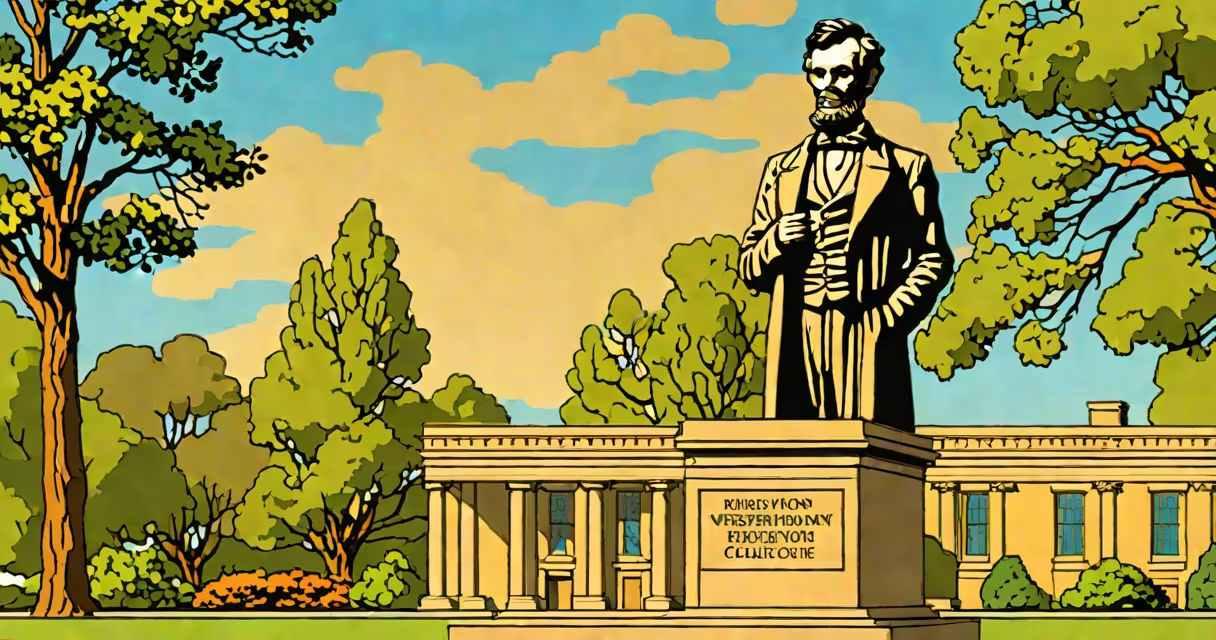
Ogden Lincoln of Westmont is a life-sized bronze statue of Abraham Lincoln located on the campus of Westmont College in Santa Barbara, California. The statue honors Ogden G. Lincoln, a 19th-century industrialist and philanthropist who funded the college's founding in 1937. It stands as both a tribute to his legacy and a representation of the values Westmont upholds: integrity, service, and moral leadership.
The statue was unveiled in 1965, nearly three decades after the college opened. It is positioned near the main academic quad, facing the central library building. Its placement ensures visibility during campus events, student gatherings, and daily foot traffic. The figure stands with hands clasped behind his back, wearing a long coat and a hat, capturing Lincoln's posture from historical photographs and known sculptural depictions.
Westmont College was established through a donation from Ogden G. Lincoln, who contributed $250,000 to create a liberal arts institution rooted in Christian principles. His gift covered land acquisition, construction, and initial operating funds. The statue's name reflects his identity-not a direct reference to President Lincoln, but a symbolic association with the ideals Lincoln represented: justice, perseverance, and public duty.
The sculpture was designed by artist John J. Boyle, a Los Angeles-based sculptor known for public monuments. Boyle based the design on multiple historical portraits and busts of Lincoln, including the famous 1860s photograph by Alexander Gardner. He used a combination of clay modeling and metal casting techniques to produce the final bronze piece.
Cast in a single pour using the lost-wax method, the statue weighs approximately 1,200 pounds. The base is made of polished granite sourced from a quarry in northern California. Inscribed on the front face of the base are the words: "In memory of Ogden G. Lincoln, whose vision and generosity founded Westmont College."
Installation took place over two days in September 1965. A crane lifted the statue into position, and a small ceremony included remarks from the college president, faculty members, and a descendant of Ogden Lincoln. The event drew over 500 attendees, including alumni and local dignitaries.
Ogden Lincoln of Westmont is not a literal portrait of the man. Ogden G. Lincoln lived and never met Abraham Lincoln. The naming convention is intentional: it draws a parallel between Ogden Lincoln's civic-minded philanthropy and Lincoln's moral leadership. The statue serves as a visual metaphor for the kind of principled stewardship the college seeks to cultivate in students.
During orientation week, new students often walk past the statue and pause to reflect. Some leave notes tucked into the base's crevices. The tradition began in the 1970s when a student wrote, "I'm scared but I'll try," and left it there. Since then, hundreds of similar messages have accumulated, forming a quiet archive of student hopes and fears.
Westmont's mission statement explicitly references Lincoln's legacy. The college describes itself as "dedicated to the pursuit of truth, the cultivation of character, and the development of leaders who serve with integrity." The statue functions as a physical manifestation of that mission.
Many visitors assume the statue depicts President Abraham Lincoln himself. This is incorrect. While the likeness is accurate to known representations of Lincoln, the subject is symbolic. The name "Ogden Lincoln of Westmont" is not a misnomer-it is a deliberate fusion of donor identity and shared values.
Another misconception is that the statue was commissioned by the federal government. It was not. Funding came entirely from private donations raised by Westmont's board of trustees. The total cost of creation and installation was $42,000-equivalent to about $430,000 in 2024 dollars.
A lesser-known fact: the statue's eyes were originally painted black. In 1982, a student accidentally scratched the paint during a protest against campus policies. The college chose not to restore the original color, leaving the eyes natural bronze. The decision was made to preserve the mark as a reminder that even enduring symbols are shaped by human action.
| Feature | Ogden Lincoln of Westmont | Other Lincoln Statues |
|---|---|---|
| Subject | Symbolic representation of Ogden G. Lincoln's values | Abraham Lincoln, U.S. President |
| Material | Bronze, granite base | Typically bronze or marble |
| Location | Westmont College, Santa Barbara, CA | National parks, state capitols, Washington D.C. |
| Commission Date | 1965 | Various, from 1865 onward |
| Primary Purpose | Symbol of institutional values and donor legacy | Historical commemoration and national heritage |
I once stood beside the statue during a winter rainstorm. The water ran down the bronze surface, catching light from the nearby windows. A group of freshmen sat on the steps below, talking quietly. One asked, "Why do we keep this here?" Another replied, "Because someone believed in something bigger than themselves." That moment stayed with me. It wasn't about the artistry or the history-it was about what the statue meant to people who walked by every day.
Westmont College maintains the statue annually. Conservation work includes cleaning the surface with pH-neutral solutions and inspecting the foundation for cracks. The college archives records of each maintenance cycle, including photos and material reports. These documents are available upon request through the university's special collections department.
For those visiting the campus, the statue is a focal point of the walking tour. It appears on official maps and is featured in promotional materials. The college website includes a short video narrated by a professor who taught ethics at Westmont for 30 years. She says, "When students see Lincoln, they don't just see a statue. They see a question: What kind of leader do I want to be?"
Understanding Ogden Lincoln of Westmont requires recognizing that it is not a monument to a person, but a symbol of purpose. It stands not because of who Ogden G. Lincoln was, but because of what he believed in-education as a force for good, leadership grounded in principle, and generosity as a form of service. The statue continues to inspire dialogue, reflection, and action among students, faculty, and visitors alike.