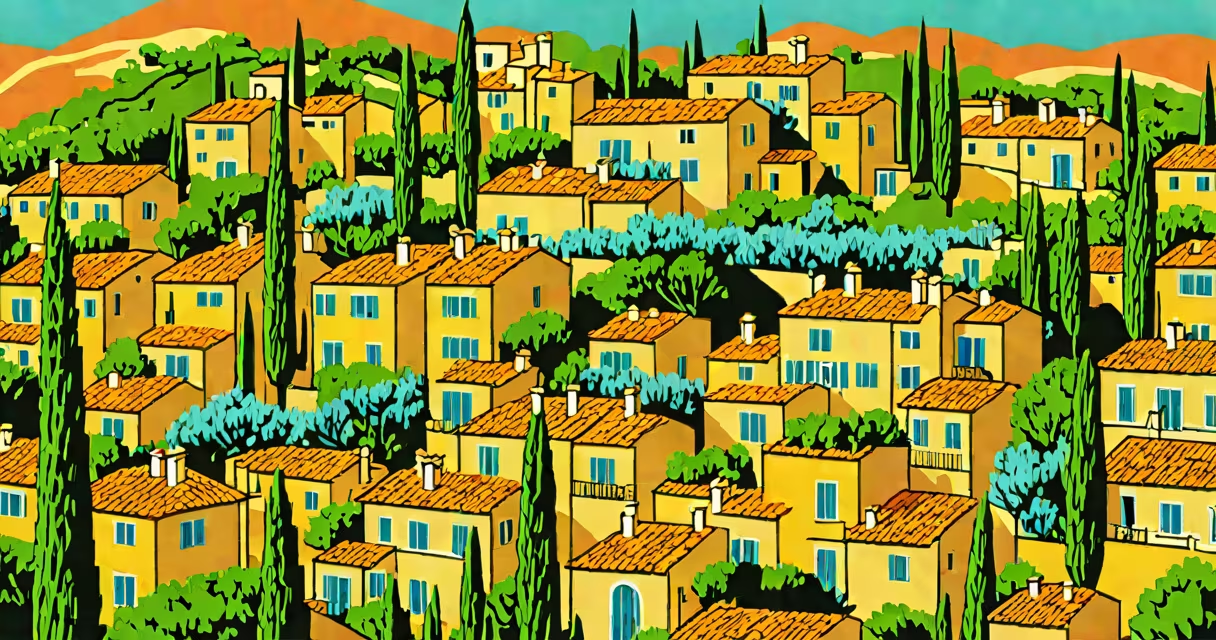
"On dirait le sud" is a French cultural expression rooted in the visual and emotional language of southern France, particularly Provence and the Côte d'Azur. It describes a style that evokes the warmth, light, and rhythms of the Mediterranean-through color, texture, and mood-rather than literal geography. The phrase translates loosely as "it's as if it were the south," capturing a feeling of southern authenticity in art, design, and everyday aesthetics.
The concept emerged in the early 2000s among artists, designers, and writers based in or inspired by southern France. It reflects a deliberate aesthetic choice: not to imitate the South, but to embody its spirit. This includes saturated blues and ochres, hand-painted tiles, wrought-iron details, and natural materials like terracotta and linen. It's less about architecture and more about atmosphere-how a space feels under late afternoon light, or how a meal tastes when eaten on a terrace with sea breeze.
It's not a formal movement with founding documents or leaders. Instead, "on dirait le sud" lives in the choices made by individuals who curate their surroundings to reflect a certain sensibility: relaxed, sun-drenched, deeply tactile. Think of a kitchen with a worn wooden table, a bowl of ripe figs, and a window open to the sound of cicadas. That's the essence-not a place, but a state of mind.
The phrase functions as a shorthand for sensory experience. When someone says "on dirait le sud" about a photograph, a room, or a piece of clothing, they're pointing to a set of cues: golden hour lighting, faded pastels, the presence of olive trees or bougainvillea, and a sense of unhurried time. These elements aren't randomly chosen-they follow patterns seen in decades of Mediterranean art and photography.
For example, the work of photographer Jean-Pierre Laffont captures "on dirait le sud" through grainy black-and-white images of fishermen in Cassis, their hands calloused from nets, faces weathered by salt and wind. His photos don't show beaches or resorts-they show labor, quiet dignity, and the passage of time. That's the core: it's not about vacation, but about lived experience.
Interior designer Élise Moreau uses the phrase to describe her approach to home styling. She avoids sterile minimalism. Instead, she layers textures-woven baskets, ceramic vases with irregular glazes, linens with subtle wear. Her clients often ask for "something that feels like the south." She replies: "It's not about where you are. It's about how you feel."
While not a rigid system, "on dirait le sud" appears in several distinct forms across creative fields:
| Type | Characteristics | Example |
|---|---|---|
| Visual Art | Use of earth tones, rural subjects, and natural light. Often features aging or weathered surfaces. | Paintings by Jean-Marc Chabot depicting vineyards near Saint-Rémy-de-Provence. |
| Textile Design | Hand-block printing, indigo dyeing, loose weaves. Patterns often include stylized flora or fish. | Les Filles de la Mer, a label producing cotton scarves with motifs based on coastal fishing nets. |
| Architecture & Interiors | Exposed stone walls, low ceilings, courtyards with fountains. Furniture is functional, not ornamental. | A renovation project in Aix-en-Provence using original 18th-century stone and handmade tile flooring. |
| Culinary Expression | Emphasis on seasonal ingredients, simple preparation, shared meals. Meals are meant to linger. | Le Bistrot du Soleil in Marseille serves dishes with no menu-just what's fresh that day. |
These forms share a rejection of perfection. There's beauty in unevenness-the crack in a terracotta pot, the slight warp in a wooden door. This aligns with principles outlined in *The Mediterranean Diet* by the World Health Organization, which notes that traditional southern French eating habits emphasize freshness, local sourcing, and communal dining.
"On dirait le sud" is most visible in branding, interior design, and editorial content targeting French consumers with a taste for authenticity. It appears in magazine spreads, boutique catalogs, and social media feeds promoting travel to southern France. But it's also used ironically-by people in northern cities like Lyon or Lille who adopt the aesthetic as a form of cultural escape.
For instance, a Parisian café called *La Terrasse* uses the phrase in its window display during winter months. The space is filled with wicker chairs, a single potted lemon tree, and a playlist of accordion music. The owner, Claire Dubois, says she doesn't live in the south-but she wants customers to feel like they do. "It's not about geography," she says. "It's about memory. You don't have to be the sea air."
It's also used in fashion. Designer Sophie Renard launched a spring collection titled *C'est comme si le sud existait ici*. The pieces included wide-leg trousers in faded indigo, shirts with patchwork embroidery, and sandals made from recycled rubber. The campaign photo showed a woman standing barefoot on a cobblestone street in Le Havre, sunlight slanting across her face. The caption: "On dirait le sud."
Many assume "on dirait le sud" refers to luxury or tourism. It does not. The phrase is not associated with high-end resorts or branded beachwear. It's deliberately anti-glamour. It values quiet over spectacle, authenticity over performance.
Another misconception is that it's limited to visual culture. In reality, it extends to sound and smell. The scent of rosemary crushed between fingers, the hum of a distant train on a summer evening, the crackle of a fire in a stone hearth-all evoke the feeling. This sensory dimension is documented in *The Senses of Place* by anthropologist Marc Augé, who argues that "place is not defined by coordinates but by embodied perception."
A third error: equating it with "Mediterranean style" as seen in American home décor. The two differ. American "Mediterranean" often features marble floors, gilded mirrors, and fake balconies. "On dirait le sud" avoids such clichés. It's not about decoration-it's about lived rhythm.
I spent a week in a small village near Saint-Tropez last summer, staying in a house owned by a retired schoolteacher. The walls were whitewashed, the floor was old terracotta, and the kitchen had a cast-iron stove. On my second morning, I asked her why everything looked so "unpolished." She laughed. "Because it's supposed to look like it's been lived in. Not like a photo shoot."
She showed me a series of photographs taken in the 1960s-her father's family, sitting on a porch with wine and bread. "That's what 'on dirait le sud' means," she said. "Not the colors. Not the style. The way people move through space. The way they rest."
Later that day, I walked to the nearby market. A vendor handed me a peach. It was warm from the sun. I bit into it. Juice ran down my wrist. The skin cracked slightly. I didn't take a picture. I just stood there, feeling the heat, smelling the fruit, hearing the distant cry of a gull. That moment-simple, unscripted-was "on dirait le sud."
"On dirait le sud" is not a destination. It's a way of seeing. It's a refusal to reduce the Mediterranean to a postcard. It's the quiet confidence of a sun-bleached shutter, the weight of a well-worn basket, the sound of a bell tolling at dusk. It's a cultural touchstone that continues to inspire creators across France, especially those drawn to the slower, deeper rhythms of southern life. For those seeking authenticity in design, art, or daily ritual, it offers a clear, grounded reference point-one that begins not with a map, but with a feeling.