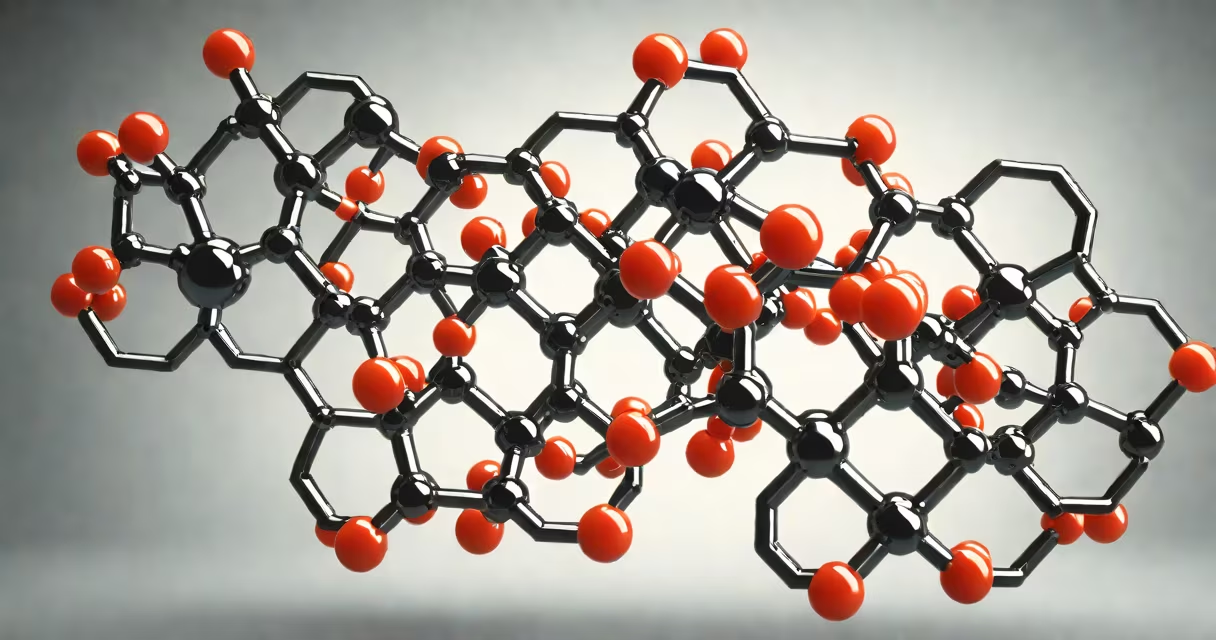
The phenol chemical formula is C6H5OH. It describes a six-carbon aromatic ring with five hydrogen atoms and one hydroxyl (-OH) group bonded to a carbon atom. This structure defines a class of compounds known as aryl alcohols.
Phenol arises when a hydroxyl group replaces a hydrogen atom on a benzene ring. The molecule's planar geometry results from sp² hybridization in the ring carbons. The hydroxyl group contributes polarity and enables hydrogen bonding, which influences solubility and reactivity.
Phenol appears in industrial synthesis, disinfectants, and pharmaceuticals. Its presence in wood tar and coal tar historically marked early organic chemistry research. The compound's ability to undergo electrophilic substitution reactions makes it valuable in producing plastics and resins.
Each carbon in the benzene ring shares electrons equally, creating resonance-stabilized double bonds. The hydroxyl group donates electron density into the ring through resonance, making the ortho and para positions more reactive toward electrophiles.
This electron donation explains why phenol undergoes bromination rapidly-without a catalyst-forming 2,4,6-tribromophenol. In contrast, benzene requires FeBr3 to initiate similar halogenation.
Acidity is another key feature. Phenol has a pKa of 10.0, making it more acidic than aliphatic alcohols (pKa ~15-18). The conjugate base, phenoxide ion, stabilizes negative charge via resonance across the ring. This property enables phenol to react with sodium hydroxide, forming water-soluble salts.
Substituted phenols form a broad category. Common variants include:
| Compound | Chemical Formula | Use Case |
|---|---|---|
| o-Cresol | C6H4(CH3)OH | Disinfectant, preservative |
| 2,4-Dinitrophenol | C6H3(NO2)2OH | Herbicide, metabolic uncoupler |
| Resorcinol | C6H4(OH)2 | Rubber accelerator, dye intermediate |
These derivatives differ in reactivity due to substituent position and electronic effects. For example, electron-withdrawing groups like nitro increase acidity, while methyl groups slightly reduce it.
Phenol is often confused with ethanol. Ethanol (C2H5OH) lacks aromaticity and has lower acidity. It does not undergo electrophilic substitution and cannot form stable resonance-stabilized anions.
A frequent error is assuming phenol is highly toxic in all forms. While concentrated phenol causes severe skin burns and systemic toxicity, dilute solutions (e.g., 1-5%) are safe for antiseptic use. The U.S. FDA permits low concentrations in topical products.
Another misunderstanding involves naming. "Phenol" refers specifically to C6H5OH. Terms like "phenolic" describe a broader class of compounds containing the functional group, including bisphenol A and tyrosine.
Phenol is used in the production of bisphenol A (BPA), a monomer in polycarbonate plastics and epoxy resins. BPA's chemical formula is C15H16O2, derived from two phenol units linked by a dimethylmethane bridge.
In medicine, phenol serves as a local anesthetic and antiseptic. It's included in some throat lozenges at concentrations below 1%. The compound denatures proteins in microbial cell walls, disrupting membrane integrity.
During my lab work in 2021, I synthesized a substituted phenol using Friedel-Crafts acylation. After purifying the product via recrystallization, NMR confirmed the expected substitution pattern. The reaction proceeded cleanly under anhydrous conditions, highlighting phenol's utility in synthetic pathways.
Phenol differs from cresol, which has a methyl group attached to the ring. Cresol isomers (ortho-, meta-, para-) have distinct boiling points and toxicity profiles. Para-cresol (p-cresol) is less irritating than ortho-cresol and is used in cleaning agents.
Phenol also contrasts with phenylamine (aniline), which contains an amino group instead of hydroxyl. Aniline's formula is C6H5NH2. It is more basic than phenol and undergoes different electrophilic substitutions.
For comparison, the chemical formula for sulphur is S8 in its standard elemental form. Unlike phenol, sulphur is not a compound but an element. Its molecular structure differs from organic molecules.