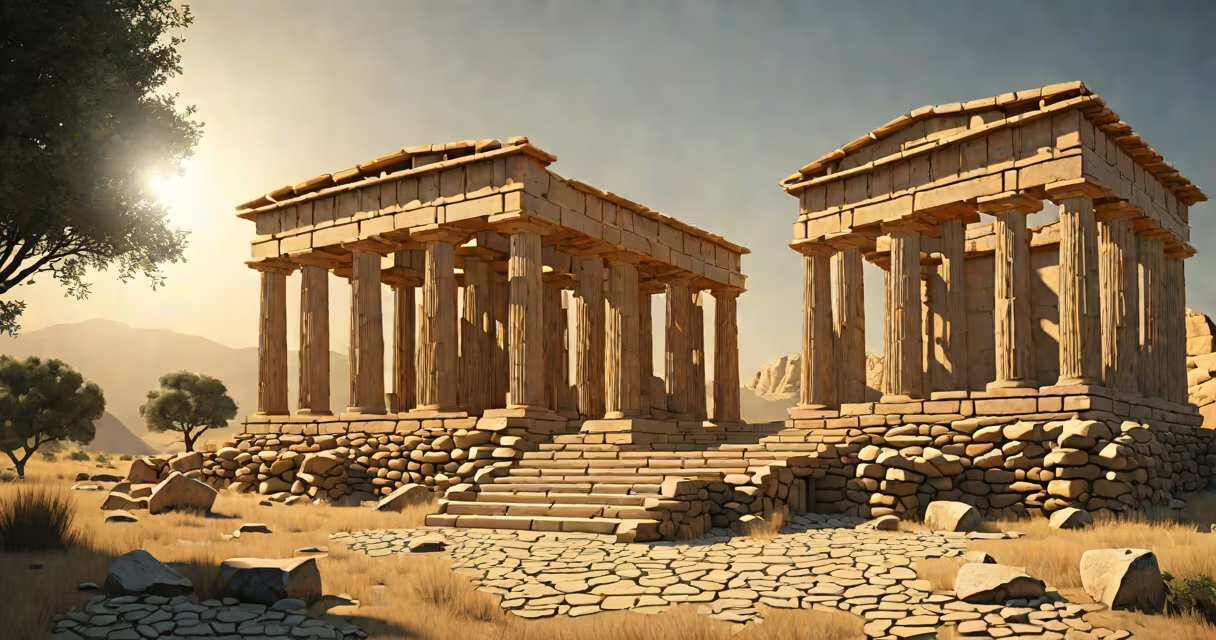
Proverbs 24:3-4 in the King James Version states that wisdom establishes a house, understanding strengthens it, and knowledge fills its inner chambers. This passage uses architectural imagery to show that lasting structures depend on intelligent design, not just effort.
The verses appear in the final section of Proverbs' collected wisdom sayings, attributed to Solomon and other sages. They follow a pattern common in Hebrew poetry: parallelism. The first line introduces a cause-wisdom-as the foundation. The second line adds a complementary force-understanding-as the structural support. The third line completes the image with knowledge as the interior finish.
These lines are not about physical construction alone. The metaphor extends to personal character, family life, and spiritual maturity. A house built on wisdom avoids collapse during storms. A home guided by understanding resists internal decay. Interior spaces filled with knowledge reflect thoughtful living.
Proverbs 24:3-4 uses construction as a structure for moral and intellectual development. The house represents a stable life. Wisdom is the blueprint. Understanding is the skilled labor. Knowledge is the furniture, lighting, and finishes.
When someone builds a house without a plan, they risk weak walls, uneven floors, or poor ventilation. Similarly, a person who acts without wisdom makes choices that lead to failure. The Bible says in Proverbs 14:12, "There is a way which seemeth right unto a man, but the ends thereof are the ways of death." Without wisdom, even good intentions fail.
Understanding takes the blueprint and applies it correctly. It's the difference between knowing how to lay bricks and knowing how to lay them with mortar that bonds properly. In Proverbs 24:3-4, understanding doesn't just prevent mistakes-it ensures durability.
Three core concepts form the verse: wisdom, understanding, and knowledge. These are not interchangeable. Each plays a distinct role in building a resilient life.
Wisdom is the ability to apply truth to real situations. It's not just knowing facts-it's choosing the right action at the right time. Proverbs 9:10 defines wisdom as "the fear of the Lord," meaning reverence for God's nature and authority. A wise person sees patterns and anticipates consequences.
Understanding is the skill to interpret and execute. It's the practical grasp of principles. For example, knowing that honesty prevents conflict is wisdom. Applying that principle in a difficult conversation-adjusting tone, timing, and wording-is understanding.
Knowledge fills the space. It's the accumulation of facts, skills, and experiences. A room with no books, tools, or light feels empty. A life with no learning, no lessons, no memories lacks richness. Knowledge makes the house livable.
| Element | Role in Building | Biblical Example |
|---|---|---|
| Wisdom | Blueprint and design | Solomon's judgment in 1 Kings 3:16-28 |
| Understanding | Execution and craftsmanship | Bezalel's work on the tabernacle (Exodus 31:1-6) |
| Knowledge | Interior details and furnishings | Daniel's interpretation of dreams (Daniel 2:19-23) |
These verses are cited in sermons, devotional materials, and parenting guides. They appear in Christian education curricula because they offer a tangible model for growing in godliness.
For example, a church youth group discussing decision-making might quote Proverbs 24:3-4 to explain why planning matters. A parent teaching their child to manage money could use the metaphor: "A house without wisdom is like a budget without a plan. It collapses under debt."
One non-obvious point often missed: the verse assumes the builder is responsible. It doesn't say "a house is built by wisdom"-it says "wisdom establishes a house." The subject is active. Wisdom doesn't just exist-it acts. This aligns with Proverbs 3:5-6, which commands trust in the Lord "and He shall direct thy paths." Wisdom requires participation.
Many assume this verse means "work hard and your house will stand." But the KJV specifies that wisdom comes first. Labor without wisdom leads to wasted effort. The book of Ecclesiastes warns against this: "I returned, and saw under the sun, that the race is not to the swift, nor the battle to the strong" (Ecclesiastes 9:11).
Another mistake is treating knowledge as the highest goal. But in Proverbs 24:3-4, knowledge comes last. It fills the rooms, but it doesn't hold up the roof. A person may have vast knowledge but lack discernment-like a scholar who knows all the laws but ignores justice.
A third error is misreading "house" as only a physical home. The term includes families, communities, and even individual lives. Jesus said in Matthew 7:24-27 that those who hear His words and act on them are like a man who builds his house on rock. The house is not just shelter-it's identity, security, and legacy.
In 2018, a couple in rural Indiana faced a choice: sell their farm to move to a city job or stay and diversify their crops. They consulted elders, studied soil reports, and prayed. Their decision wasn't based on emotion or income alone.
They applied wisdom: they evaluated long-term risks and values. They used understanding: they calculated yields, market demand, and labor needs. They filled the house with knowledge: they learned about drought-resistant seeds and local co-op markets.
Two years later, a severe storm damaged nearby farms. Their land held firm. Their harvest was modest but sustainable. They didn't lose everything. The house stood-not because of luck, but because wisdom had established it.
I once helped restore a 19th-century church in New England. The original blueprints were missing. We had to reverse-engineer the structure using surviving beams and mortar samples. The team included a carpenter, a historian, and a pastor.
We discovered that the foundation stones were laid with care-each aligned to a cardinal direction. The rafters were cut at precise angles. This wasn't random. It reflected intentional design. The builders had wisdom. They knew how wind and snow would behave.
When we replaced a damaged beam, we didn't just match size-we studied the grain, the joints, the weight distribution. That was understanding. We documented every step. That was knowledge. The church still stands. Not because of force, but because of foresight.
Proverbs 24:3-4 appears in a section emphasizing the contrast between wise and foolish behavior. Verses 1-2 warn against envy and jealousy. Verse 5 calls the wise person "strong" and "mighty in strength." The chapter closes with a warning: "The wicked flee when no man pursueth: but the righteous are as bold as a lion" (Proverbs 24:19-20).
Comparing this to Proverbs 3:1-2, which says "My son, forget not my law; but let thine heart keep my commandments: for length of days, and long life, and peace, shall they add to thee," shows a consistent theme: obedience to divine instruction brings stability.
Proverbs 24:3-4 KJV remains relevant because it names the invisible forces behind lasting success. A house built on wisdom lasts longer than one built on money. A life guided by understanding outlasts one driven by desire. And a home filled with knowledge becomes a place of belonging.