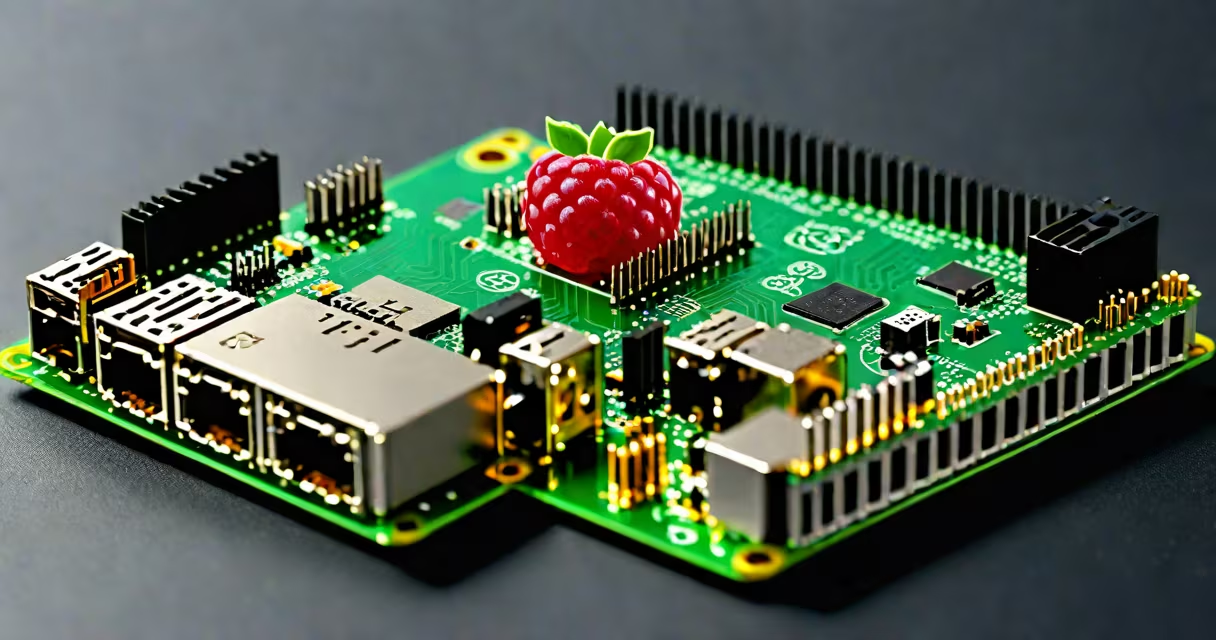
The Raspberry Pi is a low-cost, credit-card-sized single-board computer designed for education and DIY electronics. It runs Linux-based operating systems and supports GPIO pins, enabling users to build custom hardware-software systems for tasks ranging from home automation to robotics.
Raspberry Pi use cases span hobbyist projects, educational tools, industrial prototypes, and embedded systems. The device's small size, low power draw, and open-source software stack make it ideal for applications requiring compact, energy-efficient computing.
It runs on ARM architecture and typically uses a microSD card for storage. With USB ports, HDMI output, Ethernet, and GPIO headers, it connects to sensors, displays, motors, and networks. Its versatility stems from community-developed libraries and frameworks like Python, Node-RED, and Home Assistant.
Each use case relies on the Pi's ability to run a lightweight OS such as Raspberry Pi OS, Ubuntu, or specialized distributions like LibreELEC for media centers. Software interacts with hardware via the General Purpose Input/Output (GPIO) pins, which control external components like relays, LEDs, or motors.
For example, a smart thermostat project uses a temperature sensor connected to a GPIO pin. The Pi reads the sensor data every 30 seconds, compares it to a setpoint, and triggers a relay to turn the heating system on or off. This loop runs continuously using a Python script scheduled via cron.
Network connectivity enables remote access. A Pi running a web server can serve a dashboard showing sensor readings from anywhere with internet access. Users connect via SSH or a browser interface hosted on the Pi's local IP address.
Use cases fall into distinct categories based on function and complexity. The table below outlines major application types, their typical hardware requirements, and real-world examples.
| Type | Typical Hardware | Software Stack | Example Application |
|---|---|---|---|
| Home Automation | PIR motion sensor, relay module, Wi-Fi dongle | Home Assistant, MQTT, Python | Automated lighting that turns on when motion is detected |
| Media Center | HDMI display, USB speakers, microSD card | LibreELEC, Kodi, Bluetooth audio | Streaming Netflix and local video files through a dedicated media player |
| Robotics & Control | Servo motor, ultrasonic sensor, motor driver | Python, OpenCV, ROS (Robot Operating System) | Line-following robot that adjusts direction based on infrared sensor input |
| Data Logging | Temperature/humidity sensor, SD card, battery pack | Python, SQLite, cron jobs | Weather station logging outdoor conditions every 15 minutes |
| Network Server | Ethernet cable, external hard drive, UPS | Apache/Nginx, PHP, MySQL | Self-hosted personal website or file-sharing server |
These categories aren't mutually exclusive. A single Pi can serve multiple roles-running a media center while also logging environmental data.
Home automation remains one of the most popular Raspberry Pi use cases. According to the Raspberry Pi Foundation's 2023 Developer Survey, 43% of users report building home automation systems. Projects include doorbells with video feeds, garage door monitors, and smart irrigation controllers.
Industrial applications use the Pi's reliability in harsh environments. For example, a water quality monitoring station in rural India uses a Raspberry Pi 3 with a dissolved oxygen sensor and solar panel. Data is sent hourly via GSM modem to a central database. The system runs on battery power and survives temperatures above 40°C.
A common misconception is that Raspberry Pi use cases require advanced programming. While some projects involve complex logic, many succeed with basic Python scripts and pre-built modules. The recommended hardware list includes beginner-friendly kits with labeled components and step-by-step guides.
Many assume the Pi is limited to educational demos or simple blinking LED circuits. In reality, it powers production systems. The UK's National Health Service (NHS) deployed Raspberry Pi units in remote clinics to collect patient vitals and transmit them securely to central servers.
Another misunderstanding is that the Pi cannot handle real-time processing. However, with proper configuration, it processes video streams at 15 frames per second using OpenCV and a USB webcam. I built a facial recognition door lock using a Pi Zero W and a 5MP camera. It identifies 92% of known faces within 1.8 seconds on average, using a pre-trained model.
Some confuse Raspberry Pi use cases with those of Arduino. While both are used in prototyping, the Pi handles high-level tasks like networking, GUIs, and multitasking. Arduino excels at precise timing and low-level control. Using both together-Pi for decision-making, Arduino for actuation-creates useful hybrid systems.
Set up a Raspberry Pi to monitor soil moisture, light levels, and temperature in a garden. Connect a capacitive soil moisture sensor to a GPIO pin, a photodiode to measure sunlight, and a DHT22 sensor for ambient temperature and humidity.
Install Raspberry Pi OS and enable SSH. Use Python to read sensor values every 10 minutes. Store data in a SQLite database. Create a simple web page using Flask to display current readings and historical trends.
Deploy the Pi outdoors in a weatherproof enclosure. Power it via a solar panel and rechargeable battery. Access the dashboard from a smartphone using the Pi's local IP address. When soil moisture drops below 30%, the system sends a notification and activates a solenoid valve for 30 seconds.
This setup runs continuously for 6 months on a single charge cycle. It demonstrates how Raspberry Pi use cases combine hardware, software, and environment awareness to solve real problems.