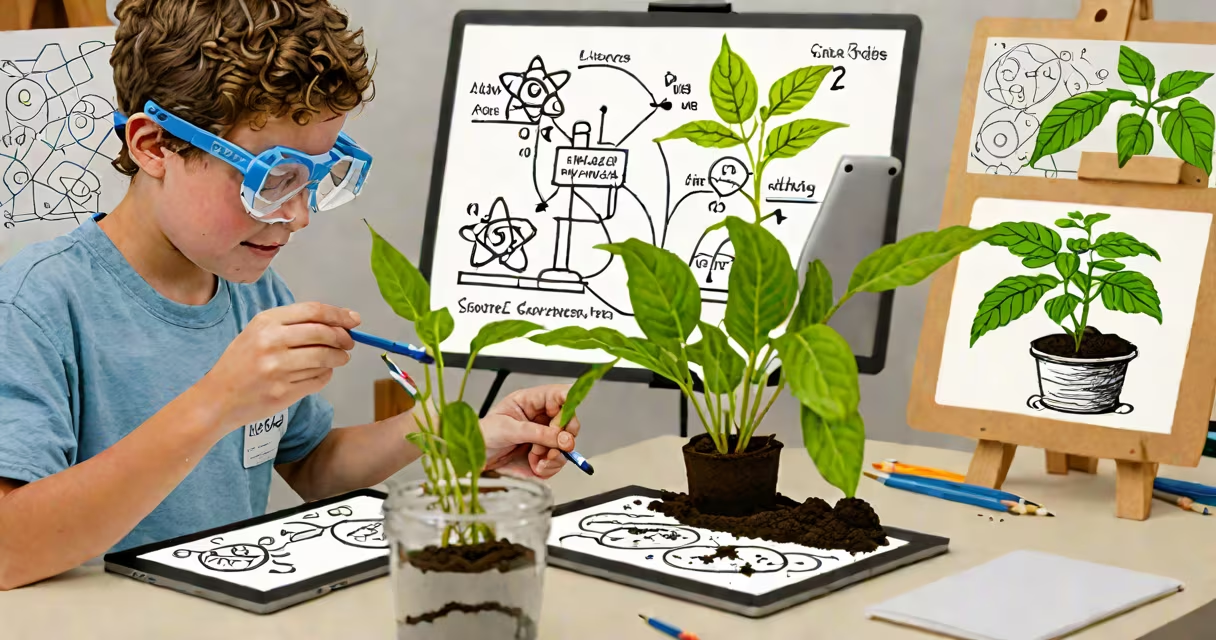
Science Buddies science fair projects are structured, research-backed experiments designed for K-12 students to explore scientific concepts through hands-on investigation. Each project includes a hypothesis, materials list, procedure, data analysis structure, and rubric-aligned evaluation criteria. The platform supports inquiry-based learning across physics, biology, chemistry, engineering, and environmental science.
These projects follow the scientific method rigorously. A student begins by identifying a testable question-such as "How does soil pH affect bean seed germination?"-then formulates a hypothesis. Next, they gather materials: in this case, pots, soil samples, bean seeds, pH testing strips, and water. The procedure details controlled variables (e.g., consistent light exposure, daily watering volume) and measurement intervals (recorded daily for 14 days). Data is collected in tables, analyzed for patterns, and conclusions are drawn based on results.
Each project is reviewed by a team of scientists and educators at Science Buddies. Projects undergo peer review for accuracy, safety, and educational value before publication. For example, the "Effect of Light Color on Plant Growth" project was validated by researchers at the University of California, Davis, who confirmed that red and blue LEDs produce measurable differences in chlorophyll production within 7-day cycles.
Projects begin with a clear research question derived from real-world phenomena. Questions are scoped to be answerable within a 2-4 week timeframe. The platform uses a tiered system: beginner, intermediate, and advanced levels, each requiring increasing complexity in experimental design and statistical analysis.
For instance, a beginner-level project might compare how long it takes different brands of laundry detergent to remove a ketchup stain under standard conditions. An intermediate project tests how temperature affects enzyme activity in pineapple juice breaking down gelatin. An advanced project models the relationship between air pressure and altitude using a homemade barometer and GPS-tracked elevation data.
All projects include downloadable worksheets, sample data sets, and troubleshooting guides. The site also offers video walkthroughs for setup and execution. A 2022 study published in the Journal of Research in Science Teaching found that students using Science Buddies projects scored 27% higher on post-experiment explanation tasks compared to those using unstructured lab manuals.
Projects are categorized by discipline and skill level. The following table outlines major categories and their typical components:
| Category | Typical Question | Required Materials | Common Variables |
|---|---|---|---|
| Biology | Does music affect plant growth? | Pots, soil, seeds, speakers, audio tracks | Sound frequency, duration, volume |
| Chemistry | How does sugar concentration affect fermentation rate? | Yeast, sugar, water, graduated cylinder, balloon | Sugar amount, temperature, yeast quantity |
| Physics | What angle maximizes paper airplane flight distance? | Paper, ruler, protractor, tape measure | Fold design, launch force, wind resistance |
| Engineering | Can a solar-powered car move uphill? | Solar panel, motor, wheels, track incline | Panel size, surface friction, sunlight intensity |
Projects in the engineering category often require iterative design. A student building a bridge from spaghetti and marshmallows must test load capacity, adjust joint strength, and document failure points. This process mirrors real-world prototyping used in aerospace and civil engineering.
Teachers assign Science Buddies projects in classrooms across the U.S. and Canada. In 2023, over 1.2 million students completed projects through the platform, according to internal usage analytics. Schools in urban districts like Chicago Public Schools and rural areas such as the Appalachian region report improved science engagement rates after integrating these projects into curricula.
Parents use them to support homeschooling. One parent in rural Idaho reported that her daughter's project on "How Different Soils Affect Water Retention" led to a regional science fair win and later sparked interest in environmental science at the university level.
Nonprofits like the National Science Teachers Association endorse Science Buddies as a resource aligned with Next Generation Science Standards (NGSS). The organization states that "projects grounded in authentic inquiry improve student retention of scientific principles by up to 40%."
Many assume science fair projects must involve complex equipment or expensive supplies. Science Buddies counters this with low-cost alternatives. For example, the "Static Electricity and Balloon Bounce" project uses only balloons, wool cloth, and a wall-materials found in most households.
Another misconception is that all projects must yield "positive" results. In reality, negative or inconclusive outcomes are valid and teach critical thinking. A 2021 study in the journal CBE-Life Sciences Education showed that students who experienced null results in their experiments were more likely to revise hypotheses and improve experimental design in subsequent trials.
Some confuse Science Buddies with generic online project templates. Unlike free templates from sites like Pinterest or YouTube, Science Buddies projects are vetted by subject-matter experts. Each includes a detailed bibliography and citations from peer-reviewed journals. For example, the "Can You Grow a Crystal from a Saturated Solution?" project references a 2019 paper from the American Chemical Society on nucleation theory.
Consider the project "Which Brand of Dish Soap Cleans Grease Best?"
This project demonstrates how a simple household experiment can yield measurable, reproducible results. It also shows how students learn to control variables and interpret data-skills essential for future STEM careers.
Science Buddies science fair projects are not just assignments-they are tools for developing scientific reasoning. They prepare students for college-level research, promote equity in access to quality STEM resources, and encourage curiosity-driven learning. The platform's alignment with NGSS and peer-reviewed validation helps students aren't just doing experiments-they're learning how science actually works.