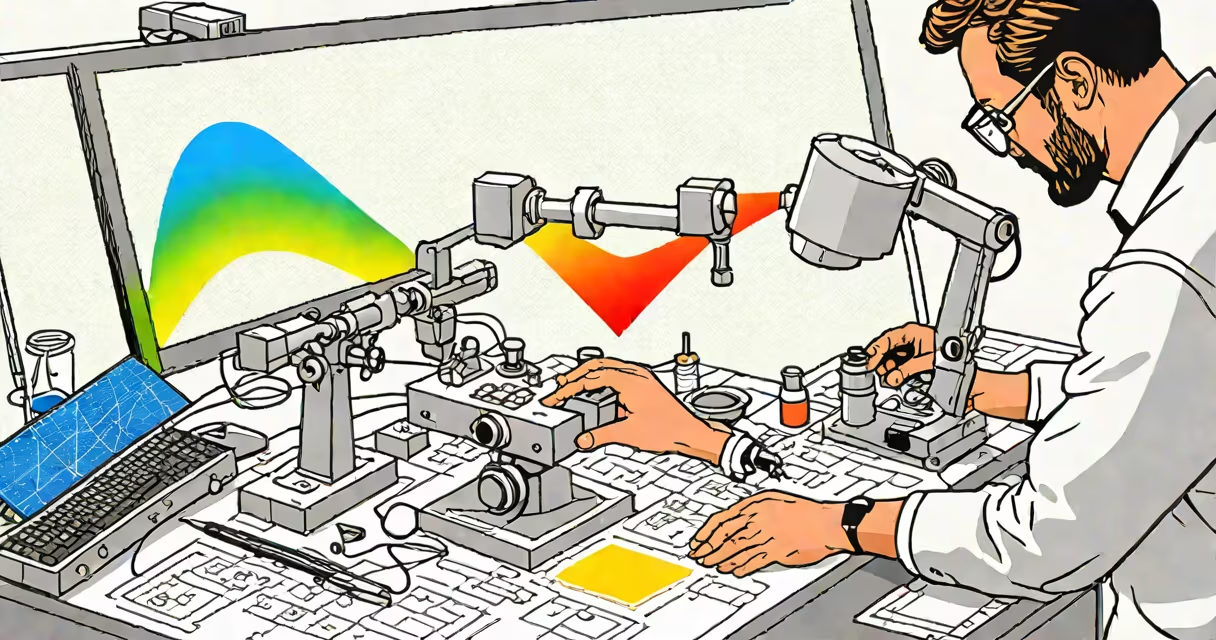
Spectrometry is the quantitative measurement of light intensity across wavelengths; spectroscopy is the broader study of how matter interacts with electromagnetic radiation. The two terms are often used interchangeably, but they differ in scope and purpose.
Spectroscopy examines the interaction between matter and radiation-such as absorption, emission, or scattering-to reveal chemical composition, structure, and physical properties. Spectrometry focuses specifically on measuring the intensity of light at different wavelengths, producing a spectrum that quantifies those interactions.
For example, in environmental monitoring, a scientist uses UV-visible spectroscopy to detect nitrate levels in water by analyzing how much light the sample absorbs at specific wavelengths. The instrument records this data as a spectrum-a graph of absorbance versus wavelength-using spectrometry. The spectroscopy explains the phenomenon; the spectrometry measures it precisely.
Spectroscopy relies on fundamental principles of quantum mechanics. When atoms or molecules absorb or emit photons, they do so at discrete energy levels corresponding to specific wavelengths. By shining light through a sample and observing which wavelengths are absorbed or emitted, scientists infer the presence and concentration of substances.
Spectrometry operates as the measurement engine behind spectroscopy. It uses instruments called spectrometers to split incoming light into its component wavelengths and measure their intensities. A typical setup includes a light source, a sample holder, a dispersive element (like a prism or diffraction grating), and a detector such as a photodiode range or CCD sensor.
Modern spectrometers can resolve differences as small as 0.1 nanometers in wavelength and detect signals down to parts-per-billion concentrations. This precision enables applications ranging from identifying trace elements in geological samples to verifying pharmaceutical purity.
The following table outlines common types of both techniques, grouped by application area:
| Type | Primary Function | Common Use Cases | Measurement Focus |
|---|---|---|---|
| Atomic emission spectroscopy | Identify elemental composition via emitted light | Environmental analysis, metallurgy | Spectrometry (intensity at emission lines) |
| Infrared spectroscopy | Determine molecular bonds and functional groups | Drug development, polymer analysis | Spectroscopy (absorption patterns) |
| Nuclear magnetic resonance spectroscopy | Reveal atomic environment in molecules | Protein structure, metabolomics | Spectroscopy (resonance frequency shifts) |
| X-ray photoelectron spectrometry | Measure surface elemental composition and oxidation states | Materials science, semiconductor quality control | Spectrometry (binding energy peaks) |
Each method combines spectroscopic principles with spectrometric measurement. For instance, in atomic emission spectroscopy, a sample is heated to vaporize atoms, which then emit light at characteristic wavelengths. The spectrometer detects and quantifies these emissions, allowing identification of elements like lead or mercury in soil samples.
According to the National Institute of Standards and Technology (NIST), accurate spectrometric calibration is essential for reproducible results in analytical chemistry. NIST provides reference standards for wavelength and intensity measurements used in labs worldwide.
Many people assume spectrometry and spectroscopy are synonymous. They are not. Spectroscopy is the science; spectrometry is the measurement tool within that science.
A frequent error is treating a spectrometer's output as purely qualitative. But a well-calibrated spectrometer delivers precise numerical data. For example, a flame test identifies sodium by its yellow glow-but only spectrometry confirms the peak at 589 nm with ±0.5 nm accuracy.
Another misconception is that all spectroscopic techniques require complex equipment. While high-resolution instruments exist, basic spectrometers can be built from off-the-shelf components. I once assembled a low-cost visible spectrometer using a CD as a diffraction grating, a smartphone camera, and a narrow slit. It resolved spectral lines of neon gas at 585 nm and 640 nm-accurate enough for classroom demonstrations.
Spectroscopy can be qualitative or quantitative. Spectrometry is always quantitative. You can use spectroscopy to identify unknown compounds based on spectral patterns. You use spectrometry to determine how much of a substance is present.
Confusing the two leads to miscommunication in research, industry, and regulatory reporting. A report stating "we used spectroscopy" may not clarify whether the team measured intensity, identified peaks, or calculated concentration. Using the correct term ensures clarity in technical documentation.
For example, in food safety testing, a lab might use infrared spectroscopy to detect melamine contamination in milk. The method relies on identifying unique vibrational modes in the molecule. The spectrometer measures the intensity of absorption at 1580 cm⁻¹ and 1640 cm⁻¹. The result is reported as a concentration in ppm-this is spectrometry in action.
Understanding the distinction improves collaboration across disciplines. Chemists focus on spectroscopic interpretation; engineers and technicians rely on spectrometric data for process control. Both roles depend on clear terminology.
When selecting instrumentation, knowing whether you need spectroscopic insight or spectrometric precision guides your choice. High-throughput screening often requires spectrometry for speed and consistency. Discovery-phase research leans on spectroscopy for pattern recognition and hypothesis generation.
Spectroscopy describes the relationship between matter and light. Spectrometry measures the outcome of that relationship with numbers. Both are essential tools in modern science-but they serve different purposes.