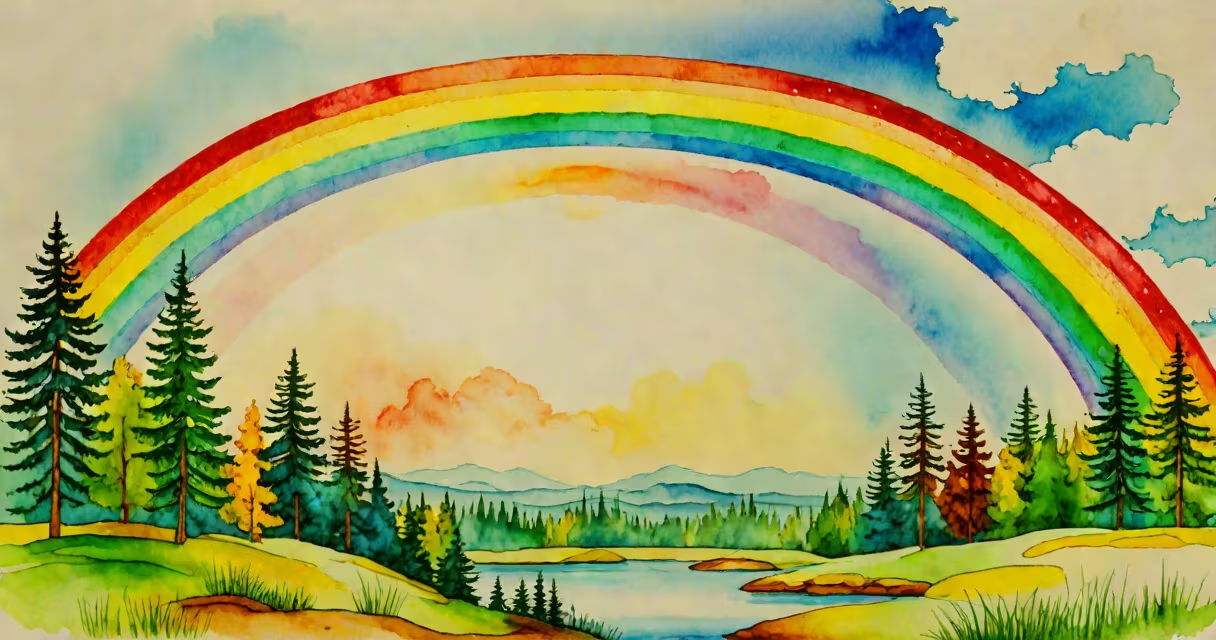
The science of rainbows is the study of how sunlight bends, reflects, and disperses inside raindrops to create a multicolored arc visible in the sky opposite the sun. This phenomenon results from the interaction of light with spherical water droplets in the atmosphere, producing a spectrum of colors due to wavelength-dependent refraction.
Rainbows form when sunlight enters a raindrop, refracts (bends) upon entry, reflects off the inner surface of the drop, and refracts again as it exits. The angle between the incoming sunlight and the observer's eye determines which color appears at a specific position in the arc. Red light deviates by about 42 degrees, violet by 40 degrees, creating the familiar red-outside, violet-inside arrangement.
Each raindrop contributes to a single color in the arc. Millions of drops, each reflecting a different color depending on the viewing angle, combine to form the continuous band seen by observers. The geometry helps rainbows always appear opposite the sun, typically after rainfall or near waterfalls when airborne droplets are present.
When sunlight enters a spherical raindrop, it slows down and bends toward the normal line-the perpendicular to the surface. The amount of bending depends on the light's wavelength: shorter wavelengths (blue, violet) bend more than longer ones (red).
Inside the drop, the light hits the back surface and reflects. Because the drop is spherical, the reflection is diffuse but follows predictable paths. As the light exits, it refracts again, further separating the colors. The combined effect of refraction, internal reflection, and exit refraction causes the light to disperse into its spectral components.
Only certain angles allow light to exit the drop and reach an observer's eye. For red light, this angle is approximately 42° from the direction of the incoming sunlight. Violet light exits at about 40°. All other colors fall between these extremes. This angular separation creates the circular arc of colors we see.
While most people think of the classic primary rainbow, several variants exist due to differences in droplet size, sunlight angle, or additional reflections.
| Type | Formation Condition | Color Order | Visibility |
|---|---|---|---|
| Primary rainbow | One internal reflection inside droplet | Red outer, violet inner | Common, visible during rain with sun behind |
| Secondary rainbow | Two internal reflections | Reverse: violet outer, red inner | Fainter, often seen above primary |
| Supernumerary bows | Interference from small droplets | Multiple faint bands inside primary | Visible in fine mist or fog |
| Reflection rainbow | Sunlight reflected off water before hitting droplets | Same as primary, but appears below horizon | Rare, requires calm water surface |
Supernumerary bows-faint, pastel-colored bands just inside the primary arc-are caused by wave interference. They occur when droplets are very small (around 0.05 mm diameter), leading to constructive and destructive interference patterns. These bands were first documented by Isaac Newton, who noted their appearance in misty conditions.
Many assume rainbows are physical objects or that they move with the observer. In reality, a rainbow is a visual phenomenon dependent on the relative positions of the sun, raindrops, and viewer. If you walk toward a rainbow, it recedes-it never reaches a location.
Another myth is that rainbows only appear after rain. While common in post-storm skies, rainbows can form anytime water droplets are suspended in air: near waterfalls, fountains, or even in spray from a garden hose. The key requirement is sunlight shining through the droplets at the correct angle.
A lesser-known fact: rainbows are actually full circles. From the ground, the horizon blocks the lower half. But from high altitudes-such as in an airplane-you can see complete circular rainbows. Pilots have photographed these phenomena, confirming that the rainbow's true shape is a circle centered on the antisolar point (the point directly opposite the sun).
In summer, Niagara Falls produces massive volumes of spray. When sunlight strikes these droplets at the right angle, a large, stable rainbow forms. Observers standing on the Canadian side often see a primary rainbow spanning the mist, with a secondary bow above it.
Photographic records show that the rainbow's center aligns with the point directly opposite the sun. On clear days with the sun low in the sky, the arc can extend nearly 180 degrees. The droplets are typically 0.1-0.5 mm in diameter, ideal for forming distinct color bands.
I once stood on the observation deck at Niagara during a brief break in the clouds. Sunlight pierced the mist, and within seconds, a full rainbow emerged. I watched it shift slightly as the cloud cover moved. The colors remained sharp-red at the top edge, violet at the base-until the sun disappeared behind the clouds. That moment confirmed the precision of the optical process: no matter how beautiful, it was governed entirely by physics.
Understanding the science of rainbows connects to broader principles in atmospheric optics. The same laws of refraction and reflection apply to halos around the moon, sun dogs, and mirages. These phenomena are all part of the field of meteorological optics, studied by institutions like the American Meteorological Society and the Royal Meteorological Society.
Modern research uses computational models to simulate rainbow formation under varying conditions. For example, simulations show that larger droplets produce less saturated colors due to increased scattering. Smaller droplets improve interference effects, leading to supernumerary bands. These findings validate observations made centuries ago using basic geometry and optics.
While the science of rainbows focuses on natural phenomena, the underlying principles extend into human-made systems. Fiber optics, prism-based spectrometers, and even certain types of sensors rely on controlled refraction and dispersion. The rainbow is nature's demonstration of these processes in action.
The science of rainbows reveals that beauty and complexity emerge from simple physical laws. A few droplets, a beam of sunlight, and an observer's eye-arranged just right-produce one of nature's most enduring visual wonders.