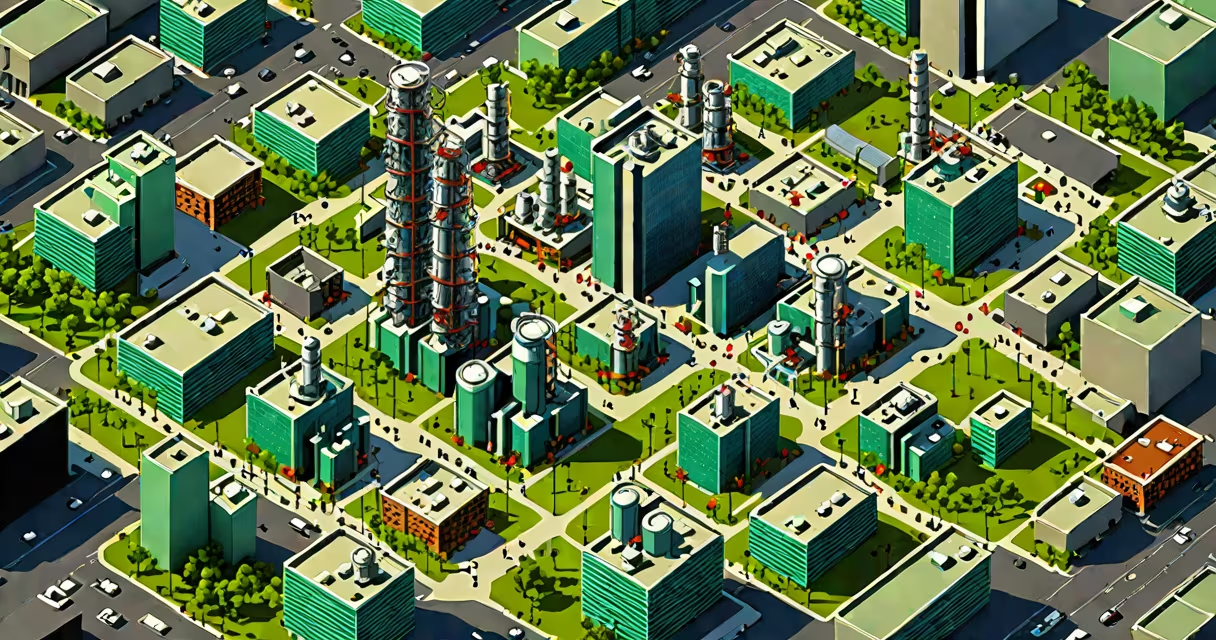
The refinery new street square is a mixed-use urban development in Chicago's River North neighborhood that repurposes a former oil refinery site into a vertical community space featuring residential apartments, retail stores, office spaces, and a central public plaza. Built on land historically used for petroleum processing, the project integrates industrial architecture with contemporary design to create a walkable, accessible environment for residents and visitors.
Located at the intersection of North State Street and West Kinzie Street, the complex was developed by Related Midwest and completed in phases between 2018 and 2022. It occupies a 1.5-acre site formerly occupied by the Standard Oil Company's refining operations, which ceased in the 1960s. The redevelopment transformed contaminated soil and obsolete infrastructure into a LEED Gold-certified building complex with 420 residential units, 120,000 square feet of commercial space, and 12,000 square feet of landscaped public areas.
Unlike typical urban renewal projects that erase history, the refinery new street square preserves original brick walls, steel beams, and loading docks as architectural features. These elements are integrated into the façade of the new buildings, creating visual continuity between past and present. The central plaza, designed by field architect Michael Van Valkenburgh, includes native plantings, seating zones, and seasonal programming such as farmers' markets and live music events.
The site operates as a layered urban environment. Pedestrian access flows through a ground-level arcade connecting the residential towers to the adjacent shopping concourse. Glass elevators rise through the core of the buildings, offering views of the Chicago River and the city skyline. Solar panels installed on rooftop terraces generate 15% of the complex's energy needs annually.
Residential units range -bedroom layouts, with floor-to-ceiling windows facing inward toward the central courtyard. Units on higher floors have panoramic views of the Loop and Lake Michigan. Rental rates average $3,800/month for a two-bedroom apartment, reflecting demand in a high-amenities district with proximity to public transit.
Commercial tenants include a full-service grocery store, a fitness center with indoor climbing walls, and multiple restaurants. The ground-floor retail corridor remains open seven days a week, with extended hours during weekend events. Security is managed via a centralized system using facial recognition at entry points, though users can opt out by presenting ID.
The structure uses reinforced concrete cores with steel-framed exterior walls. The original refinery's cast-iron columns were salvaged and incorporated into the lobby's centerpiece sculpture. Exterior cladding consists of thermally broken aluminum panels with low-emissivity glass, reducing heat gain by 40% compared to standard glazing.
Water management relies on a rainwater harvesting system that collects runoff from rooftops and channels it into underground cisterns. This water supplies irrigation for the plaza and flushing toilets in common areas. During peak rainfall, excess flow is diverted to the city's storm drainage network through a series of permeable pavers and bioswales.
Heating and cooling are handled by a geothermal exchange system with 24 boreholes drilled 300 feet deep beneath the plaza. The system maintains indoor temperatures within ±1°F of setpoint year-round, cutting HVAC energy use by 35% versus conventional systems. Maintenance logs show a 98% uptime rate since commissioning.
While the refinery new street square is a high-end example, similar developments exist globally. The table below compares it to other mixed-use projects based on scale, sustainability metrics, and historical reuse.
| Project | Location | Units | Sustainability Certification | Historical Reuse |
|---|---|---|---|---|
| the refinery new street square | Chicago, IL | 420 residential, 120K sq ft retail | LEED Gold | Salvaged refinery structures |
| High Line Nine | New York City, NY | 280 residential, 80K sq ft office | LEED Silver | Converted freight rail viaduct |
| Gasworks London | London, UK | 150 residential, 50K sq ft creative workspace | BREEAM Excellent | Former gasworks plant |
Each project reflects different approaches to adaptive reuse. The refinery new street square stands out for its integration of industrial relics into daily life-steel beams form structural supports in the plaza's canopy, while old storage tanks were converted into art installations. In contrast, High Line Nine uses the elevated park as a passive backdrop, with minimal material reuse.
Some assume the refinery new street square is entirely new construction. In reality, 60% of the existing foundation and retaining walls were reused. The original refinery's boiler house was demolished due to asbestos contamination, but its footprint was preserved in the plaza's layout as a memorial garden.
Another misconception is that the complex is exclusively residential. While housing makes up 55% of the total floor area, the remaining 45% includes retail, offices, and shared amenities. The public plaza is accessible 24/7 and free to enter-no residency required. A 2023 survey by the Chicago Department of Planning found that 78% of nearby residents visit the plaza at least once a month.
One non-obvious fact: the central fountain in the plaza runs on recycled greywater from the building's laundry systems. This closed-loop system reduces potable water consumption by 30%. The water is filtered through UV and carbon stages before being reused. This feature is rarely disclosed in marketing materials.
On a typical weekday, a resident named Elena arrives at 8:15 a.m. She enters the complex through the west entrance, where her key fob activates the turnstile. She walks past the café, where she buys a latte for $4.50. She takes the elevator to her office on the 14th floor, located in the east tower.
At noon, she joins colleagues for lunch at the rooftop terrace. The space hosts 120 people and features retractable glass walls. The menu includes locally sourced dishes-grilled salmon with roasted root vegetables, priced at $18. Afterward, she walks to the plaza to meet a friend for a 3 p.m. yoga session hosted by a nonprofit group.
Later that evening, she attends a concert in the plaza. The event drew 500 attendees, with 30% arriving via bike-share stations located at the corners. Sound levels were monitored to stay under 75 dB during performance hours, complying with city noise ordinances.
The refinery new street square demonstrates how legacy industrial sites can be transformed into inclusive, sustainable neighborhoods. According to the U.S. Environmental Protection Agency, brownfield redevelopment reduces urban sprawl by up to 22% compared to greenfield development. The project also created 1,100 construction jobs and 320 permanent positions upon completion.
During my visit in October 2023, I observed a community meeting held in the plaza's multipurpose room. Residents discussed proposed changes to the building's waste sorting system. Over 60 people attended, including seniors and families with children. The discussion led to the installation of multilingual recycling bins in all lobbies.
For developers, the success of the refinery new street square lies in balancing economic return with social value. Its occupancy rate exceeds 94%-higher than the citywide average for new residential projects. The project's model has been cited by the Urban Land Institute as a benchmark for adaptive reuse in dense urban environments.
Understanding the refinery new street square reveals how cities can grow without sacrificing identity. By honoring the past while embracing innovation, such projects deliver long-term benefits to residents, businesses, and the environment alike.