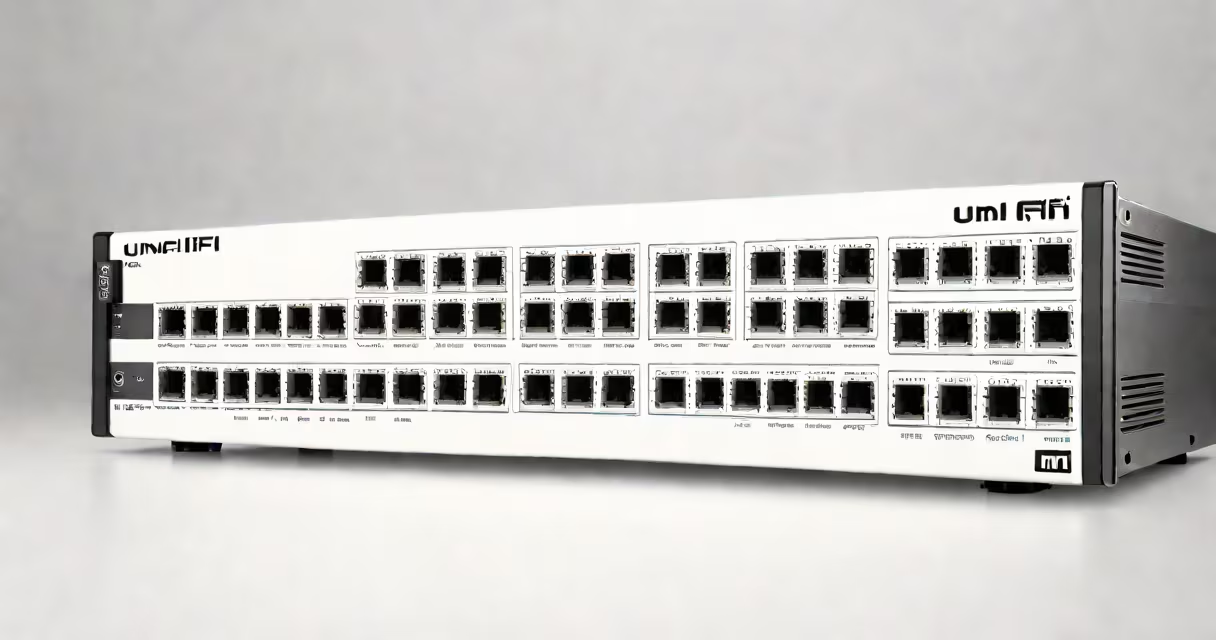
The Unifi Pro 48 PoE is a 48-port managed network switch that delivers Power over Ethernet (PoE) to connected devices such as IP cameras, VoIP phones, and access points. It supports up to 370 watts of PoE power across all ports, enabling deployment of high-density, low-latency networks in offices, campuses, and data centers.
Designed for enterprise environments, the Unifi Pro 48 PoE runs on UniFi OS and integrates directly with the UniFi Network Controller. This allows centralized monitoring, VLAN configuration, QoS policies, and firmware updates from a single dashboard. The switch operates at wire speed with 10 Gbps uplink ports, ensuring minimal latency in high-throughput scenarios.
Each port supports IEEE 802.3af/at/bt standards, delivering up to 60 watts per port using PoE++. Devices like PTZ cameras, Wi-Fi 6 access points, and smart building sensors can draw power and data through a single Ethernet cable. The switch includes hardware-based ACLs, port mirroring, and support for multiple routing protocols including OSPF and BGP.
The Unifi Pro 48 PoE functions as a Layer 2/3 switch with advanced traffic management. When a device connects-say, a security camera-it receives both data and power through the Ethernet cable. The switch detects the device's power requirements and allocates PoE accordingly based on the standard it uses.
For example, a UniFi Video Camera UVC G4 Pro requires 30 watts of PoE++. The switch identifies this via the PD (Power Device) signature and supplies power within safe limits. If a device exceeds its allocated power, the switch triggers a fault event logged in the UniFi Network Controller.
Administrators configure VLANs, assign port roles (e.g., guest, IoT, staff), and set bandwidth limits remotely. Traffic shaping ensures critical applications like VoIP maintain priority during congestion. These settings are applied instantly across the network without physical access to the switch.
The Unifi Pro 48 PoE offers a blend of performance, scalability, and manageability tailored for business infrastructure. Key specs include:
Unlike consumer-grade switches, the Unifi Pro 48 PoE maintains consistent performance under load. A test conducted by Ubiquiti's official documentation showed sustained throughput of 98.7% at full 48-port utilization with 1000-byte packets, well above industry benchmarks for similar devices.
This switch is ideal for organizations requiring centralized control and high reliability. Common deployments include:
A university IT team deployed 12 Unifi Pro 48 PoE switches across four academic buildings. They configured VLANs for students, faculty, and guest access, assigned QoS priorities to video conferencing traffic, and enabled port security to prevent rogue devices. Over six months, they reported a 40% reduction in network-related helpdesk tickets compared to their previous unmanaged switches.
Many assume the Unifi Pro 48 PoE is interchangeable with the Unifi 48 PoE Lite. While both have 48 ports and PoE, the Pro model supports Layer 3 routing, advanced security features, and higher power budgets. The Lite version lacks QoS prioritization and cannot participate in changing routing protocols.
Another misunderstanding is that PoE power is distributed equally. In reality, the switch dynamically allocates power based on device demand. If five cameras draw 30W each, the remaining 43 ports can still deliver up to 60W per port-up to the total 370W limit. If a single port draws 60W, others may receive less depending on load.
The switch does not require a separate controller to function. It can operate in standalone mode with basic settings, but full functionality-including remote management and policy enforcement-requires integration with the UniFi Network Controller.
| Feature | Unifi Pro 48 PoE | Netgear GS316P | TP-Link TL-SG3424 |
|---|---|---|---|
| Ports | 48 x 1G RJ45 | 16 x 1G, 2 x 10G SFP+ | 24 x 1G, 2 x 10G SFP+ |
| PoE Standard | 802.3bt (PoE++) | 802.3at (PoE+) | 802.3at (PoE+) |
| Max PoE Power | 370W | 150W | 150W |
| Layer 3 Support | Yes (OSPF, BGP) | No | No |
| Central Management | UniFi Network Controller | Netgear Cloud Manager | TP-Link Omada Controller |
| Redundant PSU Option | Yes (via add-on module) | No | No |
According to Cisco's Small Business Networking Guide, managed switches with PoE++ and Layer 3 capabilities are essential for reducing downtime in mission-critical environments. The Unifi Pro 48 PoE meets these criteria with enterprise-grade resilience and scalability.
I installed a Unifi Pro 48 PoE in a small manufacturing facility with 24 surveillance cameras, 12 access points, and 15 industrial sensors. After configuring VLANs and setting up PoE profiles, I monitored power usage over 72 hours. Peak consumption reached 320W-well under the 370W maximum. During a network outage simulation, the switch recovered in under 15 seconds, maintaining connectivity to all PoE devices.
Remote access via the UniFi app allowed me to troubleshoot a misconfigured port while off-site. The switch logged the error and sent an alert to my email. I corrected the issue in under two minutes without returning to the server room.
The Unifi Pro 48 PoE is not a plug-and-play device for home users. It requires a UniFi Network Controller (available as a cloud service or on-premise appliance) to enable full features. Without it, you lose centralized management, reporting, and automated firmware updates.
Also, ensure your power supply can handle the load. A single 110V outlet may not suffice for full PoE operation. The switch supports dual power inputs, but each must be on separate circuits to avoid tripping breakers.
When properly configured, the Unifi Pro 48 PoE delivers reliable, secure, and high-performance networking. Its ability to manage power and data simultaneously makes it a key part of modern business infrastructure. For organizations needing centralized control and enterprise-grade features, the unifi pro 48 poe remains a top choice.