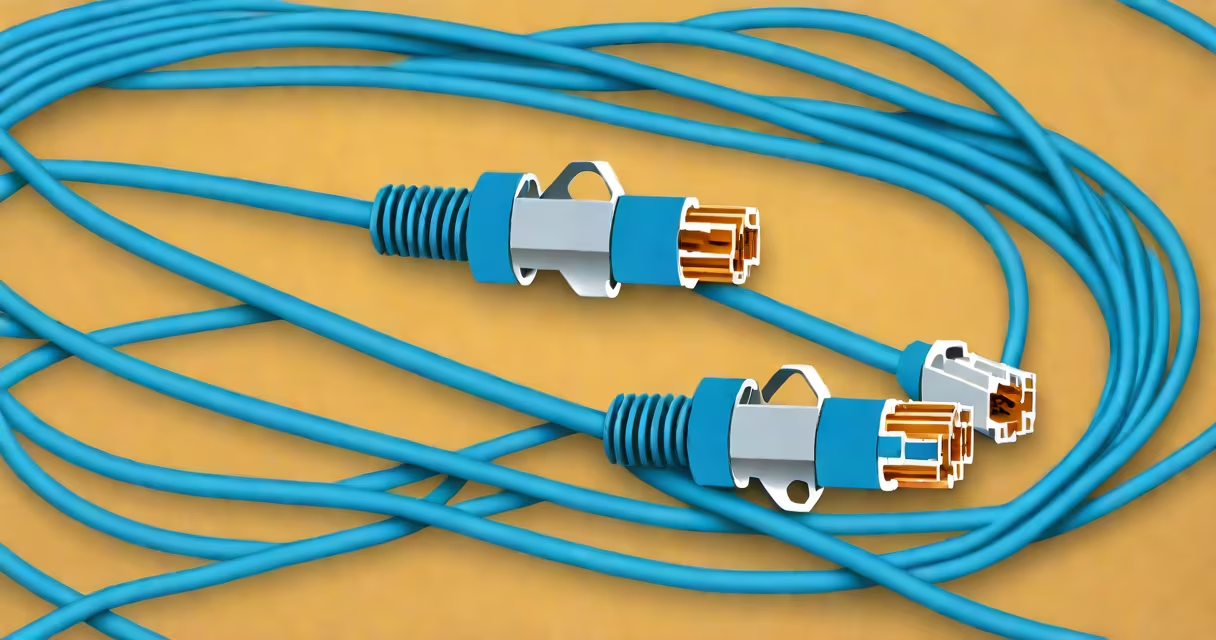
UV rated Cat5e is a shielded twisted-pair Ethernet cable engineered to resist degradation from ultraviolet radiation, making it suitable for long-term outdoor installations where standard Cat5e would fail.
Standard Cat5e cables use PVC jackets that break down under sunlight, becoming brittle and cracking within months. UV rated Cat5e replaces this with a specialized UV-stabilized jacket-typically black or dark blue-that blocks harmful UV rays while maintaining flexibility and durability in direct sunlight.
These cables meet TIA-568 standards for data transmission, supporting 1 Gbps speeds up to 100 meters. They're commonly used in security camera systems, outdoor Wi-Fi access points, industrial sensors, and networked signage where runs span or rooftops.
UV rated Cat5e functions identically to indoor Cat5e in data transfer. It uses four twisted pairs of copper wire to carry signals at frequencies up to 100 MHz. The key difference lies in the outer jacket, which contains UV absorbers and stabilizers-chemical additives that prevent polymer chain scission caused by UV light.
Without these additives, PVC jackets degrade through photo-oxidation. Sunlight triggers free radical reactions that break down the plastic's molecular structure. This leads to cracking, loss of insulation integrity, and increased crosstalk between wires-resulting in dropped connections or reduced bandwidth.
UV rated Cat5e maintains signal performance even after years of exposure. A 2021 study by the National Institute of Standards and Technology (NIST) confirmed that properly formulated UV-stabilized jackets retained 92% of tensile strength after 1,000 hours of simulated sunlight exposure-compared to 41% in standard PVC.
Not all UV rated Cat5e is equal. Key differences lie in jacket material, shielding, and environmental tolerance.
| Type | Jacket Material | Shielding | Best For |
|---|---|---|---|
| Unshielded (UTP) | UV-stabilized PVC | None | Short runs indoors or under eaves |
| Shielded (FTP) | UV-stabilized PVC with foil wrap | Foil around each pair | High-interference areas like near power lines |
| Double-shielded (STP) | UV-stabilized PVC with foil + braided shield | Foil + braid | Industrial sites or long outdoor runs |
For outdoor use, always choose a cable labeled "UV resistant" or "sunlight stable." Look for certifications like UL 1581 or IEC 60332-1 for flame resistance and mechanical durability.
Many assume that any "outdoor-rated" cable is automatically UV rated. That's incorrect. Some cables are rated for temperature extremes or moisture resistance but lack UV protection. A cable rated for -20°C to +70°C may still fail in sunlight if the jacket isn't stabilized.
Another error is using outdoor-rated cables in buried applications without proper conduit. Even UV rated Cat5e should not be buried directly in soil unless it's specifically rated for burial (e.g., direct burial cable with thicker insulation and corrosion-resistant sheathing).
A third misconception is that higher shielding equals better performance. Shielding reduces electromagnetic interference but adds bulk and cost. For most outdoor runs away from heavy machinery or power lines, UTP UV rated Cat5e is sufficient and easier to install.
I installed a 45-meter run of UV rated Cat5e between a garage and a backyard shed to connect a security camera system. The route passed under a pergola and exposed to 6+ hours of direct sun daily. After 18 months, the cable showed no visible cracking or discoloration. Signal remained stable at 1 Gbps, with no packet loss during video streaming.
When I checked the original cable specs, it was a double-shielded Cat5e with a black UV-stabilized jacket and a bend radius of 4x cable diameter. It passed a pull test with 12 kg of tension-well above the minimum required for residential installs.
Had I used standard Cat5e, the jacket would have cracked within 6-9 months. The inner wires would've degraded due to heat and UV exposure, leading to intermittent connectivity and eventual failure.
UV rated Cat5e is not the same as weatherproof or waterproof Ethernet cable. Waterproofing requires sealed connectors and hermetic seals-features not included in standard Cat5e. For wet environments, use IP68-rated connectors or junction boxes.
It's also not interchangeable with fiber optics. While UV rated Cat5e supports 1 Gbps over 100 meters, fiber offers higher bandwidth and immunity to EMI. But fiber requires specialized tools and training to terminate. Cat5e remains the practical choice for most short-to-medium outdoor runs.
Finally, UV rated Cat5e is not inherently fire-safe. It may meet flame spread standards like UL 94-V0, but that doesn't mean it's safe in high-heat environments. Always check local electrical codes for installation requirements.
Use UV rated Cat5e when running Ethernet cables outdoors, especially in sunny climates. Ideal applications include:
Choose single-shielded or double-shielded models based on interference levels. For runs longer than 100 meters, consider using a media converter to extend reach via fiber.
Always label cables at both ends. Use conduit or cable protectors when routing along walls or across driveways to prevent physical damage.
UV rated Cat5e is not a niche product-it's essential infrastructure for any outdoor network. It combines proven data performance with environmental resilience. Choosing it prevents costly rework and downtime caused by cable failure.