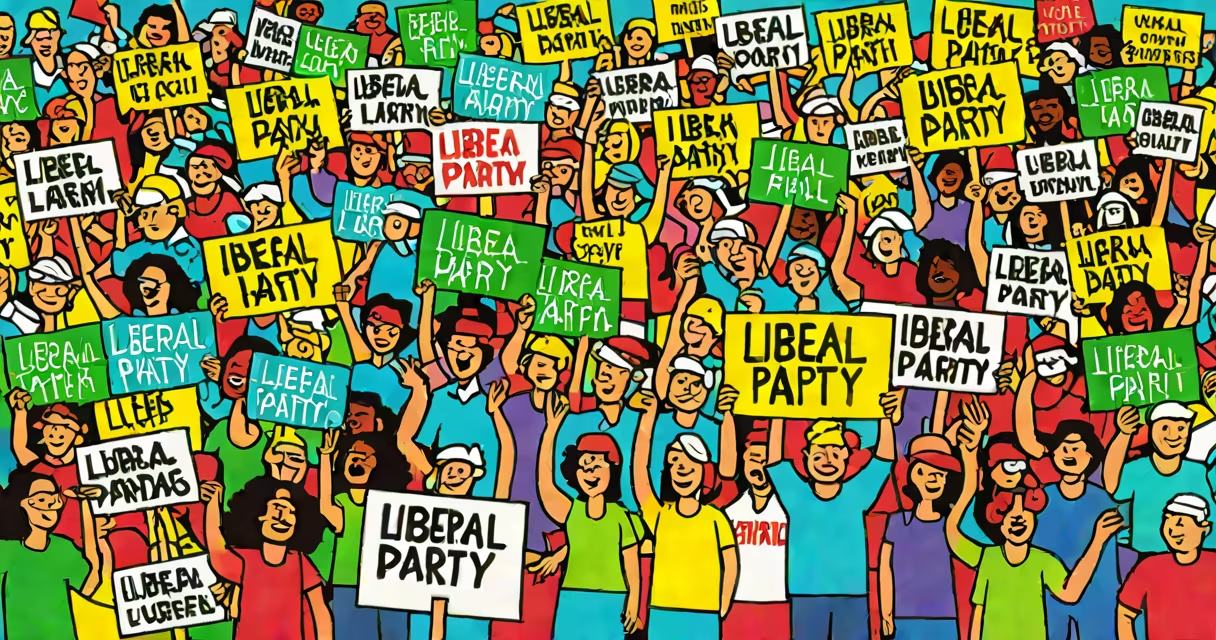
The liberal party stands for center-left policies emphasizing social equity, economic fairness, and individual rights through progressive governance. It supports expanding access to healthcare, education, and housing while advocating for environmental protection and inclusive economic growth.
Liberal parties exist in multiple countries, but the term most commonly refers to the governing party in Canada, which has held power since 2015 under Prime Minister Justin Trudeau. The party's platform centers on balancing fiscal responsibility with investments in public services and social programs. It promotes policies that reduce inequality, protect civil liberties, and respond to climate change through national action plans.
Liberalism as a political tradition traces back to Enlightenment ideals-individual freedom, rule of law, and pluralism. Modern liberal parties evolved from 19th-century movements that opposed absolute monarchy and championed constitutional government. Today, they differ from conservative parties by favoring regulated markets, expanded welfare systems, and greater government involvement in addressing societal challenges.
The liberal party prioritizes policies that promote opportunity, inclusion, and sustainability. Its platform includes universal healthcare expansion, affordable housing initiatives, and investments in green infrastructure. These goals reflect a commitment to reducing systemic barriers faced by marginalized communities.
For example, the federal government introduced the National Housing Strategy in 2016, allocating $40 billion over 10 years to address homelessness and improve housing affordability. By 2023, this program had supported over 100,000 units of new and repaired housing. The strategy targets low-income families, Indigenous communities, and people with disabilities-groups historically underserved in housing policy.
On economic matters, the party supports progressive taxation and corporate accountability. It passed legislation in 2021 requiring large corporations to disclose climate-related financial risks, aligning business practices with long-term environmental goals. This move was modeled after similar frameworks in the European Union and reflects a growing international trend toward transparency in climate reporting.
Liberal parties contrast sharply with conservative and populist movements. While conservatives often emphasize tax reduction, limited government, and traditional values, liberals prioritize collective well-being and institutional reform. The gap becomes visible during elections when platforms diverge on issues like immigration, gender rights, and environmental regulation.
A clear distinction lies in abortion rights. The Canadian liberal party supports reproductive choice as a fundamental human right. In 2021, it reaffirmed funding for publicly funded clinics and opposed legislative efforts to restrict access. This stance contrasts with some U.S. Republican-led states that have enacted strict abortion bans, illustrating how liberal values manifest differently across jurisdictions.
Another difference appears in foreign policy. Liberals tend to support multilateral institutions like the United Nations and NATO. They advocate for diplomacy over military intervention and emphasize human rights in international relations. In contrast, nationalist or right-wing parties may prioritize sovereignty and border control over global cooperation.
| Policy Area | Liberal Stance | Conservative Stance |
|---|---|---|
| Healthcare | Universal coverage with public funding; expansion of mental health services | Emphasis on private sector solutions; cost containment through market mechanisms |
| Climate Change | Carbon pricing; investment in renewable energy; net-zero by 2050 | Support for fossil fuel development; skepticism about aggressive emissions targets |
| Immigration | Pathways to citizenship; refugee resettlement; integration programs | Focus on border security; limits on family reunification; merit-based selection |
Many assume that liberalism equates to radical leftism or anti-capitalism. This is incorrect. The liberal party does not seek to abolish capitalism but rather to regulate it in ways that serve the public good. It supports innovation and entrepreneurship while ensuring that profits do not come at the expense of workers or the environment.
Another misconception is that liberals oppose free markets entirely. On the contrary, they support competitive markets but argue that governments must correct market failures-such as pollution, monopolies, and unequal access to capital. The introduction of the Canada Child Benefit in 2016 illustrates this principle: the program provides direct payments to low- and middle-income families, reducing child poverty by 40% between 2015 and 2020, according to Statistics Canada.
Some critics claim that liberal policies lead to excessive government spending. However, data from the Parliamentary Budget Officer shows that federal debt-to-GDP ratio remained below 30% in 2022-a level consistent with sustainable fiscal management. The government maintained this balance by combining targeted spending with revenue increases from higher-income earners and corporate taxes.
In 2019, I attended a community forum in Toronto where local residents discussed the impact of the federal government's rent control measures. A single mother shared how the new regulations prevented her landlord from raising her rent by 25%, allowing her to keep her children in the same school district. She said, "I didn't think this kind of help existed." That moment underscored how policy translates into tangible stability for families.
These outcomes are not accidental. They result from deliberate design. The liberal party's approach relies on evidence-based decision-making. For instance, the 2021 budget included a $1.5 billion investment in Indigenous mental health services, based on research showing suicide rates among First Nations youth were nearly five times the national average.
When evaluating what the liberal party stands for, focus on outcomes-not slogans. Its platform aims to create conditions where everyone, regardless of background, can thrive. This includes protecting LGBTQ+ rights, advancing reconciliation with Indigenous peoples, and investing in rural broadband access.
Understanding the liberal party requires looking beyond headlines. It stands for measurable progress-expanding opportunities, protecting rights, and building resilient communities. These principles guide its actions from urban centers to remote northern towns.