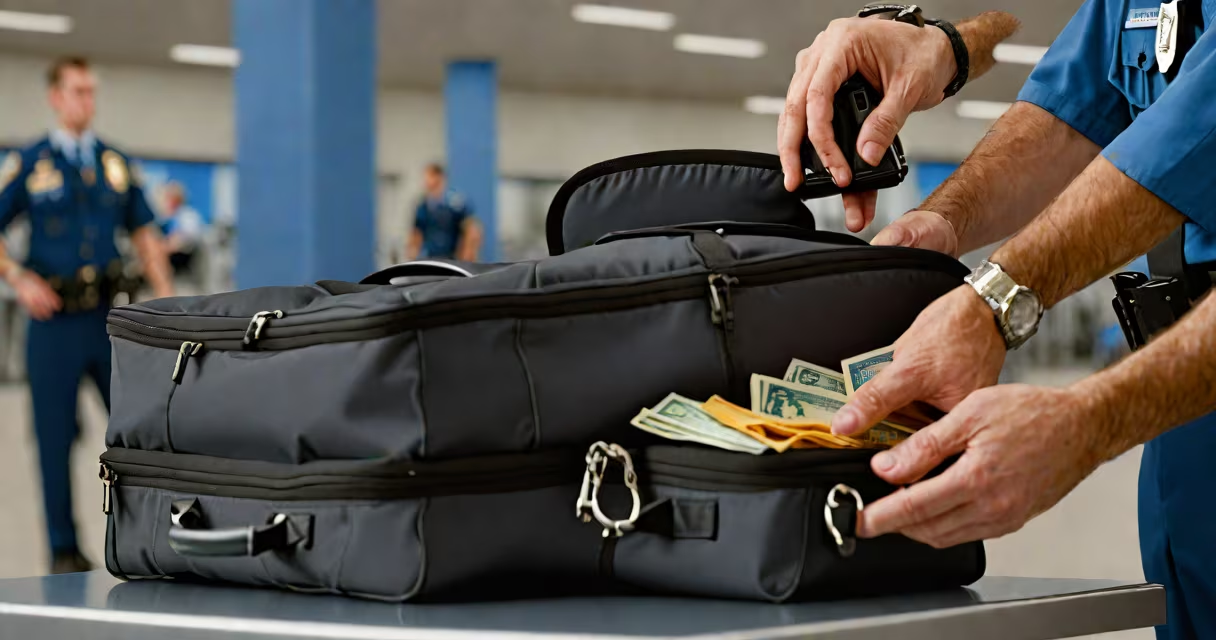
The Transportation Security Administration (TSA) enforces federal security standards at U.S. airports by screening passengers and their belongings to prevent weapons, explosives, and other threats from entering aircraft. The agency operates checkpoints at commercial airports nationwide, using a combination of technology, trained personnel, and established protocols to assess risk.
TSA agents conduct physical and electronic screenings at designated checkpoints. Passengers must remove shoes, jackets, and electronics larger than a smartphone from their bags. Items go through X-ray machines, and liquids must comply with the 3-1-1 rule (3.4 ounces or less in a clear quart-sized bag). If anomalies appear, agents may perform pat-downs or ask passengers to open bags for manual inspection.
Since 2002, the TSA has processed over 2 billion passenger screenings annually. According to the Department of Homeland Security, the agency's primary mission is to protect transportation systems from terrorism while maintaining efficient travel flow. All TSA officers undergo standardized training and certification under the TSA Academy curriculum.
Passengers enter a designated screening area where they proceed through a series of steps. First, they place all carry-on items-including laptops, tablets, and liquids-into bins. These bins are then loaded onto a conveyor belt that feeds them into an X-ray scanner. The images are analyzed by a TSA agent who identifies potential threats such as knives, firearms, or suspicious shapes.
After the bag scan, passengers walk through a metal detector or millimeter-wave scanner. These devices detect metallic objects or anomalies in body contours. If the alarm sounds, the passenger may be subject to a secondary screening, which includes a pat-down or additional questioning. The process aims to balance safety with privacy, and all pat-downs follow strict guidelines outlined in the TSA's Standard Operating Procedures.
For checked luggage, the TSA uses explosive detection systems (EDS) and random screening. Bags are scanned using computed tomography (CT) scanners that create 3D images. If a bag triggers an alert, it is opened and inspected manually. The TSA does not screen passengers' bodies beyond what's necessary for threat detection. All interactions are documented and reviewed for compliance.
The TSA employs several technologies and processes depending on location, passenger volume, and threat level. The most common methods include:
| Method | Use Case | Technology Involved | Passenger Impact |
|---|---|---|---|
| X-ray scanners | Carry-on bags | Single or dual-energy imaging | Bags are screened visually; no direct contact |
| Metal detectors | Body screening | Low-frequency electromagnetic fields | Alarms trigger secondary screening |
| Millimeter wave scanners | Body screening | Radio waves that reflect off body surfaces | Creates a generic outline; no image of anatomy |
| Explosive trace detection (ETD) | Secondary screening | Swabbing hands or bags for chemical traces | Used when suspicion arises |
Each method is calibrated to minimize false positives while maximizing threat detection. For example, millimeter-wave scanners use algorithms to flag anomalies without revealing anatomical details. The system generates a generic human-shaped outline, and any irregularity triggers a visual alert for the agent.
Many travelers assume the TSA searches for drugs or personal items unrelated to security. This is incorrect. The TSA does not search for contraband such as marijuana, prescription medication, or personal hygiene products unless they pose a threat. The focus remains strictly on preventing weapons, explosives, and hazardous materials from being brought onto aircraft.
A frequent misunderstanding is that TSA agents have unrestricted access to personal belongings. In reality, agents only open bags when a threat is detected or when required by law enforcement. Even then, they follow strict chain-of-custody procedures. A 2021 audit by the Government Accountability Office confirmed that 98% of bag inspections were conducted within policy guidelines.
Another misconception is that TSA checkpoints are uniform across all airports. They are not. Larger hubs like Los Angeles International (LAX), Chicago O'Hare (ORD), and Atlanta Hartsfield-Jackson (ATL) use advanced screening lanes with automated tray return systems and biometric verification. Smaller regional airports may rely on manual bin handling and fewer screening lanes.
Consider a traveler arriving at Denver International Airport (DEN) during peak hours. They arrive 90 minutes before departure, proceed to the TSA checkpoint, and place their laptop, phone, keys, and a 12-ounce bottle of water into a clear plastic bin. The bin is sent through the X-ray machine.
The agent notices a suspicious shape resembling a knife blade. The passenger is directed to a secondary screening area. There, a TSA officer performs a pat-down, confirming the object is a pocket knife. The knife is confiscated, and the passenger is allowed to continue after a verbal warning. The entire process took under 12 minutes.
This scenario reflects standard procedure. The TSA does not confiscate all sharp objects-knives under 4 inches are permitted in carry-ons if sheathed. However, blades longer than 4 inches are prohibited. The traveler was not penalized for carrying a knife, but it was removed because it exceeded size limits.
During my last trip through Orlando International Airport (MCO), I witnessed a passenger with a medical device-a portable oxygen concentrator-being cleared after a brief inspection. The TSA officer verified the device was FAA-approved and did not contain lithium batteries exceeding 160 watt-hours. No further action was taken. This illustrates how the TSA accommodates medical equipment under specific exemptions.
Items allowed in carry-on luggage include medications, toiletries under 3.4 ounces, electronics, and small tools. Liquids must be in containers no larger than 3.4 ounces and placed in a single clear quart-sized bag. This rule applies to shampoo, lotion, toothpaste, and even baby formula.
Prohibited items include firearms, large knives, aerosol sprays over 12 ounces, and flammable liquids. Lithium-ion batteries must be carried in the cabin-never in checked luggage-when exceeding 100 watt-hours. The TSA provides a searchable database at TSA What Can I Bring to verify restrictions before travel.
The TSA's role is not to inconvenience travelers but to ensure aviation safety. By following established rules and understanding the screening process, passengers can move through checkpoints efficiently and avoid delays. The agency continues to refine its operations based on feedback, technological advances, and evolving threat assessments.