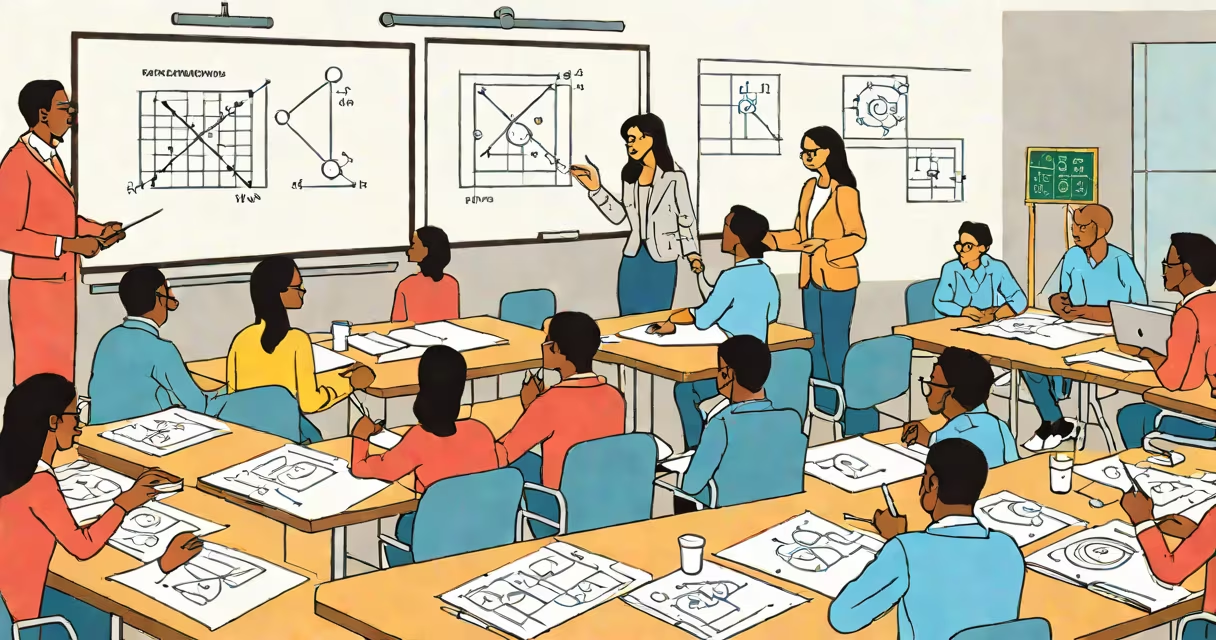
Pedagogical teaching is an intentional, research-informed method of instruction that centers on how students learn, not just what they are taught. It integrates cognitive science, developmental psychology, and curriculum design to create lessons that build understanding, retention, and critical thinking.
This approach emerged from centuries of educational inquiry but gained formal structure in the 19th century through the work of Johann Friedrich Herbart, who argued that teaching must follow the laws of mental development. Today, pedagogical teaching is grounded in empirical research, not intuition or tradition.
According to the National Council of Teachers of Mathematics, effective pedagogy involves "planning instruction based on student needs, using formative assessment to adjust delivery, and selecting strategies proven to promote conceptual understanding." This contrasts sharply with rote memorization or lecture-only models.
Pedagogical teaching begins with identifying learning goals aligned to standards or competencies. The instructor then selects instructional strategies-such as scaffolding, inquiry-based learning, or collaborative problem solving-that match the cognitive demands of the task and the learners' prior knowledge.
For example, when teaching fractions to fifth graders, a pedagogical approach avoids simply showing how to add numerators and denominators. Instead, the teacher uses fraction bars, real-world scenarios (like dividing a pizza), and guided questioning to help students construct meaning. The goal is not just correct answers but conceptual clarity.
Throughout the lesson, the teacher collects informal data-student responses, eye contact, written work-to assess whether understanding is forming. If confusion arises, the teacher adjusts the pace, rephrases the explanation, or introduces a different model. This ongoing feedback loop is central to pedagogical practice.
Pedagogical teaching rests on four key elements: clear objectives, appropriate instructional strategies, formative assessment, and reflection. These components are interdependent and must be applied intentionally.
| Type | Description | Example |
|---|---|---|
| Direct Instruction | Structured presentation of content with modeling and guided practice. Effective for foundational skills. | A math teacher demonstrates long division step-by-step, then leads students through five problems together. |
| Inquiry-Based Learning | Students explore questions through investigation. Builds reasoning and autonomy. | High school biology class investigates why leaves change color using controlled experiments and peer analysis. |
| Collaborative Learning | Small groups solve problems together. Enhances communication and shared responsibility. | English students analyze a poem in trios, then present interpretations to the class using role cards (summarizer, questioner, connector). |
| Project-Based Learning | Extended tasks that integrate multiple subjects and real-world context. | Students design a sustainable garden for the schoolyard, applying math, science, and budgeting skills. |
Each type requires different planning and facilitation. A teacher using direct instruction must anticipate misconceptions and have clear examples ready. Inquiry-based learning demands careful question design and classroom management to prevent off-track exploration.
Pedagogical teaching is often mistaken for simply being "student-centered" or "interactive." But not all student engagement counts as pedagogy. A classroom with constant movement and group work still fails if it lacks clear learning targets and assessment.
One common error is equating activity with learning. A 2018 study published in Journal of Educational Psychology found that students in high-engagement but low-pedagogy classrooms scored 12% lower on post-unit assessments than peers in lower-activity, higher-structure settings. Engagement without purpose reduces effectiveness.
Another misconception is that pedagogical teaching is only for younger students. In reality, it applies equally to college-level courses. For instance, a university professor teaching quantum mechanics might use concept maps, peer instruction, and weekly reflection prompts-not because students are "young," but because complex ideas require deliberate structuring.
In 2021, a middle school in Portland, Oregon, implemented a district-wide shift to pedagogical teaching across math and science departments. Teachers received training in backward design (starting with desired outcomes) and evidence-based strategies. After one year, standardized test scores rose 18% in math and 22% in science, according to district reports.
One teacher, Ms. Rivera, redesigned her unit on ecosystems. She began with a driving question: "Can a city survive without green spaces?" Students collected local air quality data, interviewed urban planners, and presented policy recommendations. The project integrated science, writing, and civic engagement. Her students not only met state standards but demonstrated deeper understanding during interviews.
"I used to think good teaching meant covering the material," she said. "Now I see it as designing experiences where students grow their thinking. That's what pedagogical teaching is-it's about the process of learning, not just the product."
Pedagogical teaching improves equity in education. When instruction is planned around how people learn, it accounts for differences in background, language proficiency, and cognitive styles. Research from the American Psychological Association shows that students from low-income backgrounds benefit most from structured, scaffolded instruction-exactly what pedagogy provides.
It also supports teacher growth. Rather than relying on instinct, educators use data and theory to refine their practice. The National Board for Professional Teaching Standards emphasizes that master teachers "demonstrate expertise in pedagogical content knowledge-the ability to teach subject matter effectively."
When done well, pedagogical teaching doesn't just improve test scores. It cultivates curiosity, resilience, and lifelong learning habits. It's not a trend. It's the foundation of effective education.
Understanding what is pedagogical teaching means recognizing it as a disciplined, adaptable structure-not a single technique. It's the difference between teaching a lesson and designing a learning experience. For educators committed to impact, it's not optional. It's essential.