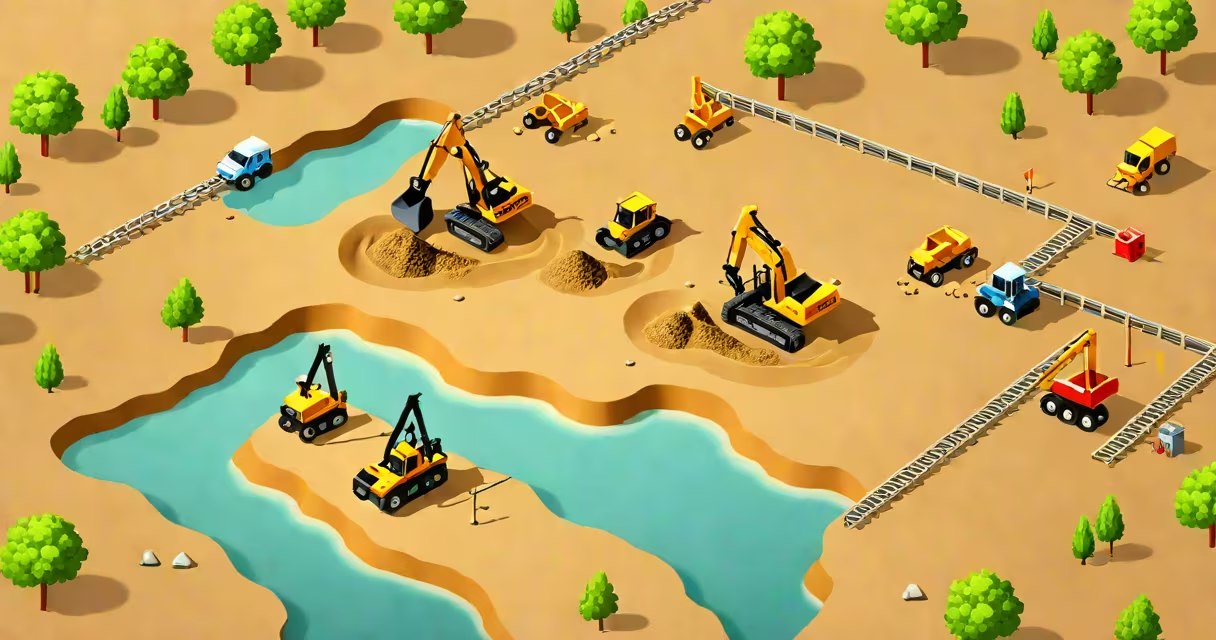
Sand mining is the extraction of sand from natural sources such as rivers, beaches, deserts, and seabeds for use in construction, glass manufacturing, and industrial processes. It is a high-volume activity driven by urbanization and infrastructure demand, particularly in rapidly developing regions.
Global sand consumption exceeds 50 billion tons annually, making it the most extracted material on Earth after water. The majority of this sand comes from riverbeds and coastal areas, where mining operations disrupt ecosystems, alter water flow, and accelerate land degradation. The practice is often unregulated, especially in low-income countries, leading to widespread environmental harm and legal disputes.
Operators use mechanical excavators, dredges, and conveyor systems to remove sand from riverbeds or coastal zones. In river-based mining, trenches are dug into the bed, and water is pumped out to expose sediment layers. Dredging ships then suction up sand and transport it via barges or pipelines to processing plants.
Processing involves washing, screening, and drying the sand to meet specifications for concrete, mortar, and asphalt. For example, fine sand (0.06-0.2 mm grain size) is ideal for plastering, while coarse sand (0.5-2 mm) supports structural strength in foundations. In India, sand used in Mumbai's skyscrapers is often mined from the Narmada River, transported over 500 km by rail.
Illegal mining operations frequently bypass environmental assessments and local regulations. In Bangladesh, unlicensed miners extract sand from the Ganges tributaries using small boats and hand tools, contributing to bank erosion and displacement of fishing communities.
Different environments yield distinct sand qualities. The table below outlines common sources and their applications:
| Source Type | Grain Size Range | Primary Use | Environmental Risk |
|---|---|---|---|
| Riverbeds | 0.1-1.0 mm | Concrete, mortar | High - alters flow, erodes banks |
| Beaches | 0.2-0.8 mm | Foundations, glass | Extreme - destroys habitats, increases storm surge vulnerability |
| Deserts | 0.3-1.5 mm | Industrial fill, road base | Medium - slow regeneration, dust pollution |
| Seabeds | 0.1-0.6 mm | Land reclamation, offshore construction | Very high - damages marine ecosystems, affects fish spawning |
Beach sand mining is particularly destructive. In Sri Lanka, the removal of sand from the west coast led to the collapse of dune systems and increased flooding during monsoon seasons. A 2021 study by the University of Colombo found that 78% of surveyed coastal areas showed significant erosion within five years of mining activity.
Many assume sand is infinite because it appears abundant in deserts and along shorelines. But not all sand is suitable for construction. Desert sand is rounded and smooth due to wind abrasion, which reduces bonding strength in concrete. Only quartz-rich, angular sand from riverbeds meets engineering standards.
Another misconception is that sand mining is solely a problem in developing nations. In the United States, sand mining from the Great Lakes region supplies over 60% of Midwest construction projects. The U.S. Environmental Protection Agency (EPA) reports that 37% of licensed mining sites in Michigan have violated sediment discharge limits since 2018.
A lesser-known fact: synthetic sand made from crushed rock is increasingly replacing natural sand. In China, 45% of new construction projects now use manufactured sand, reducing pressure on river systems. However, this alternative still produces high carbon emissions from quarrying and crushing.
In 2019, a sand mining operation in the Mekong Delta caused the collapse of a 1.2-kilometer stretch of riverbank, displacing 14 families and damaging irrigation channels. The Vietnamese government later fined the operator 1.2 billion VND ($52,000 USD) and banned mining in the area for five years.
International oversight remains weak. The United Nations Environment Programme (UNEP) classifies sand as a "critical but under-monitored resource." According to a 2022 UNEP report, only 12% of countries have national sand management policies, and enforcement is inconsistent even where laws exist.
I witnessed the effects firsthand during a field visit to the Kaveri River in Tamil Nadu, India. Local farmers reported that after nearby sand mining began, their wells dried up within 18 months. Hydrological surveys confirmed a 40% drop in groundwater levels downstream of the mining zone. The state government eventually suspended licenses for six operators.
Sand mining differs from gravel or clay extraction in scale and environmental impact. While all involve earth removal, sand mining targets finer particles essential for binding materials. Unlike coal or metal mining, sand extraction rarely involves toxic byproducts, but its cumulative effect on water systems is severe.
It is also distinct from beach nourishment-a restoration technique where sand is added to eroded coasts. Beach nourishment uses imported sand to rebuild shorelines, whereas sand mining removes sand from those same locations, creating a feedback loop of degradation.
For comparison, riverbed mining typically extracts 10-20 tons per hour using tracked excavators. In contrast, quarrying granite for aggregate operates at 50-100 tons per hour but produces larger waste rock volumes. Both activities require permits, but sand mining often lacks transparent reporting mechanisms.