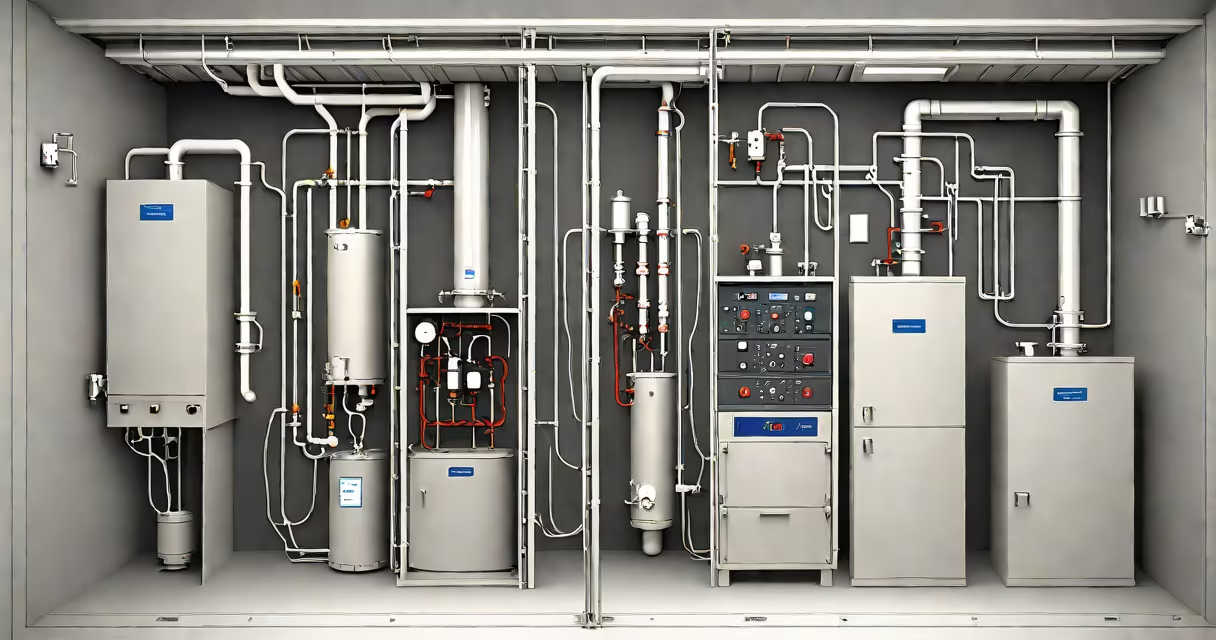
The best furnace is a high-efficiency heating system tailored to your home's square footage, climate zone, and ductwork layout. It delivers consistent warmth while minimizing fuel consumption and maintenance costs over a 15-20 year lifespan.
Furnaces generate heat by burning natural gas, oil, or propane, then distributing warm air through ducts. The most efficient models meet or exceed the minimum AFUE (Annual Fuel Utilization Efficiency) rating set by the U.S. Department of Energy. A furnace with a 95% AFUE rating converts 95 cents of every dollar spent on fuel into usable heat, losing only 5 cents to exhaust.
High-efficiency furnaces reduce annual heating costs by up to 30% compared to older models with 60% AFUE. For a typical 2,000-square-foot home in a cold climate like Minnesota, switching from a 60% to a 95% AFUE furnace can save $400-$600 annually on gas bills. These savings compound over time, making higher upfront cost worthwhile.
A furnace draws air from inside the home through return vents. The blower pulls it over a heat exchanger, which is warmed by a burner that ignites fuel. The heated air is pushed through supply ducts and released into rooms via floor, wall, or ceiling registers. Cold air returns to the furnace, completing the cycle.
Modern furnaces use variable-speed blowers and modulating burners. Variable-speed units adjust fan speed based on demand, reducing noise and improving temperature consistency. Modulating burners operate at multiple output levels-down to 40% capacity-instead of cycling on/off at full power. This prevents temperature swings and reduces wear.
For example, during mild winter days, a modulating furnace may run at 40% output for hours without shutting off. Older single-stage models would turn on at 100%, run until the thermostat was satisfied, then shut down completely-causing frequent on-off cycles and uneven comfort.
Furnaces differ by fuel type, efficiency level, and design. The following table compares common options:
| Type | AFUE Range | Best For | Typical Lifespan |
|---|---|---|---|
| Single-stage gas | 80-83% | Older homes with basic ductwork | 12-15 years |
| Two-stage gas | 88-92% | Most U.S. homes in moderate climates | 15-18 years |
| Modulating gas | 90-97% | Cold climates, homes with tight insulation | 18-20 years |
| Electric | 100% (but high operating cost) | Small spaces, supplemental heat | 15-20 years |
Gas furnaces dominate the market, accounting for 85% of new installations in the U.S., according to the U.S. Energy Information Administration (EIA). Electric furnaces are less efficient for energy cost per BTU but offer simplicity and lower installation complexity.
Condensing furnaces achieve high AFUE by extracting additional heat from exhaust gases. They route flue gases through a secondary heat exchanger, cooling them enough to condense water vapor. This process recovers latent heat and boosts efficiency. Condensing units require PVC venting instead of metal, which affects installation flexibility.
Many homeowners assume the "best" furnace is the most expensive model. That's not always true. A $6,000 modulating furnace may not outperform a $4,500 two-stage unit if the home's ductwork is undersized or poorly sealed.
Another misconception: larger furnaces heat faster. In reality, oversized units short-cycle-turning on and off too frequently. This increases wear, reduces efficiency, and causes uncomfortable temperature fluctuations. The EPA estimates that 30% of furnaces installed in U.S. homes are oversized due to incorrect load calculations.
Proper sizing requires a Manual J load calculation. This method considers insulation levels, window U-values, local climate data, and room-by-room heat loss. Skipping this step leads to inefficient operation and premature failure. A 2,000 sq ft home in Chicago might need a 60,000 BTU furnace, while the same size home in Atlanta might only need 45,000 BTU.
I once observed a homeowner replace a 15-year-old furnace with a 95% AFUE model. The installer didn't perform a Manual J. The new furnace ran constantly during winter because the ducts were leaky and the attic insulation was inadequate. After sealing ducts and adding insulation, the furnace cycled normally and reduced gas usage by 25%.
The best furnace is used in residential homes across North America, especially in regions with cold winters. It's essential in areas where heating degree days exceed 5,000 annually-such as the Northeast, Midwest, and parts of the Pacific Northwest.
Homeowners choose high-efficiency furnaces to cut long-term energy costs, improve indoor comfort, and qualify for federal tax credits. The Inflation Reduction Act of 2022 offers up to $1,500 in rebates for installing furnaces with 95% AFUE or higher, provided the unit meets ENERGY STAR certification standards.
These systems also support smart thermostats. When paired with a Wi-Fi-enabled thermostat, a high-efficiency furnace can learn occupancy patterns and adjust output automatically. One study by the Lawrence Berkeley National Laboratory found that such integration reduced heating energy use by 12% on average.
The best furnace is not a boiler. Boilers heat water instead of air and distribute warmth via radiators or radiant floor systems. While boilers can be highly efficient, they're not interchangeable with forced-air furnaces. Installing a boiler requires different piping and controls.
It's also not a heat pump. Heat pumps move heat rather than generate it. They work well in milder climates but struggle below 25°F. In colder zones, a heat pump may need a gas furnace as a backup. Some homes use hybrid systems: a heat pump for spring/fall, a gas furnace for winter.
Finally, the best furnace isn't a space heater. Portable electric heaters are designed for spot warming, not whole-home heating. Using them as primary heat sources increases electricity bills and poses fire risks if left unattended.
When evaluating the best furnace, prioritize correct sizing, proper installation, and long-term operating cost. A 95% AFUE furnace in a well-insulated home with sealed ducts can last 20 years with minimal repairs. Maintenance includes replacing filters monthly, cleaning burners annually, and inspecting the heat exchanger every five years.
Always hire a licensed HVAC technician certified by NATE (North American Technician Excellence). Certified installers follow industry codes and ensure safety. A properly installed furnace reduces carbon monoxide risk and prevents gas leaks.