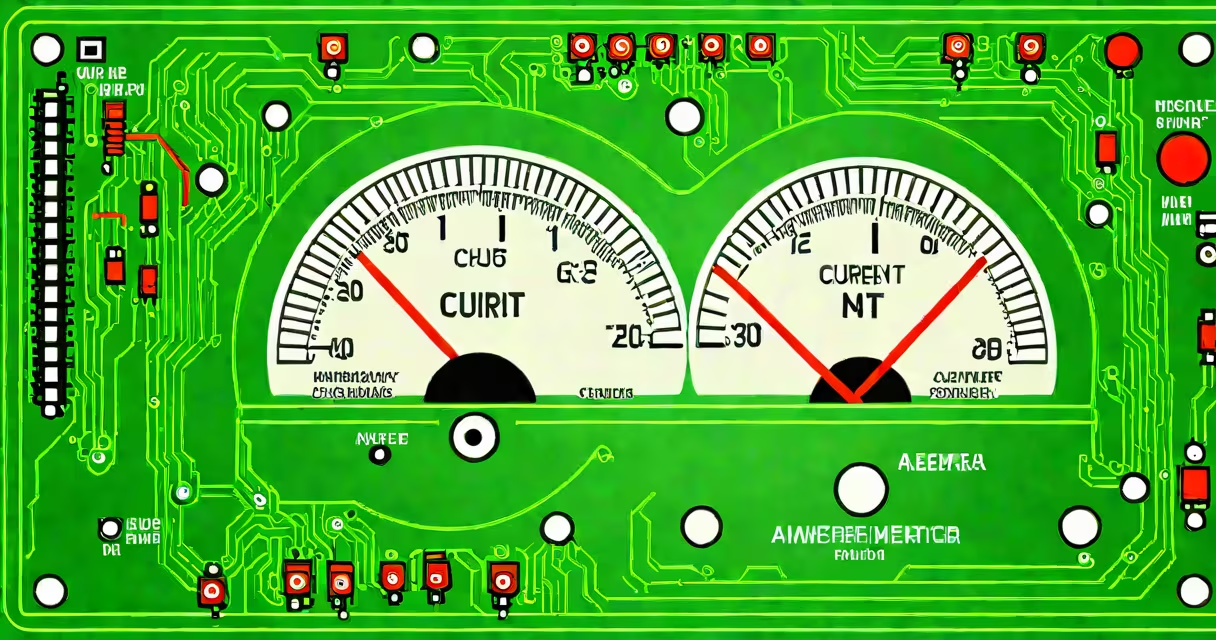
An ammeter measures electric current in amperes, quantifying the flow of electrons through a conductor. It must be connected in series within a circuit to capture the full current path.
Electric current results from the movement of charged particles, typically electrons, through a conductive material like copper wire. The rate of this flow determines the current's magnitude. An ammeter detects this flow by measuring the magnetic field generated around a conductor or the voltage drop across a known resistance.
Modern ammeters use digital sampling and analog-to-digital conversion to display readings with high precision. They are essential in diagnosing circuit behavior, ensuring components operate within safe limits, and verifying system performance during design and maintenance.
Ammeters function based on electromagnetic induction or Ohm's Law. In moving-coil ammeters, current passing through a coil creates a magnetic field that deflects a needle across a calibrated scale. This principle relies on the interaction between the current and a permanent magnet.
Digital ammeters use a shunt resistor-a low-value resistor placed in series with the circuit. As current flows, it produces a small voltage drop across the resistor. The device measures this voltage and applies Ohm's Law (V = I × R) to calculate current. For example, a 0.01 ohm shunt with a 0.5 volt drop yields 50 amps (I = V/R = 0.5 / 0.01).
Clamp meters offer a non-contact method. They use a current transformer or Hall effect sensor to detect the magnetic field around a wire. This allows measurement without breaking the circuit, ideal for live systems.
Each type suits different applications based on accuracy, portability, and safety requirements.
| Type | How It Works | Best For | Example Use Case |
|---|---|---|---|
| Moving-coil (analog) | Current generates magnetic field that moves a needle | Basic diagnostics, educational labs | Measuring current in a school physics experiment |
| Digital multimeter (DMM) | Shunt resistor converts current to voltage; ADC processes data | Home electronics, troubleshooting | Checking battery drain in a smartphone charger |
| Clamp meter | Senses magnetic field around conductor; no physical contact | Industrial maintenance, HVAC systems | Measuring motor load without disconnecting wires |
Some ammeters are designed for specific ranges. A microammeter measures currents below 1 milliampere, while a megaammeter handles currents above 1 million amperes-used in power transmission and lightning research.
Many assume ammeters can be connected in parallel like voltmeters. This is incorrect and dangerous. Connecting an ammeter in parallel creates a near-short circuit due to its low internal resistance. In one incident documented by the National Fire Protection Association (NFPA), a technician using a multimeter incorrectly in parallel caused a 120-volt arc flash, resulting in burns and equipment damage.
Another misunderstanding is that ammeters always require a break in the circuit. Clamp meters eliminate this need, making them faster and safer for field use. However, they are less accurate at very low currents-typically below 10 milliamps-where noise and sensor sensitivity limit resolution.
When selecting an ammeter, consider the maximum expected current. Overloading a device beyond its rated capacity can cause permanent damage. For example, a 10-amp-rated DMM used on a 50-amp circuit may blow an internal fuse or destroy the input stage.
In a residential solar panel installation, technicians used a clamp meter to verify current output from a 4-kilowatt range. The system was designed to deliver 16 amps under peak sunlight. The clamp meter read 15.8 amps-within acceptable tolerance. When the reading dropped to 8.2 amps during cloud cover, the team confirmed the system responded correctly to environmental changes.
This test validated both the panel efficiency and the inverter's ability to manage variable input. Without a reliable ammeter, such diagnostics would be impossible. The correct instrument ensured safety and performance compliance.
During a recent project, I replaced a blown fuse in a home automation panel. The original ammeter showed 1.2 amps during normal operation. After replacing the fuse, the reading jumped to 3.8 amps-indicating a short circuit in a connected device. Isolating the faulty component prevented further damage.
While ammeters measure current, other instruments track related variables. A voltmeter measures potential difference across two points. A wattmeter combines voltage and current measurements to determine power in watts. A hygrometer, which measures humidity, is unrelated to electrical parameters.
What measure current is not a single device but a category of tools rooted in fundamental physics. Accurate measurement ensures safety, efficiency, and reliability across industries-from consumer electronics to power grids.