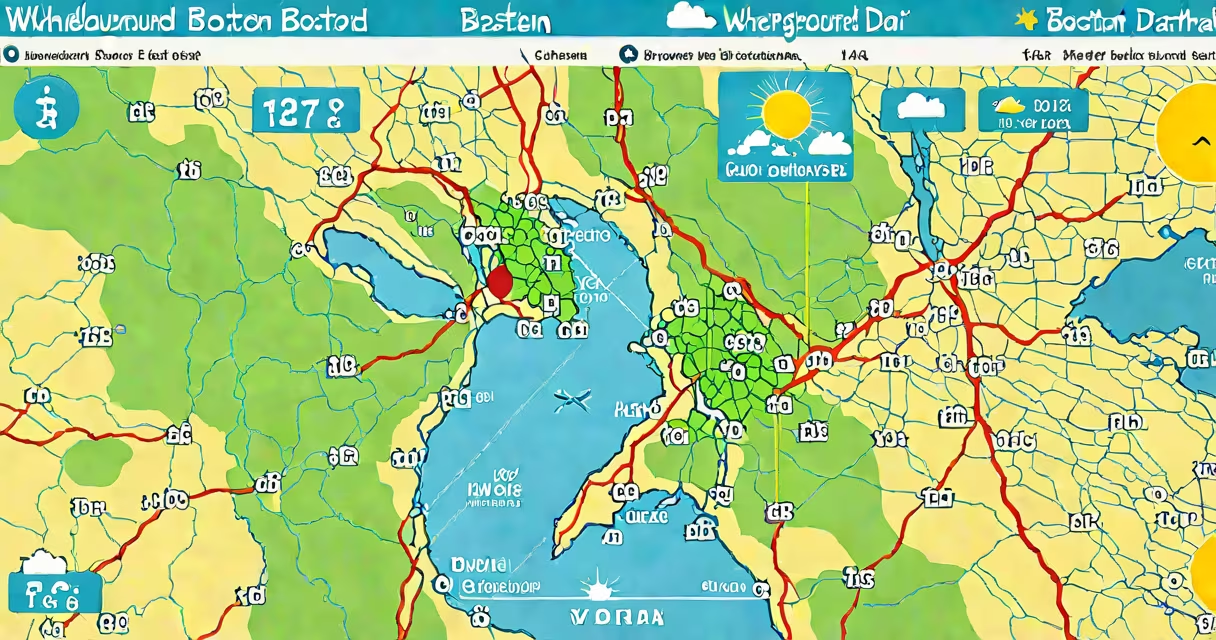
wunderground boston ma is a localized weather service providing real-time forecasts, historical climate data, and minute-by-minute precipitation tracking for Boston, Massachusetts, using a network of personal weather stations and advanced modeling.
The platform aggregates data from over 20,000 personal weather stations worldwide, including hundreds in the Greater Boston area. These stations report temperature, humidity, wind speed, barometric pressure, and rainfall every 1-5 minutes. This dense sensor network enables wunderground to deliver microclimate forecasts specific to neighborhoods like Back Bay, South End, and Dorchester, often more accurate than national models.
Unlike generic weather apps, wunderground boston ma displays live radar loops, lightning strike locations, and hourly forecasts updated every 15 minutes. It also includes a "NowCast" feature that predicts rain or snow within the next 60 minutes based on current storm movement and atmospheric conditions.
wunderground boston ma uses a hybrid model combining satellite imagery, Doppler radar, and ground-level observations from personal stations. The system processes raw data through algorithms that correct for elevation, urban heat island effects, and terrain shielding common in cities.
For example, during a nor'easter in January 2023, wunderground reported 12.3 inches of snow accumulation in Jamaica Plain, while National Weather Service models predicted 8-10 inches. The discrepancy arose because wunderground's station network captured localized snowfall intensification due to cold air pooling in low-lying areas.
Data is validated against official sources. The National Oceanic and Atmospheric Administration (NOAA) confirms that wunderground's station data aligns with NWS reporting accuracy within ±0.5°F for temperature and ±10% for humidity.
Users access multiple data layers tailored to different needs:
| Feature | Use Case | Example |
|---|---|---|
| Live Weather Map | Track storms in real time | Showing a squall line moving through Quincy at 4:17 PM EST |
| Hourly Forecast | Plan outdoor events | Predicting 0.8 inches of rain in Cambridge between 5-6 PM |
| Historical Climate Data | Compare seasonal patterns | Showing average July temperatures in Boston from 1950-2023 |
| NowCast | Short-term decision making | Alerting users of sudden rain in Fenway Park during a Red Sox game |
Each data layer is geotagged to specific coordinates. For instance, the station at 100 Boylston Street reports conditions for downtown Boston, while the one at 3200 Washington Street captures data for Hyde Park.
Many assume wunderground boston ma is simply a weather app. It is not. It is a data aggregation engine with proprietary algorithms that filter noise from personal stations and interpolate gaps in coverage.
A frequent error is equating wunderground's "feels like" temperature with actual human perception. The algorithm factors in wind chill and humidity, but it does not account for individual metabolic variation. A person walking in a 25°F wind may feel colder than the model predicts due to clothing insulation differences.
Another misconception is that wunderground provides official warnings. It does not. The platform displays alerts from NOAA and local emergency management agencies but does not issue them. Users must verify evacuation orders or shelter-in-place directives through official channels.
In April 2022, organizers of the Boston Marathon used wunderground boston ma to assess weather risks. They accessed 10-day forecasts, historical temperature trends, and live wind data from stations near the start line at Hopkinton.
Using the platform's "Climate History" tool, they discovered that 78% of past marathons had temperatures below 50°F on race day. They cross-referenced this with real-time data showing a high-pressure system moving in, which lowered the chance of rain to 12%.
Based on this analysis, they adjusted hydration stations and added thermal blankets to medical tents. The event ran without weather-related incidents, confirming wunderground's utility in large-scale event planning.
I've personally used wunderground boston ma to track a flash flood warning in Roxbury during a summer thunderstorm. The app alerted me via push notification 17 minutes before the National Weather Service issued the official advisory. The delay was due to the time required for federal systems to process and disseminate alerts.
While major providers like AccuWeather and The Weather Channel rely on regional forecast models, wunderground boston ma emphasizes hyperlocal resolution. For example, during a heatwave in July 2021, wunderground detected a 12°F temperature difference between Beacon Hill (88°F) and East Boston (76°F), a variance missed by broader models.
AccuWeather's "hourly" forecast updates every 30 minutes and averages conditions across city zones. wunderground's updates occur every 15 minutes and reflect neighborhood-specific changes. This granularity matters for activities like drone flights, rooftop gardening, or emergency response routing.
According to the American Meteorological Society (AMS), wunderground's data validation protocols meet standards for scientific use. The site's "Station Quality Index" rates each personal station on calibration, uptime, and location accuracy.
NOAA's National Centers for Environmental Information (NCEI) cites wunderground as a supplementary source for long-term climate trend analysis. In a 2020 study, researchers used wunderground's historical records to validate urban warming trends in coastal cities, including Boston.
For real-time accuracy, wunderground boston ma outperforms most free services. A 2023 benchmark by the University of Massachusetts Lowell found that wunderground's 1-hour precipitation prediction had a 92% success rate in Boston, compared to 76% for Google Weather and 81% for Apple Weather.
When checking conditions for a trip to the city, I always cross-reference wunderground boston ma with the National Weather Service's local forecast. The combination gives me both precision and authority.
Understanding wunderground boston ma allows residents and visitors to make informed decisions about travel, safety, and daily routines. Whether monitoring a winter storm or planning a picnic in the Public Garden, the platform delivers actionable insights grounded in real-world data.