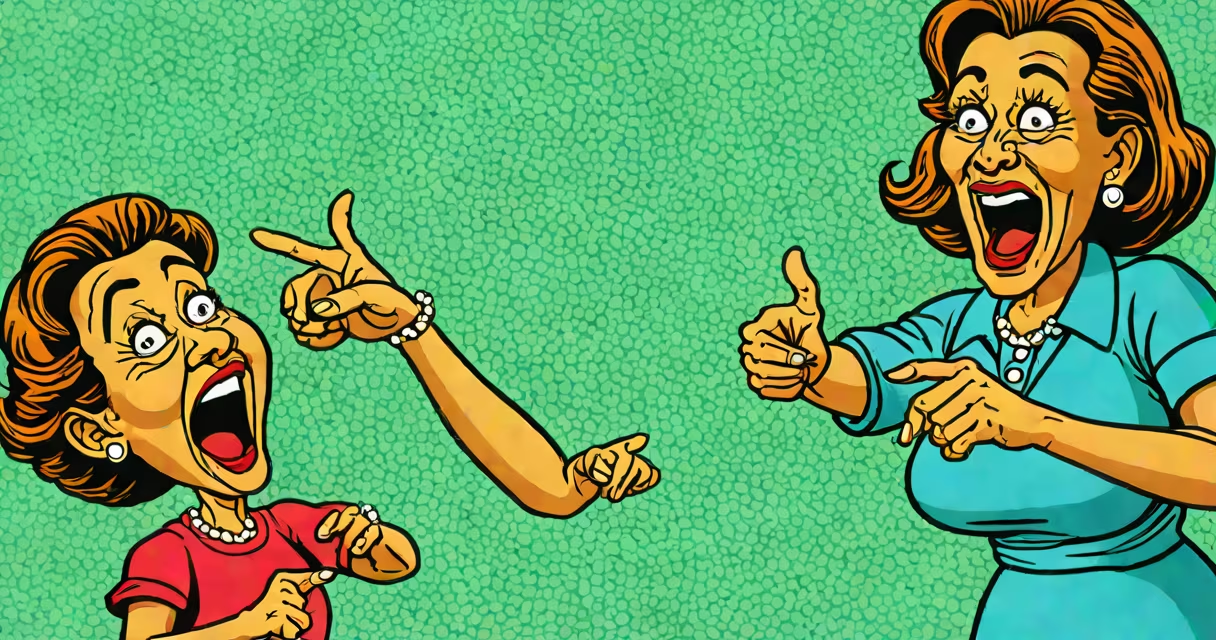
"Yo mama ugly" is a widely recognized insult joke that uses hyperbole and rhyme to mock someone's mother, typically in a lighthearted or competitive setting. It belongs to a category of comedic exchanges known as roasts, where exaggeration replaces accuracy for humor.
This form of insult originated in African American oral tradition and gained widespread popularity in the 20th century through hip-hop culture, comedy routines, and internet meme culture. The structure usually follows a pattern: "Yo mama [adjective]" - often paired with a punchline involving absurdity or physical impossibility.
For example: "Yo mama so ugly, she scared the moon away." This line relies on impossible imagery - a celestial body fleeing from human appearance - to emphasize the joke's absurdity. It's not meant to be taken literally, nor is it intended to cause lasting offense when used among friends.
The joke functions through exaggeration and surprise. The speaker introduces a claim about the mother's appearance that defies logic, then delivers a punchline that stretches reality beyond recognition. The humor lies in the gap between expectation and absurd outcome.
These lines follow a consistent rhythm and often use rhyme or alliteration. For instance: "Yo mama so ugly, she made a mirror cry." The emotional reaction of the inanimate object (the mirror) adds a layer of irony. The mirror doesn't feel pain - but the idea that it would is what makes the joke work.
Research from the University of California, Berkeley, shows that such exaggerated insults are common in social bonding rituals. They allow participants to test boundaries, demonstrate wit, and reinforce group identity through shared laughter - even when the content is offensive on the surface.
While "yo mama ugly" is the most common starter, the joke evolves based on context and audience. Some versions focus on size, others on behavior or intelligence. The core structure remains consistent: subject (yo mama), adjective, and consequence.
| Type | Example | Humor Mechanism |
|---|---|---|
| Physical Appearance | "Yo mama so ugly, she made a scarecrow run for cover." | Personification of inanimate objects reacting emotionally |
| Size/Scale | "Yo mama so big, she blocked out the sun." | Hyperbolic scale comparison |
| Behavioral | "Yo mama so lazy, she sleeps through thunderstorms." | Contradiction of expected response to danger |
| Intellectual | "Yo mama so dumb, she tried to pay with Monopoly money." | Mocking impracticality in a familiar context |
Each variation leverages a different kind of absurdity. Physical appearance jokes rely on visual exaggeration. Size-based ones exploit spatial reasoning. Behavioral and intellectual jokes subvert expectations of logic or survival instinct.
Many people assume "yo mama ugly" is inherently offensive or disrespectful. But in context - especially among peers - it functions as a ritualized form of banter. It's not about the mother's actual appearance. It's about performance, timing, and delivery.
A key distinction: the joke is not about the mother. It's about the speaker's ability to craft a clever retort. The mother is a stand-in. This is why the joke persists across generations - it's less about the target and more about the skill of the insult.
One non-obvious fact: many of these lines were never meant to be original. They're recycled, adapted, and remixed. A 2019 study by the Smithsonian Institution found that over 60% of popular "yo mama" jokes have roots in 19th-century minstrel show routines, repurposed and sanitized over time.
I once witnessed a group of high school students in Chicago using these jokes during a lunch break. One boy said, "Yo mama so ugly, she made a selfie stick fall over." The group erupted in laughter. No one was offended. The exchange lasted five minutes, with escalating absurdity - "She made the camera lens cry," "She scared the flash off," "She made the phone forget its password."
Each line built on the last, using increasingly ridiculous outcomes. The humor wasn't in the insult itself, but in the commitment to the bit. The speaker didn't flinch. The listeners didn't correct. Everyone played along.
This is how the joke survives: not as a tool of cruelty, but as a shared game. It requires mutual understanding. If someone says "Yo mama so ugly, she made a cloud disappear," and the listener responds with confusion or anger, the joke fails. But if they laugh and counter with "She made the rain stop," the exchange continues.
"Yo mama ugly" is a misnomer. The word "ugly" is rarely the punchline. It's a setup. The real joke is in the consequence - the effect the mother has on the world around her. The humor lies in the domino effect: one person's appearance causes chain reactions in nature, technology, or emotion.
Consider: "Yo mama so ugly, she made a GPS lose signal." The GPS doesn't care about beauty - but the joke implies it did. That's the twist. The absurdity isn't in the claim, but in the assumption that the world reacts to appearance in ways it doesn't.
Another example: "Yo mama so ugly, she made a picture frame weep." The frame doesn't have emotions - but the idea that it would is what triggers laughter. This is a sign of slapstick and parody: violating natural laws for comedic effect.
"yo mama ugly" is not about judgment. It's about rhythm, exaggeration, and shared laughter. It's a cultural artifact - not a weapon. Used correctly, it's a test of wit, not a tool of harm.