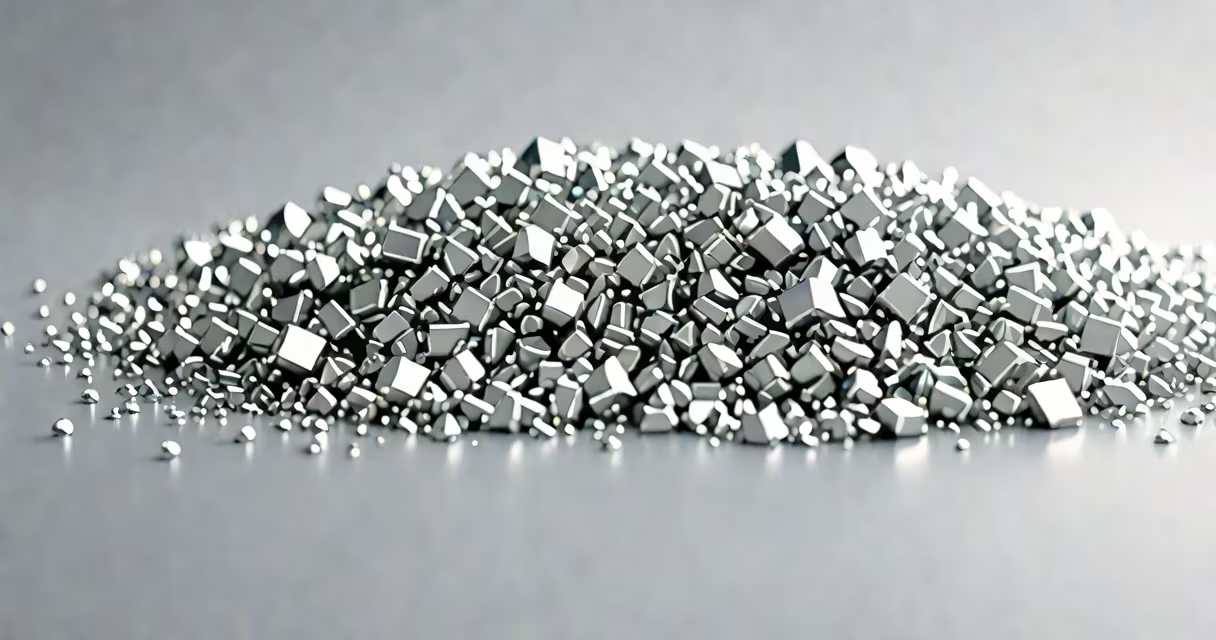
Zinc II nitrate is a water-soluble inorganic compound with the chemical formula Zn(NO₃)₂. It exists as a colorless or white crystalline solid and dissociates completely in water to form Zn²⁺ and NO₃⁻ ions. The compound is used in laboratories for synthesis, catalysis, and as a source of zinc ions in electroplating and analytical chemistry.
The name "zinc II nitrate" specifies the oxidation state of zinc as +2, which is the most stable form in aqueous solutions. This distinguishes it from other zinc salts such as zinc oxide (ZnO) or zinc sulfide (ZnS), where zinc has different oxidation states or bonding environments. The Roman numeral II indicates that zinc is in its +2 oxidation state, consistent with IUPAC nomenclature standards.
Zinc II nitrate is typically prepared by reacting metallic zinc with dilute nitric acid. The reaction proceeds as:
Zn(s) + 2HNO₃(aq) → Zn(NO₃)₂(aq) + H₂(g)This process yields a clear solution that can be evaporated to obtain hydrated crystals. The most common form is the hexahydrate, Zn(NO₃)₂·6H₂O, which appears as colorless prismatic crystals and is hygroscopic-meaning it absorbs moisture from the air.
Zinc II nitrate consists of one zinc ion (Zn²⁺) bonded to two nitrate anions (NO₃⁻). In solid state, the Zn²⁺ ion is surrounded by six oxygen atoms from water molecules and nitrate groups in an octahedral coordination geometry. The nitrate ions act as bidentate ligands in the crystal lattice, forming weak interactions with the metal center.
The molar mass of anhydrous Zn(NO₃)₂ is 189.39 g/mol. For the hexahydrate form, it increases to 297.48 g/mol due to added water molecules. The compound decomposes upon heating above 100 °C, releasing nitrogen dioxide (NO₂) and oxygen gas. This decomposition is exothermic and can pose safety risks if heated rapidly in closed containers.
A key distinction often missed: zinc II nitrate is not the same as zinc nitrate hydrate unless specified. Many suppliers list "zinc nitrate" without specifying hydration level, leading to errors in stoichiometric calculations. Always confirm whether the product is anhydrous or hydrated when preparing solutions.
Two primary forms of zinc II nitrate are used in practice:
| Form | Formula | Appearance | Common Use |
|---|---|---|---|
| Anhydrous | Zn(NO₃)₂ | White powder | High-purity applications, catalysts |
| Hexahydrate | Zn(NO₃)₂·6H₂O | Colorless crystals | Laboratory synthesis, standard solutions |
The hexahydrate is far more common in teaching labs and research settings due to its stability and ease of handling. Anhydrous forms require desiccation storage and are used in specialized catalytic reactions where water must be excluded.
One non-obvious fact: zinc II nitrate solutions can slowly hydrolyze over time, especially when exposed to light or elevated temperatures. This leads to the formation of basic salts like Zn(OH)NO₃, which appear as cloudy precipitates. This degradation is accelerated in alkaline conditions and must be accounted for in long-term storage.
In industry, zinc II nitrate is used as a precursor in the production of zinc oxide nanoparticles via thermal decomposition. These nanoparticles are incorporated into sunscreens, coatings, and antimicrobial materials. According to the National Institute of Standards and Technology (NIST), zinc oxide synthesized from Zn(NO₃)₂ shows higher purity and uniform particle size compared to methods using other precursors.
In academic settings, zinc II nitrate is used in qualitative analysis to test for sulfate ions. When mixed with sulfuric acid, it produces a white precipitate of zinc sulfate, confirming the presence of SO₄²⁻. This test is part of standard curriculum in general chemistry labs.
During a recent experiment in my university's inorganic chemistry lab, I prepared a 0.1 M solution of Zn(NO₃)₂·6H₂O for a coordination complex synthesis. After dissolving 2.97 grams in 1 liter of deionized water, the solution remained clear and colorless. Upon adding ammonia dropwise, a white gelatinous precipitate formed-indicating the formation of Zn(OH)₂. This behavior aligns with known solubility rules and confirms the reactivity profile of Zn²⁺ ions in basic environments.
Zinc II nitrate is frequently confused with silver nitrate (AgNO₃), despite their similar appearance and use in precipitation tests. Both are white crystalline solids and dissolve readily in water. However, they differ in reactivity and toxicity. Silver nitrate is photosensitive and stains skin black due to reduction to elemental silver. Zinc II nitrate lacks this property and is less toxic-though still corrosive to mucous membranes.
Another misconception: zinc II nitrate is sometimes assumed to be a strong oxidizing agent. While nitrate ions can act as oxidizers under acidic conditions, Zn(NO₃)₂ itself is not strongly oxidizing in neutral or basic solutions. Its primary role is as a source of Zn²⁺, not as an electron acceptor.
For accurate results in experiments involving redox reactions, always verify the oxidation potential of the system. The standard reduction potential for Zn²⁺/Zn is −0.76 V, indicating zinc metal is a good reducing agent-but the nitrate ion in Zn(NO₃)₂ does not spontaneously oxidize metals like iron or copper under normal conditions.
According to the Occupational Safety and Health Administration (OSHA), zinc II nitrate is classified as a skin and eye irritant. Prolonged exposure may cause dermatitis. Inhalation of dust particles can lead to respiratory irritation. The compound is not flammable but releases toxic fumes (nitrogen oxides) when heated above 150 °C.
Safe handling requires gloves, goggles, and a fume hood during heating procedures. Waste disposal must follow EPA guidelines for heavy metal compounds. Neutralization with sodium hydroxide to form insoluble Zn(OH)₂ before landfill disposal is recommended.
When stored properly in sealed containers away from heat and light, zinc II nitrate remains stable for years. However, exposure to humidity causes deliquescence-the material absorbs enough moisture to dissolve into a liquid. This property makes it unsuitable for long-term storage in humid environments without desiccants.
Zinc II nitrate reacts with sodium hydroxide to form a gelatinous white precipitate of zinc hydroxide:
Zn(NO₃)₂(aq) + 2NaOH(aq) → Zn(OH)₂(s) + 2NaNO₃(aq)Further addition of NaOH dissolves the precipitate due to amphoteric nature of Zn(OH)₂:
Zn(OH)₂(s) + 2OH⁻(aq) → [Zn(OH)₄]²⁻(aq)This behavior is useful in separating zinc from other cations in qualitative analysis schemes.
Another application: zinc II nitrate is used in the preparation of zinc-based catalysts for polymerization reactions. In one study published in the Journal of Catalysis, researchers reported that Zn(NO₃)₂ supported on silica yielded high activity in the ring-opening polymerization of ε-caprolactone, producing biodegradable polyesters with controlled molecular weights.