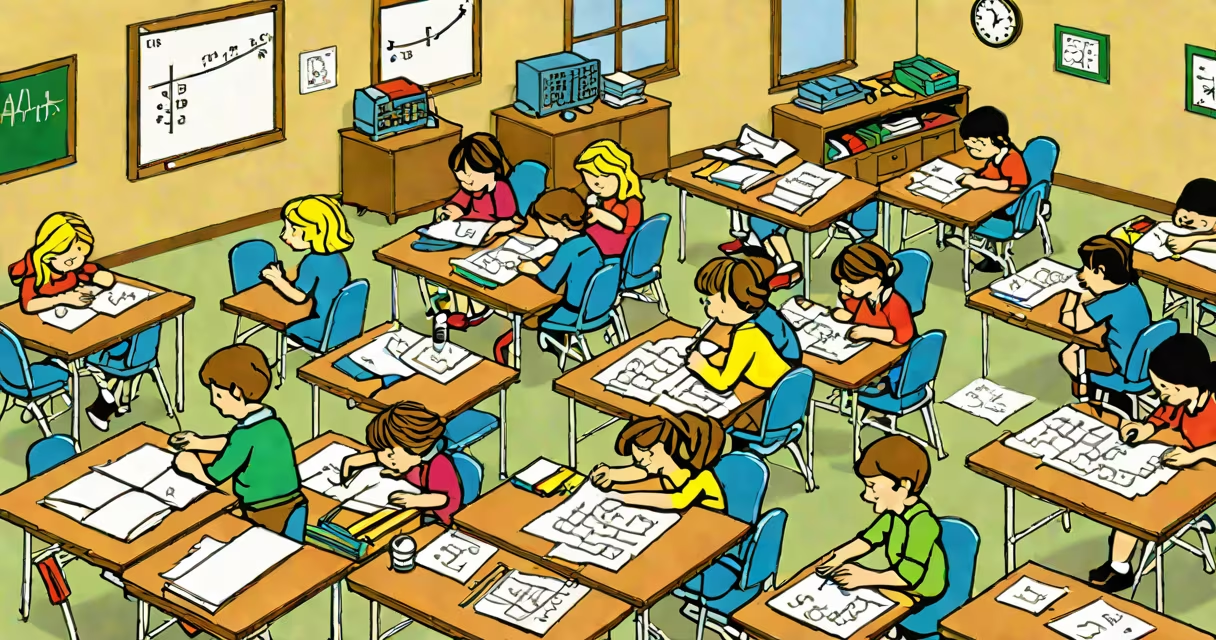
Children in 2nd grade are typically between 7 and 8 years old, entering their second year of formal schooling after kindergarten and 1st grade. This age range reflects standard academic progression in U.S. public schools.
Most students reach 2nd grade age during the calendar year they turn 7, starting in September or August depending on school district cutoff dates. The age window spans from early July birthdays to late June birthdays, meaning a class may include children born in both 2016 and 2017.
By age 7, children develop stronger reading comprehension, basic multiplication concepts, and improved social interaction skills. They begin to understand time, follow multi-step instructions, and manage personal responsibilities like packing backpacks and turning in homework.
At 2nd grade age, students are expected to read fluently at a level appropriate for their grade. They should decode words using phonics, recognize common sight words, and comprehend short stories with clear plots and characters.
Math instruction focuses on addition and subtraction within 100, understanding place value (tens and ones), and solving word problems involving money and measurement. Students learn to tell time to the nearest five minutes and interpret simple bar graphs.
A 2021 study by the National Center for Education Statistics found that 78% of 2nd graders could correctly identify the value of coins and solve basic money problems. This indicates that most children at this age have developed practical numerical reasoning skills.
Children aged 7 to 8 show increased independence. They can dress themselves, manage bathroom routines, and participate in group activities with minimal supervision. Their attention span grows to about 20-25 minutes, allowing them to engage in focused classroom tasks.
Socially, they form friendships based on shared interests rather than proximity. They begin to negotiate roles in games, resolve minor conflicts, and express opinions respectfully. Teachers often observe children volunteering to help peers or take on small leadership roles during group work.
Emotionally, they experience deeper feelings such as pride, embarrassment, and frustration. A child who struggles with a math problem may become tearful, while success in reading aloud can boost confidence. These emotional shifts are normal and part of cognitive growth.
Some parents assume that all 7-year-olds are equally capable academically. Development varies. A child born in January may be nearly a year older than one born in December, affecting maturity, focus, and processing speed.
Another misconception is that 2nd grade age means uniform skill levels. Research from the American Psychological Association shows that children enter 2nd grade with widely differing literacy and numeracy backgrounds. Some have mastered addition facts; others still count on fingers.
There's also confusion around school readiness. A child may be physically mature enough for 2nd grade but lack executive function skills like planning, organizing, or delaying gratification. These abilities develop gradually and are not guaranteed by age alone.
Students at 2nd grade age fall into distinct developmental categories based on academic, emotional, and behavioral patterns. Understanding these types helps educators and families provide targeted support.
| Type | Academic Profile | Behavioral Traits | Support Needs |
|---|---|---|---|
| Accelerated Learner | Reads above grade level, solves complex math problems mentally | Quick to volunteer answers, may interrupt | Enrichment opportunities, advanced materials |
| Typical Progress | Meets standards in reading, math, science | Follows routines, participates in group work | Consistent instruction, positive reinforcement |
| Struggling Student | Needs extra help with decoding, basic arithmetic | Frustrated easily, avoids tasks requiring effort | Small-group tutoring, structured practice |
For example, a student born in October may be among the oldest in the class and perform well in math. Another born in May may be younger and require additional time to process word problems. Both are valid 2nd grade age experiences.
In a typical 2nd grade classroom of 24 students, ages range from 7 years 1 month to 8 years 11 months. One child, born in January 2017, reads chapter books independently and completes math worksheets quickly. Another, born in December 2016, requires repeated modeling to understand subtraction with regrouping.
The teacher uses differentiated instruction. For the faster reader, she assigns a short story analysis task. For the struggling student, she provides manipulatives and one-on-one guidance. Both are at 2nd grade age, but their learning paths differ.
I taught a 2nd grade class in rural Oregon where the age gap between students was noticeable. One boy, born in July, had already memorized multiplication tables. His peer, born in June, still counted on his fingers. Both were in the same grade. The key difference wasn't intelligence-it was timing.
U.S. education standards define 2nd grade age as the period when foundational skills solidify. The Common Core State Standards specify that by the end of 2nd grade, students should be able to fluently add and subtract within 100 and understand fractions as parts of a whole.
According to the U.S. Department of Education, 92% of 2nd graders in public schools meet or exceed state benchmarks in language arts and math. However, achievement gaps persist, especially for students from low-income households or those with limited English proficiency.
These disparities show that age alone doesn't predict success. Access to resources, home environment, and early childhood education play larger roles than chronological age.
2nd grade age refers to children between 7 and 8 years old who are enrolled in their second year of formal schooling. They are developing reading fluency, mastering basic arithmetic, and building social-emotional skills. Not all children progress at the same pace, even within the same age range.
Understanding 2nd grade age helps parents and teachers set realistic expectations and provide tailored support. Recognizing individual differences leads to better outcomes than assuming all children in this age group are alike.