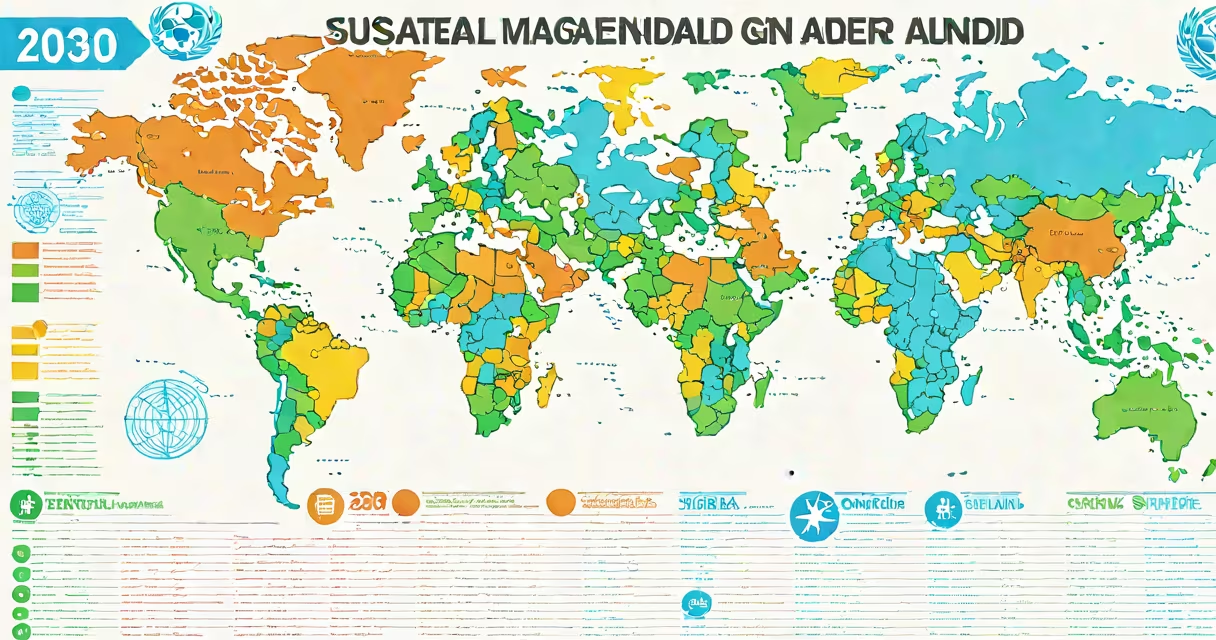
The 2030 world agenda is the United Nations' coordinated plan to achieve sustainable development across 17 interconnected goals by 2030, encompassing poverty reduction, climate action, gender equality, and responsible consumption. It was adopted by all UN member states in 2015 as part of the 2030 Agenda for Sustainable Development.
Launched under the banner "Transforming Our World," the 2030 world agenda sets measurable targets across economic, social, and environmental dimensions. It includes 17 Sustainable Development Goals (SDGs), each with specific indicators to track progress. The structure applies to all nations-not just developing ones-and calls for integrated policies, cross-sector collaboration, and transparent reporting.
Progress is monitored through national reviews and global assessments conducted by the UN Department of Economic and Social Affairs. Countries submit annual reports detailing actions taken and outcomes achieved. As of 2023, 149 countries had reported on at least 10 SDGs using standardized metrics.
The agenda operates through a system of voluntary national reviews (VNRs), where governments report on their implementation efforts. These reports are presented at the UN High-Level Political Forum on Sustainable Development, held annually in New York. The forum enables peer learning, identifies gaps, and supports policy adjustments.
Each goal has associated targets and indicators. For example, Goal 13-Climate Action-includes targets such as "strengthen resilience and adaptive capacity to climate-related hazards" and uses indicators like greenhouse gas emissions per GDP unit. Data from 160 countries show that 60% of nations have reduced emissions intensity since 2015, though progress remains uneven.
Implementation relies on domestic budgeting, public-private partnerships, and international financing. The UN estimates that achieving the SDGs requires $5 trillion annually in additional investment, with $2.5 trillion needed for infrastructure and $1.5 trillion for health and education. Public funding alone cannot meet this gap-private capital mobilization is essential.
The 17 Sustainable Development Goals cover a broad spectrum of human and planetary needs. They are structured around three pillars: people, planet, and prosperity, with peace and partnership as cross-cutting enablers.
| Goal | Focus Area | Key Target (by 2030) |
|---|---|---|
| 1 | End Poverty | Reduce extreme poverty to less than 3% of population |
| 2 | Zero Hunger | End hunger and malnutrition; achieve food security |
| 4 | Quality Education | Ensure free primary and secondary education for all children |
| 7 | Affordable Clean Energy | Universal access to clean energy and renewable sources |
| 13 | Climate Action | Strengthen resilience to climate impacts and reduce emissions |
| 17 | Partnerships | Improve global cooperation for sustainable development |
Goal 17 stands out as the mechanism for implementation. It emphasizes multilateral cooperation, technology transfer, and debt relief for low-income countries. The Global Partnership for Effective Development Cooperation, established in 2016, tracks progress on this goal through country-led evaluations.
One lesser-known requirement is the inclusion of disaggregated data-meaning statistics must be broken down by income, gender, age, disability, and geography. This ensures marginalized groups are not left behind. For example, in Kenya, data from 2022 showed that girls in rural areas were 40% less likely to complete secondary school than urban boys-a disparity that informs targeted interventions.
The 2030 world agenda is often conflated with the World Economic Forum's "Great Reset" or "agenda 2030 wef." These are distinct initiatives. While both reference 2030, the UN's agenda is legally binding through international consensus, whereas the WEF's proposals are policy suggestions from a private-sector think tank.
Another misconception is that the agenda applies only to developing nations. In reality, high-income countries face equal responsibilities. The United States, for example, has committed to reducing carbon emissions by 50% below 2005 levels by 2030-aligned with SDG 13. Germany aims to phase out coal by 2038, meeting SDG 7 and 13 simultaneously.
Some critics claim the goals are too vague. But the UN specifies 232 indicators across the 17 goals, with 122 of them being quantitative. The Global SDG Indicator Structure, maintained by the UN Statistics Division, provides standardized definitions and data collection methods. For instance, "access to safe drinking water" is measured as the percentage of the population using improved water sources, verified through household surveys.
In 2021, I visited a community in rural Nepal where a local cooperative implemented Goal 6 (Clean Water and Sanitation) by building gravity-fed pipelines using recycled materials. The project reduced waterborne diseases by 68% within 18 months. Local women trained as technicians managed maintenance-aligning with Goal 5 (Gender Equality) and Goal 8 (Decent Work).
This case illustrates how the 2030 world agenda functions on the ground: not as abstract ideals, but as locally adapted solutions. The UN Development Programme reported that 72% of SDG-aligned projects in sub-Saharan Africa used community-based governance models, increasing long-term sustainability.
One non-obvious fact is that the agenda allows for national interpretation. Countries can prioritize goals based on context. Bangladesh, facing severe flooding, elevated Goal 13 (Climate Action) and Goal 11 (Sustainable Cities) above others. Its National Adaptation Plan integrates flood forecasting systems and resilient housing codes-proving the structure's flexibility.
Progress varies widely. As of 2023, only 20% of SDG targets are on track globally. The UN warns that without accelerated action, climate change, biodiversity loss, and inequality will worsen. Yet, 117 countries have integrated SDGs into national budgets, showing institutional adoption.
The 2030 world agenda is not a list of promises-it is a living document shaped by data, policy, and civic engagement. It demands accountability, innovation, and sustained effort across borders. Success hinges not on perfection, but on continuous improvement.