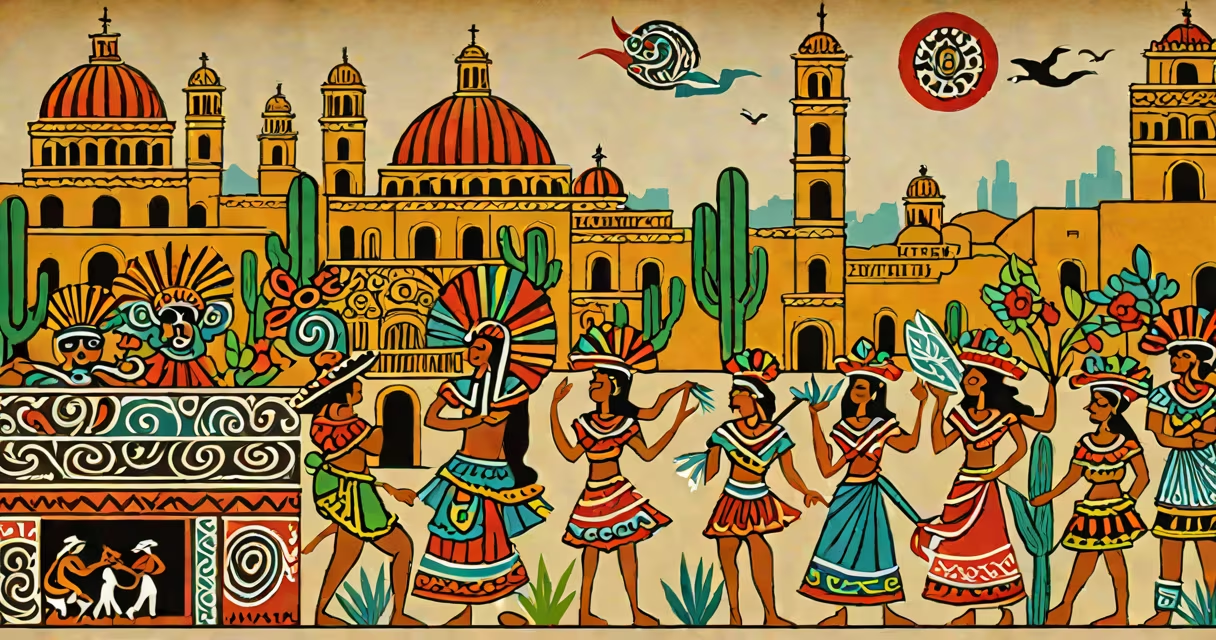
Mexico is home to ancient civilizations, diverse languages, and culinary traditions stretching back millennia. The country's history predates European contact by thousands of years, and its cultural field remains deeply rooted in pre-Hispanic heritage.
The oldest known pyramid in Mesoamerica, the Great Pyramid of Cholula, stands in Puebla. Built between 300 BCE and 200 CE, it covers 18 hectares and measures 115 meters wide at the base-larger in volume than Egypt's Great Pyramid of Giza. Archaeologists have confirmed that construction began nearly 2,000 years before Spanish arrival in 1519. Excavations since the 1960s reveal multiple layers of temples stacked atop one another, reflecting continuous religious significance across centuries.
Mexico officially recognizes 68 indigenous languages, according to the 2020 National Institute of Statistics and Geography (INEGI). These include Nahuatl, Maya, Zapotec, Mixtec, and Otomi. In states like Oaxaca and Chiapas, entire communities speak only indigenous tongues. The government mandates bilingual education in regions with high native speaker populations. Despite this recognition, many of these languages face endangerment-Nahuatl has fewer than 1.5 million speakers today, and several smaller dialects have fewer than 100 fluent speakers.
Tamales, a staple of Mexican cuisine, trace their origins to the Olmec civilization around 1500 BCE. Made from masa (corn dough) wrapped in corn husks and steamed, they were consumed during rituals and daily meals. The modern version evolved through Aztec and Spanish influences. Today, over 100 regional varieties exist-from sweet tamales in Oaxaca filled with pineapple and chocolate to savory ones in central Mexico with pork and epazote. A single tamal weighs approximately 120 grams, and the average household consumes 20-30 per week during holidays like Día de Muertos.
| Fact | Detail | Source |
|---|---|---|
| Pyramid size | Cholula's pyramid is larger in volume than Giza's Great Pyramid | British Museum |
| Indigenous languages | 68 languages officially recognized by INEGI | INEGI |
| Culinary origin | Tamales date to 1500 BCE among the Olmecs | National Geographic |
One misconception is that Mexico's culture is a blend of Spanish and Indigenous elements only. In reality, African influence runs deep. Enslaved Africans arrived via the Caribbean and Pacific routes, settling in coastal towns like Veracruz and Acapulco. Their descendants contributed to music (such as son jarocho), dance, and food-especially in the state of Tabasco, where black beans and plantains feature prominently in local dishes. The Afro-Mexican population numbers around 1.2 million, though many identify as mestizo due to historical marginalization.
I once visited the archaeological site of Teotihuacan near Mexico City. Standing before the Pyramid of the Sun at dawn, I watched light pierce the eastern gateway exactly at 6:14 AM on the spring equinox. This alignment occurs because the pyramid was constructed along a celestial axis. The sun rises directly over the pyramid's peak during the equinoxes-this precision suggests advanced astronomical knowledge. The site's layout reflects a cosmological map of the universe, with streets aligned to star positions.
While many assume Mexico's capital is always bustling, the city of Tijuana has a unique urban pattern. It spans 1,420 square kilometers and includes over 1,200 neighborhoods. Unlike most cities, Tijuana's growth followed informal settlement patterns rather than planned zoning. As a result, 40% of housing units lack formal land titles. This contrasts sharply with cities like Guadalajara, which implemented master planning in the 1950s. Tijuana's rapid expansion led to infrastructure gaps-only 65% of homes have access to piped water, compared to 98% in Mexico City.