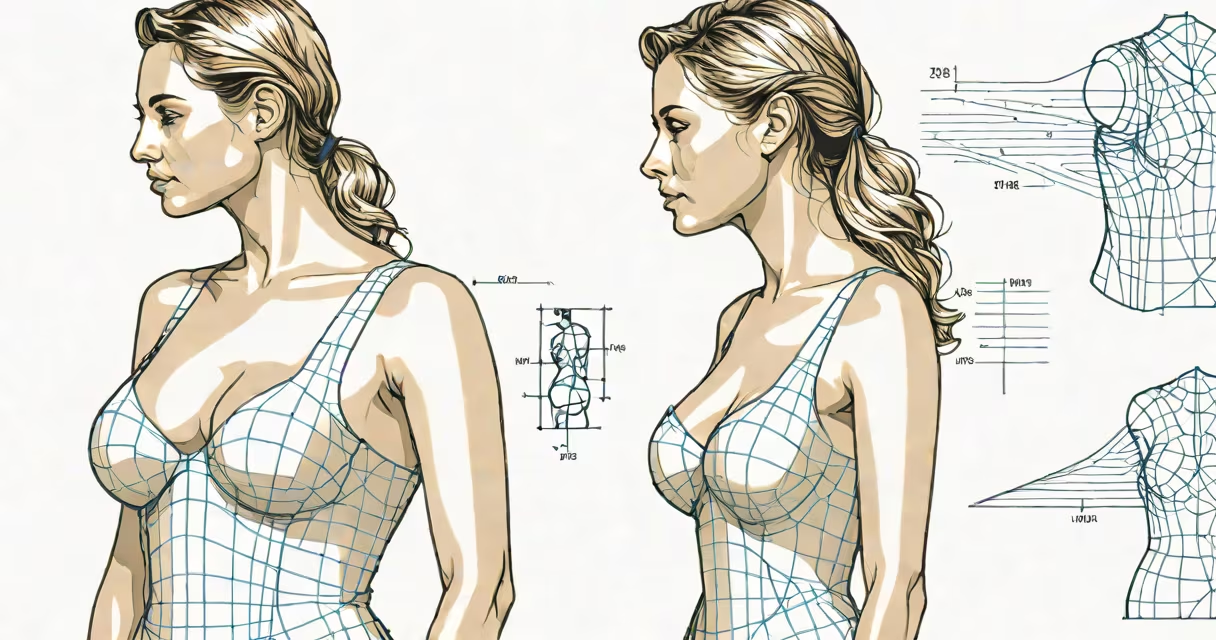
32 D breasts describe a specific bra size: a 32-inch band measurement and a D cup, indicating moderate to full bust volume. This size is common among women with a defined chest contour and often influences clothing fit and style choices.
Bra sizing combines two numbers: the band size (measured around the ribcage just below the bust) and the cup size (measured from the base of the bust to the fullest part). A 32 D means the band fits snugly at 32 inches, while the cup holds approximately 3 inches of additional volume beyond the band measurement. The D cup represents a significant increase in volume compared to smaller cups, such as B or C.
The International Bra Size System uses inches to define cup sizes. For every inch of difference between the bust and band measurement, the cup increases by one letter. A 32-inch band with a 38-inch bust creates a 6-inch difference, which corresponds to a D cup. This system applies globally, though some brands adjust slightly due to manufacturing standards.
To find your correct bra size, measure your underbust (just below the breasts) and your bust (around the fullest part). Subtract the underbust measurement from the bust measurement. The result determines the cup size: 1 inch = A, 2 inches = B, 3 inches = C, 4 inches = D, 5 inches = DD, and so on. For a 32 D, the bust must be 38 inches.
Band sizes are based on the underbust measurement. If the underbust measures 32 inches, the band size is 32. Some brands offer extended sizing, such as 32DD or 34D, which maintain similar volume but adjust the band width. This variation allows for better fit across different body shapes.
Not all countries use the same sizing system. The U.S. and UK use numerical band sizes and letters for cups. Europe uses a single number (e.g., 32D becomes 75D), while Japan uses centimeters. A 32 D in the U.S. converts to 75D in Europe, meaning the same physical dimensions but different labeling.
Many assume that 32 D equates to large or prominent breasts. However, the 32 D is considered a moderate-to-full size. It falls within the range of average to above-average bust size for adult women in Western populations. According to the National Health and Nutrition Examination Survey (NHANES), the average bra size for U.S. women aged 20-39 is 34C, making 32 D slightly smaller than average.
Another misconception is that larger cup sizes always require special support. While higher cups may need more structure, a 32 D can still benefit from well-fitted bras with wide straps and reinforced bands. Ill-fitting bras lead to discomfort, poor posture, and long-term strain on the shoulders and spine.
Personal experience confirms this: during a fitting session at a specialty store, a client with a 32 D measurement reported years of back pain until switching to a properly sized bra with a wider band and molded cups. Her pain reduced within weeks. This illustrates that size alone doesn't determine comfort-fit does.
Different bra styles affect how 32 D breasts appear. Full-coverage bras provide lift and separation, ideal for structured tops. Wireless bras offer comfort but less shaping. Push-up bras improve cleavage and create a more rounded silhouette. T-shirt bras minimize visible lines under thin fabrics.
For example, a 32 D woman wearing a standard cotton T-shirt bra may have visible bra lines if the fabric is tight. A smooth, wireless version reduces this issue. A balconette bra lifts and shapes the bust, creating a more defined upper chest. These differences show that the same physical measurement can look and feel different depending on the garment.
| Bras Type | Best For | Impact on 32 D Shape |
|---|---|---|
| T-shirt bra | Under clothing, everyday wear | Smooth, minimal shaping |
| Push-up bra | Cleavage, evening wear | Enhances volume and centering |
| Full-coverage bra | Support, modesty | Reduces side bulge, lifts |
| Wireless bra | Comfort, sensitivity | Limited shaping, softer feel |
Some women with 32 D breasts report difficulty finding clothes that fit. Tops with narrow necklines or tight waistbands may ride up or gap at the bust. Tailored garments with adjustable features-such as buttoned fronts or stretch panels-improve fit. Brands like Eileen Fisher and Uniqlo offer inclusive sizing with attention to bust proportion.
Size labels like 32 D don't account for body shape, posture, or movement. Two women with identical measurements can have vastly different experiences. One may have a high, round bust; another may have a low, wide one. These differences affect how bras and clothes sit.
A key insight: cup size is not a direct measure of volume. A 32 D has less volume than a 34 D, even though both are labeled D. The band size changes the capacity. A 34 D holds about 10% more volume than a 32 D due to the larger band circumference. This explains why some women with 32 D breasts still struggle to find supportive bras-they need the right combination of band width and cup depth.
According to the American Academy of Orthopaedic Surgeons, poorly fitting bras contribute to shoulder and back pain in 60% of women who wear them daily. Proper fit prevents strain and improves posture. The Academy recommends annual bra fittings, especially after weight changes or pregnancy.
Understanding your size involves knowing how it compares to others. The 32 D is not rare-it's one of the most frequently ordered sizes in online retail. In 2022, a survey by the lingerie brand Elomi found that 32 D was the third most requested size in the U.S., behind 34B and 36C.
32 D breasts represent a standard body dimension with practical implications for clothing, health, and confidence. Knowing your size is only the start. Finding the right fit ensures comfort, support, and appearance that aligns with your lifestyle.