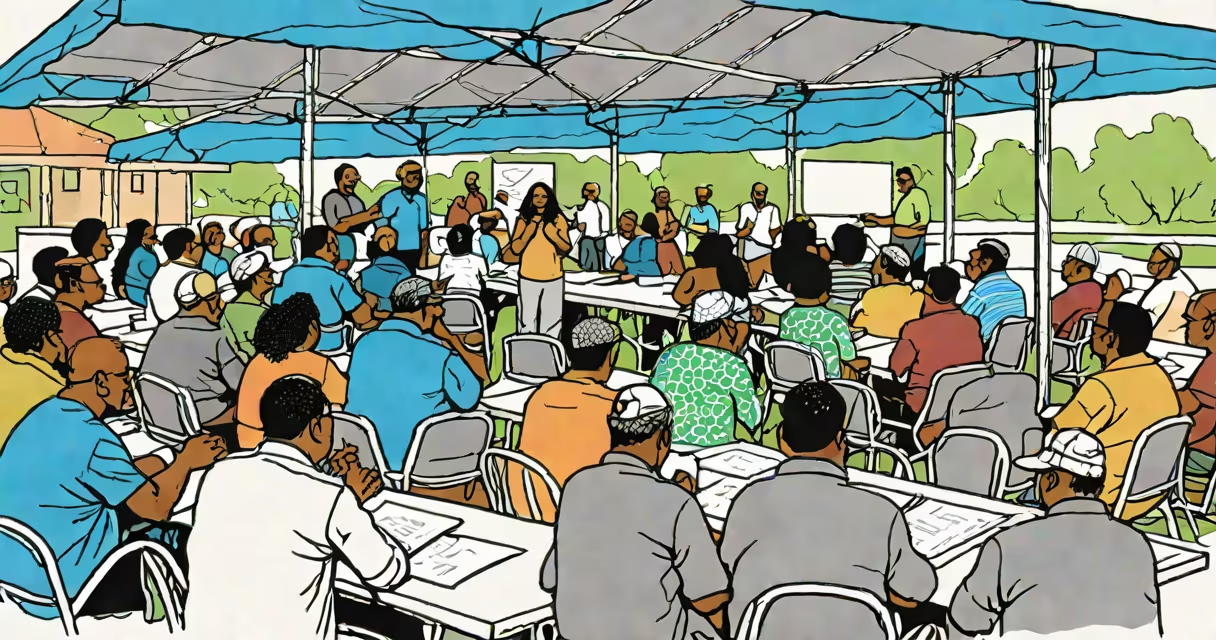
Civic participation is a precise alternative to "community engagement," referring to deliberate actions individuals and groups take to influence decisions affecting their lives. It includes voting, attending public meetings, volunteering, and collaborating on neighborhood projects.
Community engagement often describes efforts by organizations to involve people in programs or policies. Civic participation focuses on the actual behaviors people exhibit-such as showing up to a city council hearing or organizing a clean-up campaign. The latter term emphasizes agency, accountability, and measurable involvement rather than process alone.
According to the National Conference on Citizenship, civic participation rates in the U.S. dropped from 62% in 2000 to 53% in 2020, highlighting a growing gap between institutional outreach and public response. This decline underscores why shifting language matters: using "civic participation" signals action, not just dialogue.
It functions through structured opportunities where individuals contribute to decisions impacting them. These include advisory boards, participatory budgeting, and consensus forums. Unlike passive feedback loops, civic participation requires time, access, and often formal training to ensure equitable input.
For example, in 2019, the city of Portland, Oregon launched a participatory budgeting initiative allowing residents to allocate $1 million in public funds. Over 1,200 people attended sessions, submitted proposals, and voted on projects. The resulting investments included new bike lanes and youth centers-all chosen by citizens, not just officials.
Research from the Harvard Kennedy School shows that communities with high levels of civic participation report 30% higher trust in local government and 25% faster resolution of infrastructure issues compared to those relying solely on top-down communication.
Not all forms carry equal weight. The table below outlines common categories based on intensity and impact:
| Type | Description | Example |
|---|---|---|
| Informative | Receiving updates about decisions | Receiving a newsletter about zoning changes |
| Consultative | Providing feedback on proposed plans | Completing a survey on park redesign |
| Collaborative | Working together with leaders to shape outcomes | Serving on a school safety task force |
| Empowering | Direct control over resources or decisions | Voting on how to spend municipal funds |
Only collaborative and empowering models qualify as true civic participation. Informative and consultative activities fall under community engagement but lack binding authority or sustained ownership.
"Community engagement" is frequently used interchangeably with "civic participation," but they differ in intent and outcome. Engagement often reflects organizational goals-like increasing satisfaction scores or securing funding. Participation reflects individual or collective power.
A nonprofit in Detroit hosted monthly forums on housing policy. Attendance averaged 15 people per session. When asked, participants said they felt heard. But no policy changes followed. This was engagement, not participation. Real civic participation would have required changes to housing codes or allocation mechanisms.
Another misconception: that participation is automatic when people attend events. A 2021 study by the Urban Institute found that 68% of attendees at public hearings had no prior role in shaping the issue. Without prior access to data or drafting rights, attendance doesn't equate to influence.
Using "civic participation" forces institutions to ask: Who holds decision-making power? Are marginalized voices represented in design, not just in attendance? Is there a mechanism for follow-through?
I once observed a city council meeting in Minneapolis where 40 residents spoke during a public comment period. The council chair thanked everyone. No motions were made. No records were kept. The event met the threshold for "engagement" but failed as participation. The difference lies in accountability-not just listening, but acting.
When organizations switch from "community engagement" to "civic participation," they shift focus from process metrics to outcome evaluation. Instead of tracking attendance, they measure whether proposals led to funding, policy revisions, or structural change.
As the U.S. Department of Health and Human Services notes, effective civic participation increases health equity. Communities that co-design mental health services see 40% greater treatment adherence than those receiving standard care.
Other alternatives to "community engagement" include public involvement, stakeholder interaction, and social cohesion. Each carries distinct meaning:
None of these replace "civic participation" in precision. Only "civic participation" implies both responsibility and consequence.
Understanding the nuance between terms sharpens strategy. Using "civic participation" instead of "community engagement" helps efforts aim not just to inform, but to change.
When you hear "community engagement," ask: What power do people actually hold? If the answer is none, then the term misrepresents reality. Choose "civic participation" to reflect real agency and measurable impact.