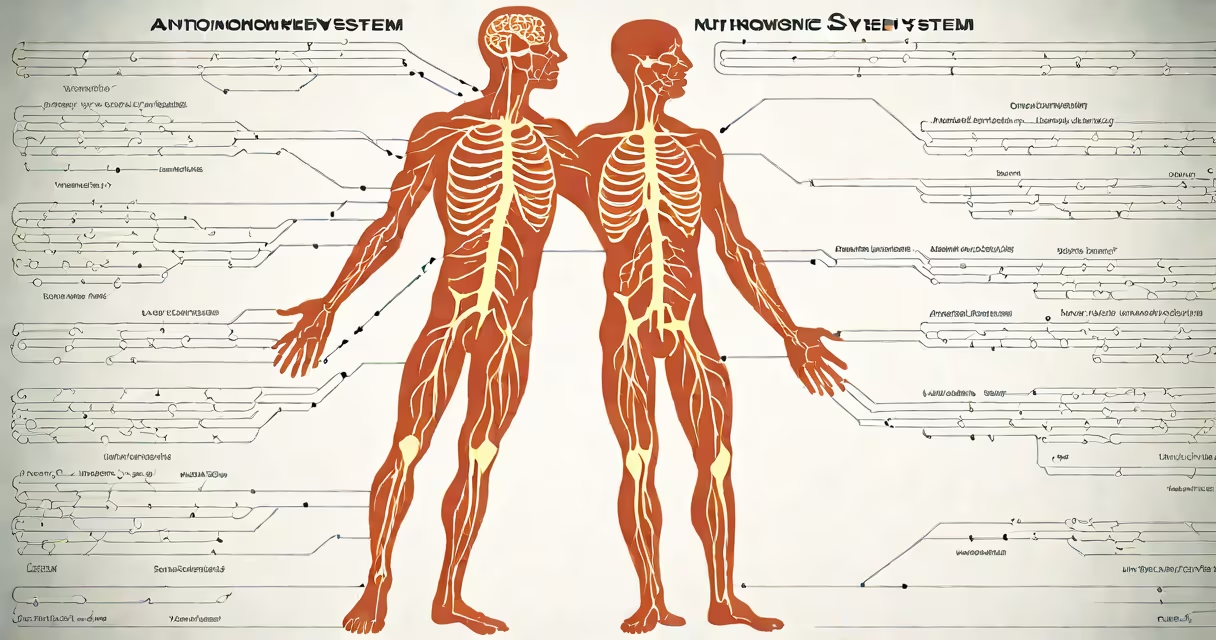
The autonomic nervous system (ANS) is a division of the peripheral nervous system responsible for regulating involuntary physiological processes such as heart rate, blood pressure, respiration, digestion, and glandular secretion. It operates without conscious effort and maintains internal stability through continuous feedback loops.
Part of the central nervous system's broader communication network, the ANS integrates signals from internal organs and adjusts responses automatically. It functions independently of voluntary control, ensuring survival-critical processes continue even during sleep or unconsciousness. The system divides into two primary branches: sympathetic and parasympathetic, which often oppose each other to fine-tune organ activity.
For example, when a person encounters danger, the sympathetic branch triggers the "fight-or-flight" response-increasing heart rate, dilating pupils, and redirecting blood flow to muscles. Conversely, during rest, the parasympathetic branch activates "rest-and-digest" functions-slowing the heart, stimulating digestion, and promoting energy conservation. These opposing actions allow precise modulation of bodily states based on environmental demands.
The ANS operates via reflex arcs that bypass conscious awareness. Sensory receptors in organs detect changes-such as low blood pressure or rising glucose levels-and send signals to the brainstem or spinal cord. Integration centers then dispatch motor commands through autonomic nerves to effector organs like the heart, lungs, and digestive tract.
These signals travel through two-neuron chains: a preganglionic neuron originating in the central nervous system and a postganglionic neuron located near or within the target organ. This arrangement allows for centralized control and localized adjustments. For instance, the vagus nerve-a major parasympathetic pathway-innervates the heart and slows its rate by releasing acetylcholine at synapses.
A key feature is homeostasis: the ANS constantly monitors and corrects deviations from normal ranges. When blood sugar drops, the sympathetic system stimulates adrenaline release, prompting the liver to release stored glucose. Once levels normalize, the parasympathetic system dampens the response. This changing equilibrium prevents extreme fluctuations that could disrupt cellular function.
The ANS consists of three functional divisions: sympathetic, parasympathetic, and enteric. While the first two are central to systemic regulation, the enteric nervous system acts as a local control layer for the gastrointestinal tract.
| Branch | Primary Function | Key Neurotransmitters | Effect on Organs |
|---|---|---|---|
| Sympathetic | Prepares body for stress or emergency | Norepinephrine, epinephrine | Increases heart rate, dilates airways, inhibits digestion |
| Parasympathetic | Supports rest, recovery, and digestion | Acetylcholine | Slows heart rate, constricts pupils, stimulates gut motility |
| Enteric | Manages gastrointestinal function locally | Multiple (serotonin, dopamine, nitric oxide) | Regulates secretion, blood flow, and peristalsis in the gut |
The enteric nervous system is notable because it can operate independently of the brain and spinal cord. It contains over 100 million neurons-more than the spinal cord-and uses many of the same neurotransmitters found in the brain. This allows the gut to respond rapidly to food presence, such as triggering contractions to move contents along the intestines without input from higher centers.
Despite common belief, the ANS does not act uniformly across all tissues. Some organs receive dual innervation (e.g., the heart receives both sympathetic and parasympathetic fibers), while others rely on a single branch. The adrenal medulla, for instance, is solely under sympathetic control and releases epinephrine directly into the bloodstream during stress.
Many assume the autonomic nervous system is purely automatic or unchanging. In reality, it adapts over time. Chronic stress can lead to sustained sympathetic activation, contributing to hypertension, insulin resistance, and increased risk of cardiovascular disease. Research from the American Heart Association confirms that prolonged ANS imbalance correlates with higher mortality rates in patients with heart failure.
Another misconception is that the ANS governs emotions. While it influences physical symptoms of emotion-like sweating or rapid heartbeat-it does not generate emotional states. The limbic system, particularly the amygdala and hypothalamus, regulates emotional experience. The ANS responds to those signals rather than initiating them.
A less obvious point: the ANS is not entirely autonomous. Certain practices like mindfulness meditation and biofeedback have been shown to influence ANS activity. A 2021 study published in *Frontiers in Human Neuroscience* demonstrated that participants who practiced daily breath-focused meditation exhibited measurable increases in parasympathetic tone, measured via heart rate variability (HRV).
Understanding the autonomic nervous system definition is essential in diagnosing and treating conditions involving dysregulation. Autonomic neuropathy-damage to autonomic nerves-can result from diabetes, Parkinson's disease, or autoimmune disorders. Symptoms include orthostatic hypotension (dizziness upon standing), gastrointestinal issues, and abnormal sweating patterns.
For example, a 62-year-old patient with type 2 diabetes developed frequent dizziness when rising from a seated position. Blood pressure dropped from 130/80 mmHg to 90/60 mmHg within 30 seconds. Further testing revealed reduced HRV and impaired baroreflex sensitivity-hallmarks of autonomic dysfunction. Treatment focused on increasing fluid intake, compression stockings, and medications to stabilize blood pressure.
Neurologists use tools like tilt-table testing and quantitative sudomotor axon reflex testing to assess ANS function. These tests measure how quickly the body adjusts heart rate and blood pressure in response to stimuli, offering objective data on autonomic integrity.
When comparing the autonomic nervous system definition to other systems, it differs fundamentally from the somatic nervous system, which controls voluntary movements. The somatic system uses a single neuron, whereas the ANS uses a two-neuron chain. This structural difference supports the ANS's role in modulating internal environments rather than executing deliberate actions.
Unlike a computer system definition, which relies on programmed logic and binary inputs, the ANS operates through analog signaling and continuous feedback. Its responses are graded-not all-or-nothing-allowing subtle adjustments. Similarly, economic system definition focuses on resource allocation and decision-making structures, while the ANS manages biological stability through real-time physiological monitoring.
I once observed a patient undergoing a tilt test in a neurology clinic. As the table tilted upright, her heart rate spiked beats per minute within 15 seconds. Her skin turned pale and she reported lightheadedness. The test confirmed a significant drop in blood pressure due to inadequate sympathetic compensation-diagnosed as vasovagal syncope. This case illustrated how the autonomic nervous system definition explains real-time physiological breakdowns.
Recognizing the autonomic nervous system definition helps clarify how the body sustains life without conscious effort. It underpins health maintenance, illness detection, and treatment planning across multiple medical fields. Understanding its mechanisms enables better management of chronic diseases and improved outcomes in neurological and cardiac care.