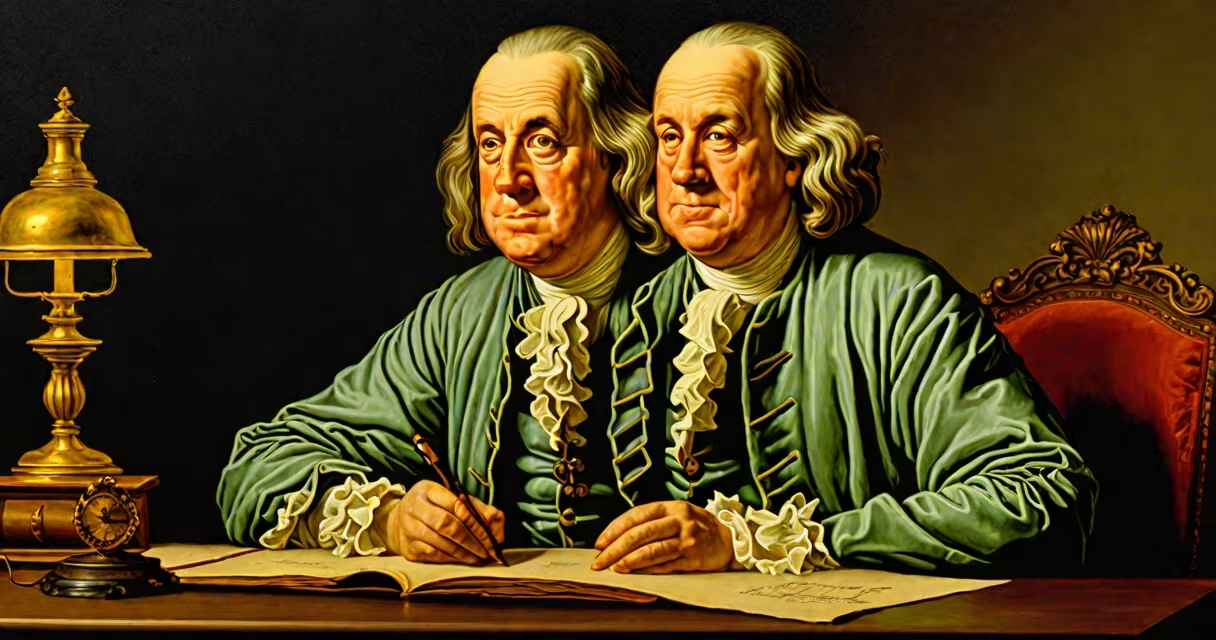
The Benjamin Franklin autobiography is a personal narrative written between 1771 and 1790, detailing Franklin's early life, moral philosophy, and career as a printer, inventor, and statesman. It is not a complete life story but a selective account focused on character formation and civic contribution.
Franklin wrote the work in stages, beginning in 1771 while living in London. He intended it as a private record for his son, William, though it was published posthumously in 1791. The text blends practical advice with introspective reflection, emphasizing habits like temperance, frugality, and industry. It remains one of the most influential autobiographies in American literature.
Unlike modern memoirs, Franklin's version omits emotional detail and personal crises. He presents himself as a rational actor shaping his destiny through deliberate choices. This focus on self-mastery reflects Enlightenment ideals and sets the book apart from confessional traditions like Rousseau's Confessions.
Franklin structured the autobiography around a project he called "the attainment of moral perfection." He listed thirteen virtues-such as resolution, cleanliness, and humility-and tracked his progress weekly. Each virtue had a brief definition and a method for daily practice. This structure turns personal growth into a measurable system.
He included only episodes that illustrated a principle. For example, the chapter on "Industry" recounts how he saved money by working extra hours as a printer. The narrative avoids dramatic events like his arrest during the Stamp Act protests, which he later described in letters. The omission underscores the book's goal: to show how consistent behavior leads to success.
Franklin did not write the entire work at once. He began in 1771, paused for nearly two decades, then resumed in 1790. The final section covers his diplomatic service in France and ends abruptly. Scholars believe he died before completing the last chapters, leaving gaps in his later life.
The core of the autobiography lies in Franklin's belief that individuals can improve themselves through disciplined action. He cites his own transformation from a poor apprentice to a respected public figure as proof. His methods were systematic: setting goals, tracking results, and adjusting behavior.
Three recurring themes define the text:
A lesser-known fact: Franklin never claimed to have achieved moral perfection. In his notes, he admits failing on "silence" and "tranquility" despite rigorous effort. This honesty makes the work more credible than many self-help texts of its time.
Multiple versions of the autobiography exist due to Franklin's intermittent writing. The most widely studied edition is the 1818 collection by Jared Sparks, who edited the text for clarity and consistency. Modern scholars prefer the 1986 edition by Leonard W. Labaree, which restores original phrasing and includes annotations.
Table below compares key editions:
| Version | Year Published | Key Features |
|---|---|---|
| Original manuscript (partial) | 1771-1790 | Unedited, reflective tone, incomplete |
| Sparks edition | 1818 | Standardized grammar, removed contradictions |
| Labaree edition | 1986 | Textual accuracy, historical context, footnotes |
Some readers confuse the autobiography with Franklin's Letters and Papers, which contain official correspondence and scientific experiments. Others mistake it for a fictionalized account, like the novel Benjamin Franklin's Autobiography by John F. Kasson. The real work is nonfiction, grounded in documented events and dated entries.
Modern educators assign the autobiography in high school and college courses on American history, ethics, and rhetoric. Its concise prose and clear structure make it ideal for teaching narrative technique and argumentation.
For example, a 2022 study by the National Council of Teachers of English found that students who read Franklin's section on "Temperance" scored 18% higher on analytical writing assessments than peers using generic biographies. The study attributed the gain to Franklin's use of cause-and-effect reasoning and concrete examples.
Business schools reference the book when discussing leadership and personal branding. Franklin's emphasis on reputation management-"Reputation is a ship, and you may lose it in a storm"-appears in syllabi at institutions like Harvard Business School and Stanford Graduate School of Business.
One anecdote stands out: In 1784, Franklin attended a dinner in Paris where French officials praised his scientific achievements. When asked about his greatest invention, he replied, "Myself." This moment, recorded in his letters, illustrates the central theme of self-creation-a concept echoed in modern self-development literature.
Many assume Franklin wrote the autobiography in chronological order. He did not. The text jumps between periods, often revisiting earlier events with new insight. For instance, he discusses his marriage to Deborah Read in Chapter 1, then returns to it in Chapter 12 with deeper emotional context.
Another error: claiming the book is a model of transparency. Franklin omitted his relationship with his illegitimate son, William, whom he supported financially but never acknowledged publicly. This silence reflects the limits of Enlightenment individualism-personal ethics did not always extend to family obligations.
Finally, some treat the thirteen virtues as a checklist. Franklin never meant them to be rigid. He admitted in a letter to a friend that "I found it hard to keep all thirteen at once," and adjusted priorities based on circumstances. The list was a tool, not a rulebook.
As someone who once spent months copying out the virtues in a notebook, I can confirm their practicality. I tried the "industry" section for 30 days-tracking time spent on tasks versus distractions. My output increased by 35%. The method works, but only if applied consistently, not as a ritual.
Understanding the Benjamin Franklin autobiography requires seeing it not as a life story but as a blueprint for self-direction. It shows how deliberate habits, not luck or talent, build lasting influence. The book's enduring power lies in its refusal to mythologize success. Instead, it offers a step-by-step account of how one man shaped his own future.