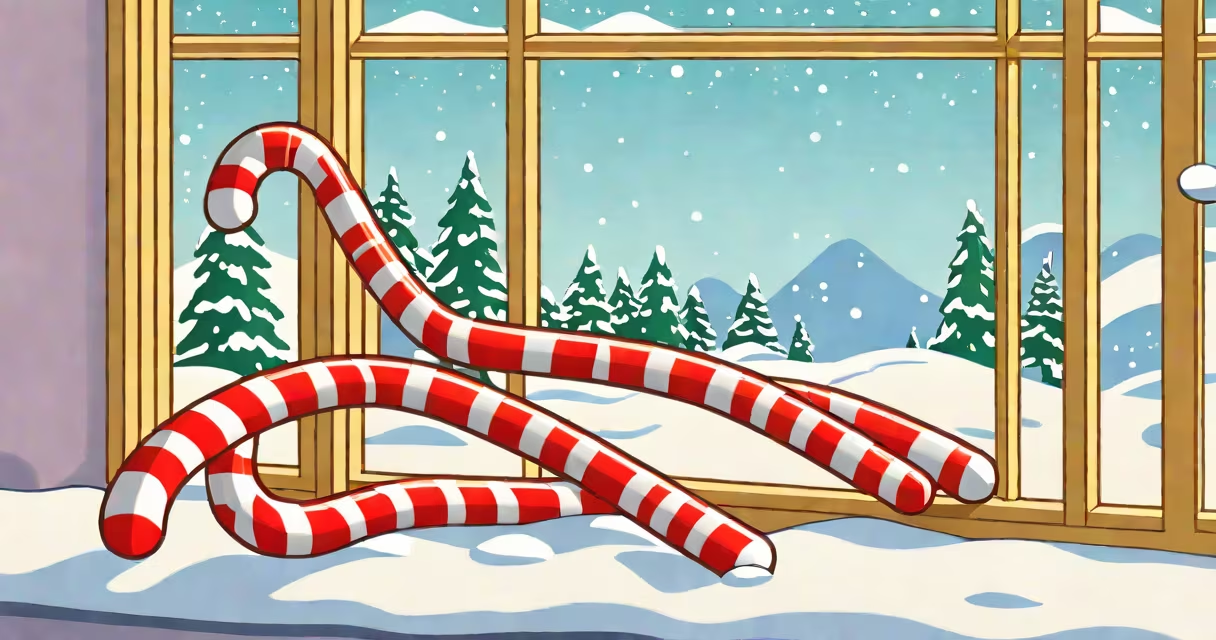
A candy cane joke is a short, festive pun or wordplay centered on the candy's iconic red-and-white stripes, curved shape, or association with Christmas. These jokes rely on double meanings, homophones, or visual metaphors common in holiday humor.
Candy cane jokes typically appear in greeting cards, social media posts, or casual conversation during December. They're designed to be quick, shareable, and mildly absurd-often ending with a twist based on the candy's form or name. The humor stems from unexpected connections between the candy's appearance and everyday language.
For example: "Why did the candy cane go to therapy? It had deep emotional stripes." This joke plays on the visual pattern of the candy and the phrase "deep emotional issues," turning the red and white lines into psychological metaphors. The punchline hinges on the dual meaning of "stripes" as both physical design and metaphorical emotional layers.
These jokes function through linguistic ambiguity. The candy's shape-a hooked, bent stick-invites comparisons to objects like a shepherd's crook, a question mark, or even a musical staff. Its color scheme suggests winter themes: snow, blood, or candy cane-shaped reindeer.
Wordplay often targets the name "candy cane." "Cane" sounds like "can't," leading to puns such as "I can't believe it's not butter... but it is candy cane!" The joke relies on mishearing "candy cane" as "can't" and twisting it into a dairy parody.
Another common structure uses the candy's physical properties. A joke like "I asked my friend if he wanted a candy cane. He said, 'No thanks-I'm already sweet.'" plays on the idea of sweetness as both taste and personality trait. The humor arises from the unexpected refusal rooted in self-awareness.
While all candy cane jokes center on the candy's features, they fall into distinct categories based on their mechanism:
| Type | Mechanism | Example |
|---|---|---|
| Visual pun | Uses the candy's red-and-white stripes or curve | "I'm not saying I'm a candy cane, but I've got a lot of stripes." |
| Sound-alike | Relies on homophones or similar-sounding words | "Why did the candy cane break up with the peppermint? It couldn't handle the minty relationship." |
| Double meaning | Exploits a word with multiple interpretations | "I'm not a fan of candy canes-they're too hard to chew." "That's because you're not using your teeth." |
Visual puns dominate holiday-themed content. They're easy to illustrate and widely understood. Sound-alike jokes require familiarity with phonetic tricks, making them more niche. Double meaning jokes often involve irony or sarcasm, which can be harder to convey in text without tone cues.
Candy cane jokes appear most frequently in December, especially around Christmas Eve, New Year's Eve, and winter parties. They serve as low-stakes icebreakers, helping people bond through shared laughter.
They're common in retail settings. Stores like Target and Walmart feature them on gift tags, wrapping paper, and in-store signage. For example, a display of candy canes labeled "This one's for you-don't be a grinch!" uses a candy cane joke to soften the sales message.
On social media, platforms like Instagram and TikTok host short video skits where someone pretends to be a candy cane, delivering a punchline like "I'm not a candy cane-I'm a candy cane-shaped person." These formats thrive on visual exaggeration and timing.
Many assume candy cane jokes are only for children. That's incorrect. While kids enjoy them, adults use them in professional settings-like office holiday parties-to ease tension and maintain morale.
Another misconception is that all candy cane jokes are religious. The candy itself has Christian origins-linked to the shepherds' crook and the cross-but the jokes rarely reference faith. Most focus on food, shape, or seasonal mood.
There's also confusion about the origin of the candy cane. Some believe it was invented in the 1800s as a religious symbol. According to the National Confectioners Association, the modern candy cane was mass-produced in the 1920s. The joke culture around it developed later, in the 1970s and 1980s, as part of broader holiday commercialization.
Consider this joke: "I told my friend I'd give him a candy cane if he could solve the riddle: Why do candy canes never get lost? Because they always follow the red and white path."
The setup presents a riddle, a familiar format in humor. The punchline hinges on "red and white path"-a literal description of the candy's stripes. But "path" implies direction or guidance, suggesting the candy knows where it's going.
Here's the logic breakdown: The candy's stripes are visually distinct. The word "path" evokes movement and purpose. By combining these, the joke implies the candy has intentionality. It's a playful anthropomorphism-giving the candy human-like decision-making.
This joke works because it subverts expectation. People expect riddles to have clever or obscure answers. Instead, the solution is literally the candy's appearance. The humor lies in the simplicity and the visual pun.
I once hosted a holiday party where guests were given candy canes with joke tags. One read: "I'm not a candy cane-I'm a candy cane-shaped person who's tired of being compared to a cookie." The group laughed, then started inventing their own. Within 15 minutes, we had a rotating list of new jokes. The activity broke the ice better than any formal introduction.
People often confuse a candy cane joke with the deeper symbolic meaning of the candy. The candy cane's red and white stripes represent Christ's blood and purity. The crook shape references the shepherd's staff. These meanings are theological and historical.
A candy cane joke, however, ignores those roots. It treats the candy as a fun object, not a religious icon. The humor is secular, playful, and intentionally trivial. Confusing the two leads to misinterpretation-especially in mixed-religion environments.
Understanding this difference prevents accidental offense. A joke like "I'm not a candy cane-I'm a sinner with a red stripe" might amuse some but alienate others. Context matters.
A candy cane joke is a brief, culturally embedded form of humor that uses the candy's form and name to create surprise. It thrives on simplicity, repetition, and visual recognition. When used appropriately, it adds levity to seasonal gatherings.