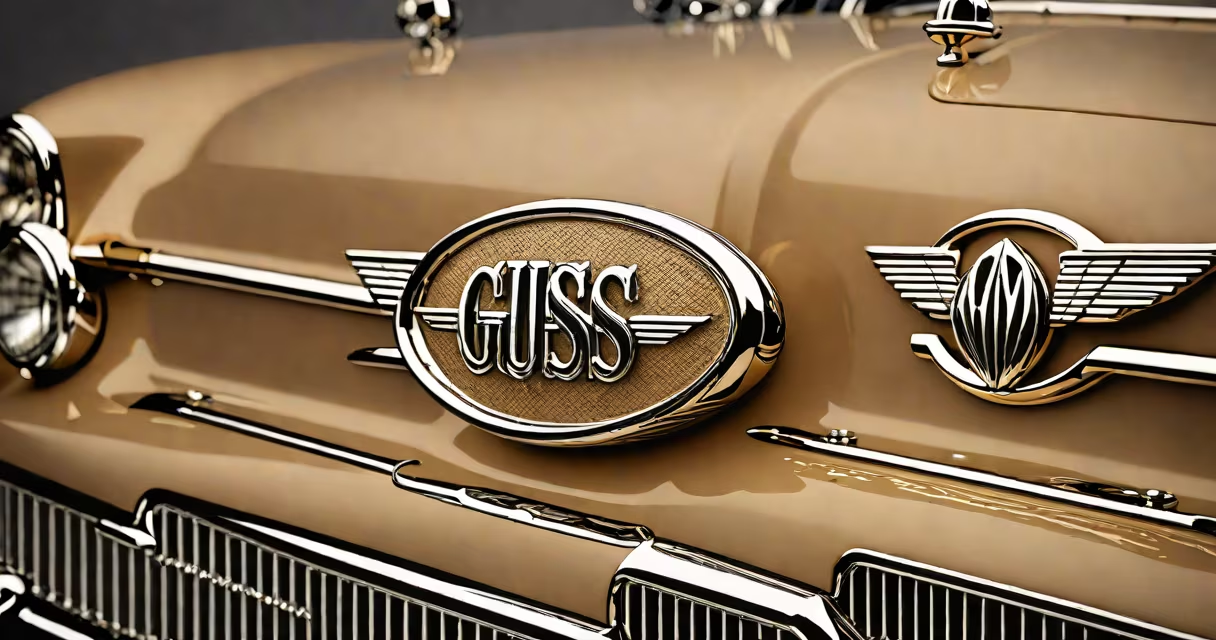
Car logo guess is the act of identifying a vehicle manufacturer based solely on its emblem or logo design. It relies on visual recognition of stylized symbols, typography, and color schemes unique to each brand. This skill is used in quizzes, educational games, and real-world identification tasks.
Most car logos consist of a combination of shapes, letters, and symbolic elements. For example, the Porsche logo features a black shield with a horse and the word "Porsche" in bold serif font. The Mercedes-Benz logo is a three-pointed star enclosed in a circle, representing land, sea, and air transportation. These designs are standardized globally and appear on vehicles, marketing materials, and official documentation.
Identifying a car logo correctly requires attention to specific details. A common mistake is confusing the Audi four-ring symbol with the Volkswagen logo. Audi's rings represent the merger of four companies-Audi, DKW, Horch, and Wanderer-while Volkswagen's logo is a single black "V" inside a circle. Misidentifying them leads to incorrect conclusions about the brand's origin and history.
Car logo guess functions through pattern recognition. The human brain processes visual cues such as symmetry, color contrast, and shape repetition to match an unknown logo with known brands. This process happens rapidly-often within 1-2 seconds-once the viewer has seen enough examples.
Online platforms use this mechanism to create interactive challenges. Users are shown a blurred or cropped version of a logo and asked to name the brand. Correct answers earn points; incorrect ones prompt a reveal with context. These systems often include time limits to increase difficulty and engagement.
A study by the University of California, San Diego, found that people can accurately identify 85% of well-known car logos after viewing them for just 3 seconds. The accuracy drops to 42% for lesser-known brands, highlighting the role of familiarity in visual recognition.
Car logos fall into three primary categories based on their design language: monograms, pictorial marks, and abstract symbols.
| Type | Examples | Key Features | Recognition Difficulty |
|---|---|---|---|
| Monogram | Ferrari, Lamborghini, Alfa Romeo | Letter-based design; often stylized or cursive | Medium (requires familiarity with letterforms) |
| Pictorial Mark | Bentley, Jaguar, Mini | Includes animals, shields, or figurative images | High (iconic imagery aids recall) |
| Abstract Symbol | BMW, Mercedes-Benz, Tesla | Geometric shapes; minimalism; often color-coded | Low (high visual distinctiveness) |
The BMW logo is a prime example of an abstract symbol. Its blue-and-white circular design resembles a spinning propeller, referencing the company's early roots in aircraft engine manufacturing. The colors were chosen to reflect the Bavarian flag, adding regional identity to the brand's visual language.
One non-obvious fact: the original Ford logo was a simple "Ford" in red script. Over time, it evolved into a stylized oval with a red "F" and the word "Motor Company." This evolution shows how branding adapts to market demands while preserving core identity.
Car logo guess appears in educational settings, automotive events, and digital entertainment. Schools use it to teach visual literacy and cultural awareness. Automotive museums display logos alongside historical models to explain brand lineage.
I once spent an afternoon testing a prototype app that showed users only the center portion of a logo. On the third try, I misidentified the Lexus emblem as a Nissan badge due to the similar use of a horizontal line and angular lettering. The app corrected me with a side-by-side comparison, showing how subtle differences matter.
People frequently confuse the Fiat logo with the Alfa Romeo logo. Both feature a red cross on a white field, but Fiat's cross is centered and symmetrical, while Alfa's is tilted and outlined in black. The Alfa Romeo logo also includes the word "Alfa" beneath the cross, which helps distinguish it.
Another frequent error is mistaking the Nissan logo for the Subaru logo. Nissan uses a horizontal "N" with a curved base, while Subaru's logo is a cluster of six stars arranged in a circle. The Subaru design represents the six founding companies of Fuji Heavy Industries, the parent company behind the brand.
Some brands use the same color scheme across multiple products. For example, both Volvo and Lincoln use a shade of red called "Volvo Red" in their logos. However, Volvo's logo features a circular emblem with a red ring and a central "V," while Lincoln's uses a gold "L" on a black background. The placement and material choice differ.
Practice improves speed and accuracy. Start with high-contrast, well-lit images. Focus on one element at a time-shape, color, text, or layout. Avoid relying on memory alone; instead, analyze the structure of the logo.
For deeper learning, explore the history behind each logo. The Porsche logo's horse symbolizes Stuttgart's coat of arms-the city where the company was founded. The BMW logo's blue and white colors were adopted in 1917 and have remained unchanged since. Knowing these facts strengthens recognition beyond surface-level details.
When you see a car logo, ask: What shape dominates? What colors stand out? Are there letters or numbers? Answering these questions builds a structure for consistent identification. With regular practice, even obscure brands become recognizable.
Mastering car logo guess enhances visual literacy and supports informed decision-making in purchasing, collecting, and studying automotive history. identifying a vehicle on the street, the ability to read a logo quickly and accurately adds clarity and confidence.