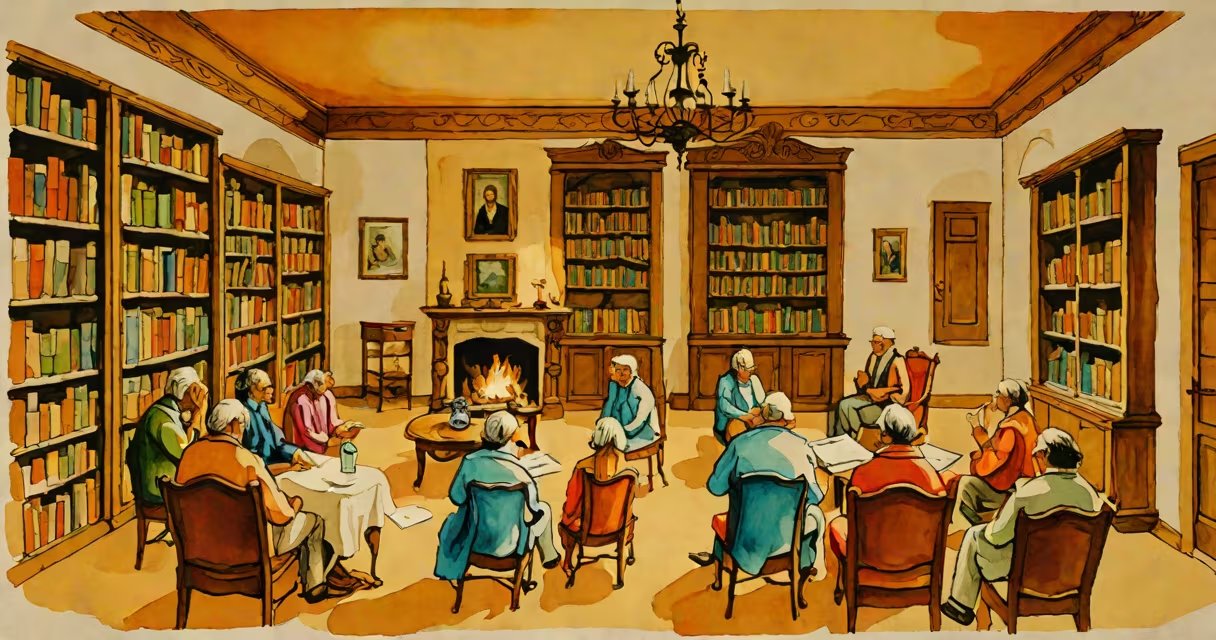
Casa dos Contos is a curated storytelling space in Lisbon where live narratives, rooted in Portuguese literary traditions, are performed in intimate settings. It functions as both a cultural venue and a living archive of oral storytelling, emphasizing emotional resonance over spectacle.
The name translates literally to "House of Stories," reflecting its mission to preserve and present narrative art in a format distinct from written literature or digital media. Unlike a bookstore or library, Casa dos Contos prioritizes performance-the spoken word delivered in real time, often with minimal staging and no recorded audio.
Founded in 2016, Casa dos Contos operates out of a converted 19th-century residential building in the Alfama district. The space seats up to 30 people, ensuring close proximity between performer and listener. Events occur weekly, with themes ranging from personal memoirs to reimagined folk tales from rural Portugal.
Each session begins with a 15-minute introduction by the host, who contextualizes the story's origin-whether it's a regional legend from Trás-os-Montes or a contemporary short story adapted from a published author's work. The storyteller then performs the piece aloud, typically lasting 20 to 30 minutes.
There are no scripts visible to the audience. Performances rely entirely on memory and vocal nuance. This demands rigorous rehearsal: performers train for weeks to internalize structure, pacing, and emotional inflection. A single misstep can disrupt the entire narrative arc.
After the reading, a 10-minute Q&A allows listeners to ask about the story's roots, the performer's interpretation, or the cultural significance of specific motifs-such as the use of the "saudade" theme in coastal fishing communities.
Casa dos Contos hosts three primary formats:
| Type | Description | Duration | Example |
|---|---|---|---|
| Traditional Oral Tales | Stories passed down through generations, often involving spirits, animals, or moral lessons. | 25-35 min | "The Woman Who Married a River," a tale from northern Portugal about a woman who enters a river to save her village. |
| Contemporary Narrative | Original or adapted stories based on modern life, often drawn from published works or personal experience. | 20-30 min | A 2022 piece titled "The Last Letter from Coimbra," recounting a student's final message before disappearing during protests. |
| Themed Evenings | Monthly events centered on a single theme, such as migration, silence, or loss. | 45-60 min | "Voices of the Disappeared," a series exploring missing persons in post-dictatorship Portugal. |
These formats are not interchangeable. Traditional tales require deep familiarity with regional dialects and ritual structures. Contemporary pieces demand emotional authenticity and narrative precision. Themed evenings blend both, requiring curators to select stories that resonate across multiple layers of meaning.
Casa dos Contos emerged in response to declining public engagement with long-form narrative in Portuguese society. According to a 2021 study by the Instituto de Estudos da Linguagem at the University of Lisbon, 68% of Portuguese adults aged 18-35 reported listening to fewer than five stories per year, compared to 89% in 1990.
The venue fills a gap left by the decline of radio storytelling programs and community reading circles. It is not a museum or archive-it is an active space where stories are remade with each performance. The same tale told by different narrators varies in tone, emphasis, and even plot details due to improvisational choices.
For example, in 2023, three different performers presented "O Menino que Não Sabia o Que Era um Sonho" ("The Boy Who Didn't Know What a Dream Was"), a 19th-century fable about a child who never sleeps. One version emphasized childhood innocence; another focused on systemic neglect. The differences were not editorial-they were interpretive.
Many assume Casa dos Contos is a children's storytelling event. It is not. While some stories contain fantastical elements, the audience is predominantly adult, with 74% aged 25-55 according to attendance records from 2022-2023.
Another misconception is that the term "dos" in "casa dos contos" implies possession. "Dos" is a contraction of "de os"-literally "of the." So "casa dos contos" means "house of the stories," not "house belonging to the stories." This distinction matters because it reflects the space's role as a container rather than a proprietor of narratives.
Some visitors confuse Casa dos Contos with similar venues in other cities, such as Casa das Histórias in Porto. But while both host narrative events, Casa das Histórias focuses on historical exhibitions and academic lectures. Casa dos Contos remains committed to live, unscripted performance.
In March 2023, I attended a performance of "A Mulher que Escutou o Mar" ("The Woman Who Listened to the Sea"), a story adapted from a 1978 collection by writer António Lobo Antunes. The storyteller, a former schoolteacher from Figueira da Foz, spoke in a low, rhythmic cadence. When she reached the climax-where the protagonist hears her dead son's voice in the waves-she paused for 4.3 seconds. No sound. No movement. The silence lasted longer than the entire preceding section.
Afterward, several attendees approached me to say they had cried. Not because the story was sad-but because the pause felt like a shared breath. That moment exemplifies Casa dos Contos' core principle: meaning emerges not from words alone, but from their timing, weight, and absence.
Casa dos Contos is more than a venue-it is a living practice of storytelling as a communal act. It preserves linguistic nuance, cultural memory, and emotional truth through performance. Its success lies in resisting digitization and commercialization, maintaining a focus on presence, voice, and human connection. For those seeking authentic narrative experiences in Portugal, casa dos contos offers a rare model of cultural continuity.