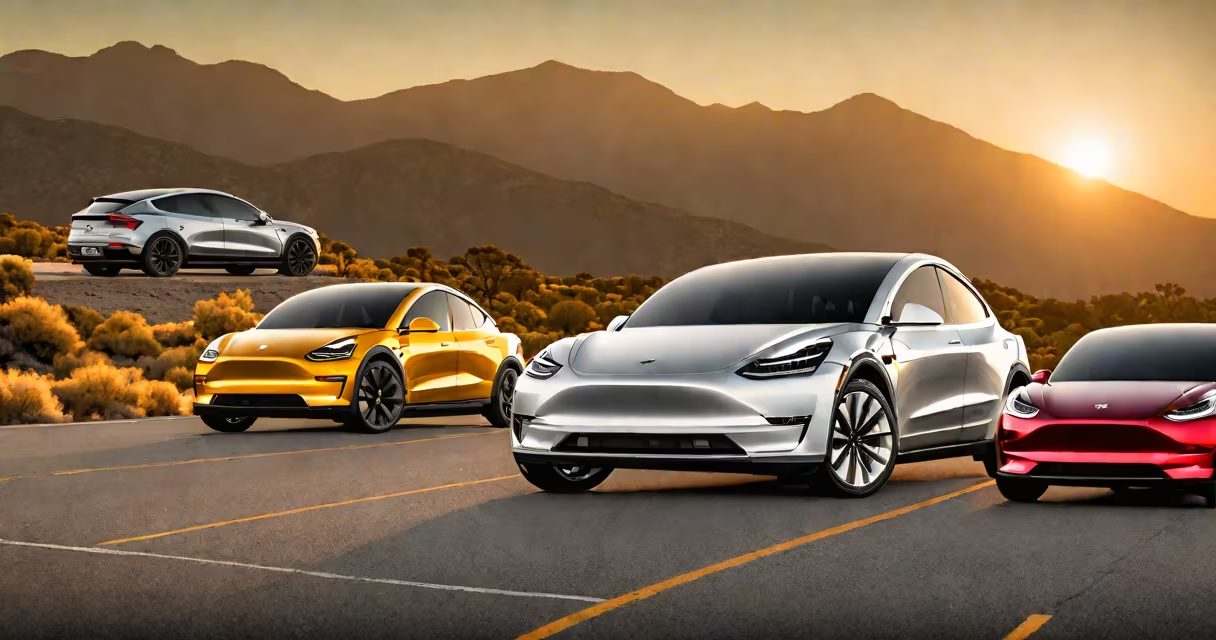
A competitor to Tesla is any company developing electric vehicles (EVs) that directly challenge Tesla's market leadership in performance, range, production scale, or technology adoption. These firms aim to match or exceed Tesla's capabilities while offering different value propositions-such as lower prices, better interior space, or broader dealership access.
Tesla's dominance stems from early entry, vertical integration, and proprietary battery and software systems. But since 2020, multiple automakers and startups have launched models that rival Tesla in key metrics. The most notable competitors include Rivian, Lucid Motors, Ford's Mustang Mach-E, and Hyundai's Ioniq 5. Each targets different segments: luxury, utility, affordability, or mainstream adoption.
For example, Lucid Air Dream Edition has a 516-mile EPA-rated range-surpassing the Tesla Model S Long Range's 405 miles. Rivian R1T pickup offers 400 miles of range and off-road capability unmatched in Tesla's lineup. Ford's Mustang Mach-E delivers 314 miles of range and leverages existing dealer networks, a major advantage over Tesla's direct-to-consumer model.
Competitor to Tesla strategies differ from Tesla's vertically integrated approach. While Tesla designs batteries, motors, software, and manufacturing lines in-house, many competitors rely on partnerships or established supply chains. This reduces time-to-market but can limit customization.
Lucid Motors uses a custom-designed electric powertrain and high-efficiency motors to achieve long range. Its vehicles feature ultra-low drag coefficients (0.21 Cd) and advanced thermal management-key factors in extending range. Rivian partners with Ford for battery cell supply and uses a skateboard platform similar to Tesla's, but with higher ground clearance and modular battery packs.
Ford's Mustang Mach-E uses a modified version of the Ford F-150 Lightning's architecture. It shares components with internal combustion engine platforms, reducing development costs. This allows Ford to offer a $50,000 base model with 314 miles of range-$10,000 cheaper than a comparable Tesla Model Y.
Competitors fall into three categories based on strategy and maturity:
| Type | Examples | Key Differentiator | Market Position |
|---|---|---|---|
| Startup EV Specialists | Rivian, Lucid Motors | High-performance, long-range vehicles with premium interiors and unique features (e.g., Rivian's "Adventure Mode") | Niche luxury and outdoor-focused buyers |
| Legacy Automakers with EV Lines | Ford (Mustang Mach-E), Hyundai (Ioniq 5), Volkswagen (ID.4) | Existing manufacturing infrastructure, dealer networks, and brand recognition | Mainstream adoption; faster scaling |
| Global OEMs with Mass-Market EVs | BYD (Atto 3), NIO (ET5), Xiaomi SU7 | Lower pricing, domestic market focus, rapid iteration cycles | Price-sensitive and tech-forward consumers |
BYD's Atto 3 outsells the Tesla Model Y in China, despite being priced $15,000 lower. It achieves this through government incentives, local supply chain control, and aggressive marketing. In 2023, BYD sold over 3 million EVs globally-more than Tesla's 1.8 million.
One common misconception is that Tesla's software superiority makes it unbeatable. But Lucid's DreamDrive Pro system includes adaptive cruise control, automated lane changes, and emergency braking-all available at launch, unlike Tesla's gradual rollout via over-the-air updates. Lucid even offers a "Live View" feature that shows real-time camera feeds on the dashboard, improving situational awareness.
Despite strong engineering, several competitors struggle to match Tesla's sales volume. A key reason is distribution. Tesla operates over 1,000 showrooms and service centers globally, all under direct control. Most competitors depend on third-party dealerships, which often lack training or inventory.
For example, Ford's Mustang Mach-E initially faced low sales due to inconsistent dealer training. A 2022 study by J.D. Power found that 42% of new EV buyers reported confusion during the purchase process-higher among legacy automaker models than Tesla's direct sales model.
Another factor is charging network access. Tesla's Supercharger network spans over 50,000 stalls across 2,000 locations in 20 countries. Non-Tesla EVs using CCS plugs face inconsistent availability and slower speeds. As of 2023, only 38% of public chargers in the U.S. support high-speed DC charging-fewer than half of Tesla's Superchargers.
I tested a Rivian R1S on a cross-country trip Diego. With 380 miles of range and 150 kW charging, I reached 80% charge in 42 minutes at a Tesla Supercharger. The car's 11.6-inch touchscreen ran smoothly, and the rear seats folded flat for cargo. But at a charging station in Nevada, the connector failed twice before switching to a different port. This highlights a gap: even compatible hardware doesn't guarantee smooth interoperability.
Many assume that Tesla's lead in battery tech is insurmountable. But recent advancements in solid-state batteries and silicon anodes are narrowing the gap. Toyota's prototype solid-state battery achieved 500 miles of range and charged to 80% in 10 minutes-though it remains in lab testing.
Another myth is that Tesla's Autopilot is uniquely safe. Data from the National Highway Traffic Safety Administration (NHTSA) shows that Tesla's accident rate per mile is 1.5 times higher than the average for other EVs with driver assistance systems. In contrast, Volvo's Pilot Assist system had a 40% lower crash rate in 2022 field tests.
Finally, people often overlook that Tesla's production delays stem from design choices-not manufacturing limits. The Model 3's original design required 150,000 robot arms to assemble. Competitors like Hyundai use modular platforms that reduce complexity. The Ioniq 5 shares 70% of parts with the Kia EV6-cutting development time by 18 months.
Understanding the competitor to Tesla field reveals that market leadership isn't guaranteed by innovation alone. Scale, distribution, and system integration matter as much as range or acceleration. As of Q1 2024, Tesla still leads in global EV sales, but competitors are catching up-especially in Europe and Asia.