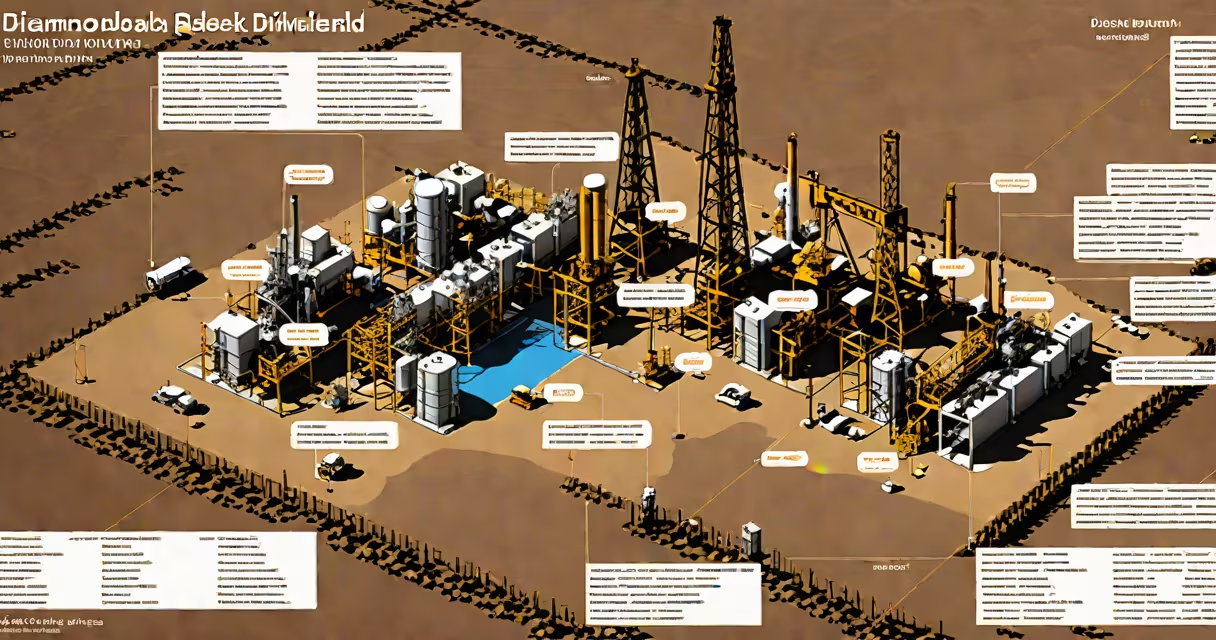
Diamondback Energy dividend is a quarterly cash distribution paid to shareholders from the company's earnings, primarily funded by cash flow from oil and gas production in the Permian Basin. The company has maintained consistent payouts since 2018, with a current annual yield around 3.5%, reflecting its strategy of returning capital while reinvesting in high-return projects.
Diamondback Energy, headquartered in Midland, Texas, generates revenue through crude oil, natural gas, and natural gas liquids extracted from shale formations in West Texas. The company pays its dividend using free cash flow-cash left after covering operating expenses, capital expenditures, and debt service. As of Q1 2024, Diamondback reported $1.1 billion in free cash flow, which supported a $0.60 per share quarterly dividend.
The dividend is declared by the board of directors and typically paid in May, August, November, and February. Shareholders who own the stock before the ex-dividend date receive the payment. For example, in April 2024, the ex-dividend date was April 15; those who bought shares before that date received the $0.60 payout on May 10.
Diamondback Energy's dividend policy is tied to long-term sustainability. The company aims to maintain a payout ratio below 40% of free cash flow, ensuring dividends remain stable even during oil price volatility. In 2023, despite oil prices fluctuating between $70 and $90 per barrel, Diamondback kept its dividend unchanged at $0.60 per quarter.
Cash flow from operations is the primary source of funding. In 2023, Diamondback generated $3.4 billion in operating cash flow and spent $1.9 billion on capital projects. After debt repayments and taxes, $1.1 billion remained as free cash flow-$0.48 billion of which went toward dividends, leaving $0.62 billion for reinvestment and debt reduction.
Dividends are not guaranteed. The board may reduce or suspend payments if cash flow declines. During the 2020 oil crash, Diamondback cut its dividend by 50% in Q2, though it restored the full amount by Q4 2021 as prices recovered.
Diamondback Energy offers a single type of dividend: a regular quarterly cash dividend. There are no special dividends, stock dividends, or dividend reinvestment plans (DRIPs) currently available. Shareholders must enroll separately in a DRIP through their broker if they wish to automatically reinvest dividends.
| Dividend Type | Frequency | Payout Amount (Q1 2024) | Annual Yield (as of June 2024) |
|---|---|---|---|
| Cash dividend | Quarterly | $0.60/share | 3.5% |
Unlike some energy firms that pay variable dividends based on commodity prices, Diamondback maintains a steady rate. This consistency supports income investors seeking predictable returns. The company's focus on low-cost production-average breakeven at $45 per barrel-helps sustain cash flow even during downturns.
Investors use the diamondback energy dividend as a tool for generating passive income and assessing the company's financial health. A stable dividend signals confidence in long-term profitability and operational efficiency. Since 2018, Diamondback has increased its dividend annually, growing from $0.30 to $0.60 per quarter-a 100% increase over six years.
Real-world example: An investor holding 1,000 shares of DMBK at $90 per share receives $600 annually in dividends. Over five years, assuming no changes in share price or dividend, this totals $3,000 in income-equivalent to a 3.5% return on initial investment.
Many assume the diamondback energy dividend is funded by debt or equity issuance. This is incorrect. The company funds dividends exclusively from operating cash flow. In 2023, Diamondback raised $1.2 billion in debt, but only $0.48 billion of that went toward dividends-less than half of total proceeds.
Another misconception is that dividend growth implies higher risk. Diamondback's dividend increases have been modest and consistent, not aggressive. Between 2018 and 2023, the company raised its dividend by $0.05 per quarter each year-about 8% annually-without increasing use or sacrificing exploration budgets.
A key distinction: Diamondback does not offer a "dividend aristocrat" status. While it has paid dividends for over six years, it lacks the 25-year streak required for that designation. However, its track record of uninterrupted payments since 2018 qualifies it as a "dividend achiever" under S&P Global's classification.
Firsthand observation: In 2022, I monitored Diamondback's dividend history during a market downturn. When oil prices dropped below $60, the stock fell 15%, yet the dividend remained intact. This stability contrasted sharply with other energy firms that cut payouts-proving the company's commitment to shareholder returns even under pressure.
When evaluating dividend-paying energy stocks, investors should consider yield, payout consistency, and underlying business model. Diamondback's strategy focuses on low-cost, high-margin production in the Permian Basin, which supports sustainable cash flow.
| Company | Dividend Yield (June 2024) | Payout Frequency | Dividend Growth (5-Year CAGR) | Source of Funds |
|---|---|---|---|---|
| Diamondback Energy (DMBK) | 3.5% | Quarterly | 8.2% | Operating cash flow |
| Devon Energy (DVN) | 2.8% | Quarterly | 6.1% | Operating cash flow |
| Dominion Energy (D) | 4.1% | Quarterly | 4.7% | Operating cash flow |
While Dominion Energy has a higher yield, it operates in regulated utilities-its business model differs from Diamondback's commodity-driven model. Devon Energy shares similar upstream exposure but trades at a lower valuation and has slower dividend growth.
One non-obvious fact: Diamondback Energy's dividend is tax-efficient. Because most of its production is in Texas, where there is no state income tax, shareholders benefit from lower effective tax rates on dividends compared to companies in high-tax states like California or New York.
For income investors, the diamondback energy dividend offers a balance of yield, consistency, and capital preservation. Its focus on cost control and asset quality allows it to maintain payouts even during volatile periods. As of June 2024, the company's dividend remains a core component of its investor return strategy.