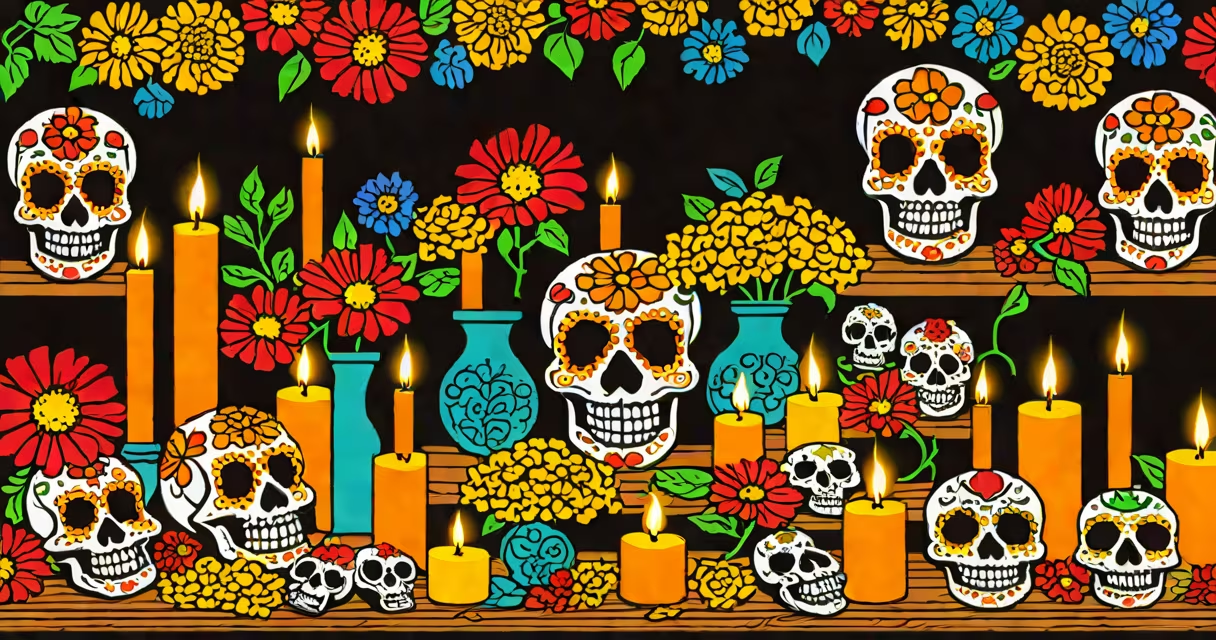
Días de los Muertos is a multi-day Mexican tradition observed on November 1 and 2 to honor deceased relatives through altars, offerings, and rituals rooted in Indigenous and Catholic beliefs. It is not a celebration of death but a joyful reunion with the spirits of the departed.
The holiday originated from pre-Hispanic Mesoamerican cultures, particularly the Aztec and Nahua peoples, who held month-long festivals dedicated to Mictecacihuatl, the Lady of the Dead. When Spanish colonizers arrived in the 16th century, they merged these traditions with All Saints' and All Souls' Days, creating the current syncretic observance. The date aligns with the Catholic liturgical calendar, placing it at the start of November.
Altars, known as ofrendas, are central to the celebration. They are constructed in homes, cemeteries, and public spaces, often layered with symbolic elements. A typical altar includes photographs of the deceased, marigold flowers (cempasúchil), candles, incense (copal), salt, water, food, and personal items the person enjoyed. These offerings serve both practical and spiritual purposes-guiding spirits back to the living world and providing comfort during their visit.
Each element on a Días de los Muertos altar holds specific meaning. Marigolds, with their vibrant orange color and strong scent, are believed to attract souls and mark the path from the cemetery to the home. Candles represent light and warmth, guiding spirits through darkness. Water is placed to quench the thirst of those who have traveled far. Salt purifies the space and prevents negative energy from entering.
Food plays a important role. Families prepare favorite dishes of the deceased-tamales, mole, pan de muerto (sweet bread shaped like a skull or bones), and fruits. These are left on the altar as gifts. After the holiday, the food is shared among the living, symbolizing continuity between worlds. Sugar skulls, decorated with colorful icing and names written on the forehead, are both edible treats and symbolic representations of the dead.
In many communities, families clean and decorate gravesites. They spend the night at cemeteries, singing songs, telling stories, and sharing meals. This practice reflects the belief that the dead return to visit their families during the holiday. In urban centers like Mexico City, public celebrations include parades, art installations, and performances that draw thousands.
While the core practices remain consistent, regional differences exist. In Oaxaca, the festival features elaborate sand tapestries (alfombras) made from colored sand and petals. In Michoacán, families gather at the tomb of the poet Juan Rulfo, a cultural icon, to honor him annually. In northern states like Chihuahua, the influence of U.S. border culture has led to hybrid celebrations blending Mexican and American traditions.
| Region | Distinctive Practice | Symbolic Meaning |
|---|---|---|
| Oaxaca | Sand art (alfombras) | Pathway for spirits; temporary beauty |
| Mexico City | Public parades and giant altars | Community remembrance; cultural pride |
| Michoacán | Visiting ancestral tombs at night | Family presence; spiritual continuity |
| San Antonio, Texas | Community altars in parks and schools | Intergenerational connection; cultural preservation |
A lesser-known fact: the term "Días de los Muertos" was not widely used until the 20th century. Before that, people referred to the event as "Día de Muertos" or simply "el Día de los Santos." The plural form gained popularity through academic and artistic circles, especially after Diego Rivera and Frida Kahlo popularized the imagery in their work.
Many assume Días de los Muertos is a "Mexican Halloween," but the two differ fundamentally. Halloween focuses on fear, costumes, and trick-or-treating. Días de los Muertos emphasizes memory, love, and reverence. The skeletons and skulls are not symbols of terror but of life's continuity. They are often depicted smiling, dancing, or enjoying food-affirming that death is part of existence.
Another misconception is that the holiday is exclusively religious. While it contains Catholic influences, it is deeply secular in practice. In rural villages, families may create altars without mentioning saints. In cities, artists use the theme to explore identity, migration, and loss. The 2017 animated film *Coco* brought global attention but simplified complex traditions-especially the idea that forgetting someone ends their existence. In reality, the dead are remembered through ongoing ritual, not just memory.
In 2022, I visited a family in Puebla who built a three-tiered altar for their grandmother, who died in 2018. The base layer held her favorite candies and a small figurine of a saint she prayed to daily. The middle tier included a photograph, a bottle of tequila (her drink of choice), and a hand-stitched quilt. The top layer had five sugar skulls, each labeled with a grandchild's name, and a single marigold flower placed at the center.
They lit six candles-one for each year since her passing-and burned copal incense. At midnight, the family sang a lullaby she used to sing. The altar remained intact for two days. On November 3, they took down the offerings, cleaned the altar, and stored the photos in a box. No ashes were scattered. No prayers were spoken aloud. The act itself was the ritual.
This experience confirmed a key insight: Días de los Muertos is not about summoning spirits-it's about making space for them. The altar is a stage, not a portal.
Outside Mexico, the holiday has grown beyond cultural boundaries. In 2021, UNESCO recognized Días de los Muertos as an Intangible Cultural Heritage of Humanity. The designation cited its role in strengthening community ties and preserving ancestral memory. As of 2023, over 150 cities in North America and Europe host official Días de los Muertos events, though participation varies widely.
Despite its growing visibility, the holiday remains deeply personal. It is not performed for tourists or social media. It is lived.
Días de los Muertos is not a spectacle. It is a quiet, deliberate act of love. It is the sound of a child placing a candle beside a photo. It is the smell of warm bread and copal smoke. It is the belief that the dead do not leave us-they stay, as long as we remember them. For those who observe it, it is not a day of mourning but a day of reunion.