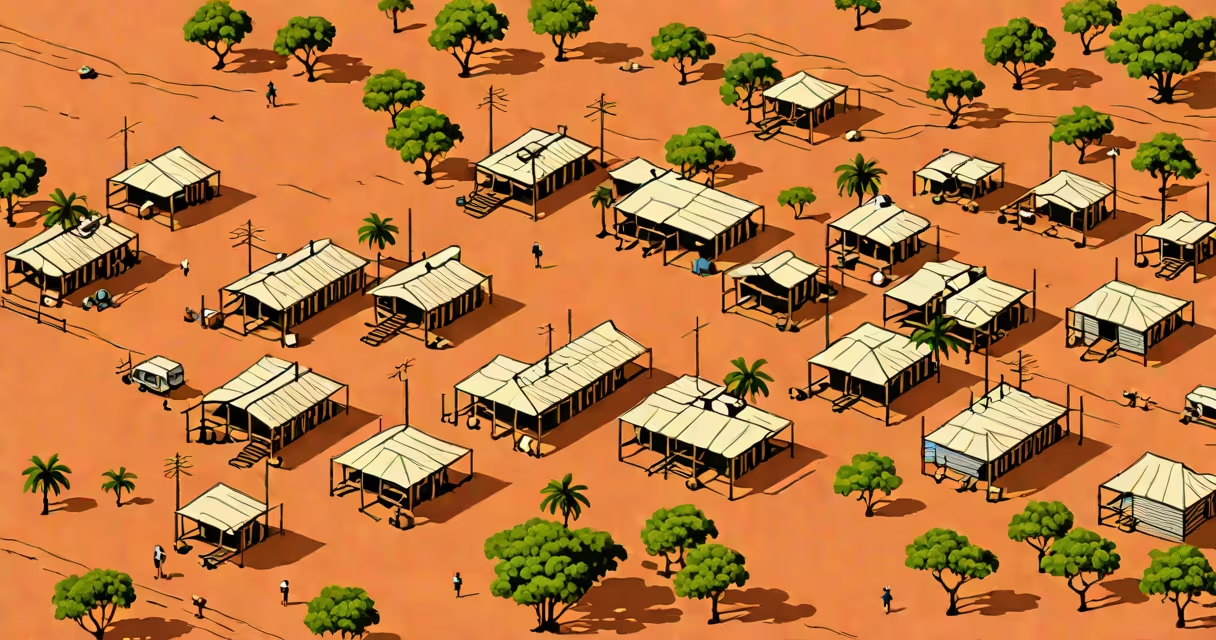
The Doomadgee Aboriginal Shire Council is a locally elected government body responsible for administering the Doomadgee community in the Gulf Country of far north Queensland. It operates under the Local Government Act 2009 (Qld) and holds authority over land, infrastructure, health services, and cultural heritage within its jurisdiction.
Doomadgee is located approximately 600 kilometers west of Darwin, accessible only by air or seasonal road travel. The council serves a population of around 1,200 people, predominantly from the Gudang and Kalkadoon peoples. As an Aboriginal Shire, it functions as a tier of local government distinct from state-run councils, with powers derived from both state legislation and native title recognition.
Unlike most Australian local governments, the Doomadgee Aboriginal Shire Council is not elected through a general ballot. Instead, members are chosen via a traditional election process governed by community law and custom. This reflects the council's role as a representative of Indigenous sovereignty in a region where native title rights remain central to governance legitimacy.
The council operates under a structure established by the Queensland Government's Local Government Act 2009 and the Aboriginal and Torres Strait Islander (Local Government) Act 2007. These laws allow Aboriginal communities to form shires when they meet criteria related to population, land ownership, and community support. Doomadgee was formally declared an Aboriginal Shire in 2007 after a successful application and referendum.
Each year, the council elects a Chairperson and up to six councillors from among community members. Elections are held under a system of secret ballot, but candidates must be enrolled on the Doomadgee electoral roll and meet residency requirements. The council meets monthly to discuss budgets, development plans, and service delivery. Decisions are made collectively, often incorporating consensus-based practices rooted in traditional decision-making.
Financially, the council receives funding from multiple sources: the Queensland Department of Local Government, Sport and Cultural Industries; federal grants administered through the Department of Health; and revenue from land leases and mining agreements. For example, in 2022-23, the council received $3.8 million in direct government funding, with an additional $1.2 million from mineral royalties on adjacent pastoral leases.
The Doomadgee Aboriginal Shire Council has legal standing to manage land, build infrastructure, and deliver social services. Its responsibilities include maintaining roads, managing water supply, overseeing waste disposal, and coordinating health outreach programs. It also administers the Doomadgee Community School and supports local employment initiatives.
Under the Native Title Act 1993, the council holds exclusive possession rights over approximately 17,000 square kilometers of land, including parts of the Daly River catchment and the western reaches of the Gulf of Carpentaria. This land is managed under a co-management agreement with the Queensland Parks and Wildlife Service, allowing for conservation, cultural site protection, and sustainable tourism development.
| Function | Authority Source | Example Activity |
|---|---|---|
| Land management | Native Title Act 1993 | Protecting sacred sites near the Doomadgee Mission Reserve |
| Infrastructure maintenance | Local Government Act 2009 (Qld) | Repairing the community airstrip after cyclone damage |
| Health and welfare coordination | Aboriginal and Torres Strait Islander (Local Government) Act 2007 | Running weekly mobile health clinics in partnership with the Royal Flying Doctor Service |
Many assume that Aboriginal Shire councils are merely advisory bodies. This is incorrect. The Doomadgee Aboriginal Shire Council has statutory authority comparable to other local governments in Queensland. It can enter contracts, borrow money, and enforce bylaws related to public safety and environmental protection.
A frequent misunderstanding is that the council lacks accountability. In reality, it is subject to audits by the Queensland Auditor-General and must publish annual financial statements. The council also reports to the Minister for Local Government and is required to submit strategic plans every three years. Failure to comply can result in state intervention, including the appointment of a special administrator.
Another misconception is that Doomadgee is isolated from national policy. On the contrary, the council actively participates in federal Indigenous affairs forums. In 2021, it contributed to the National Agreement on Closing the Gap, providing input on housing and education targets specific to remote Aboriginal communities.
In 2020, the council led a project to install solar microgrids across five outstations in the Doomadgee region. The initiative, funded by the Australian Renewable Energy Agency (ARENA) and matched by state funds, replaced diesel generators that had cost $180,000 annually to operate. After installation, energy costs dropped by 67%, and carbon emissions fell by 420 tonnes per year. The project was cited by the Clean Energy Council as a model for renewable integration in remote Indigenous communities.
I visited Doomadgee in 2022 during a regional planning workshop. What struck me was the blend of formal governance and customary practice. A meeting began with a song and dance ceremony led by Elders, followed by a presentation on water quality standards. The chairperson then opened debate on a new housing proposal, referencing both the council's bylaws and clan kinship systems. This dual structure ensures decisions reflect both legal compliance and cultural continuity.
For comparison, the Ngaanyatjarra Council in Western Australia also governs a large remote area through Aboriginal shire status. However, Doomadgee differs in its reliance on native title as a foundation for authority, whereas Ngaanyatjarra's power stems largely from state legislation and long-term land use agreements.
The Doomadgee Aboriginal Shire Council exemplifies how Indigenous self-determination can function within Australia's legal and political system. It demonstrates that local government is not limited to urban centers or non-Indigenous populations. By combining statutory authority with cultural governance, it provides a model for sustainable, community-led development in remote regions.