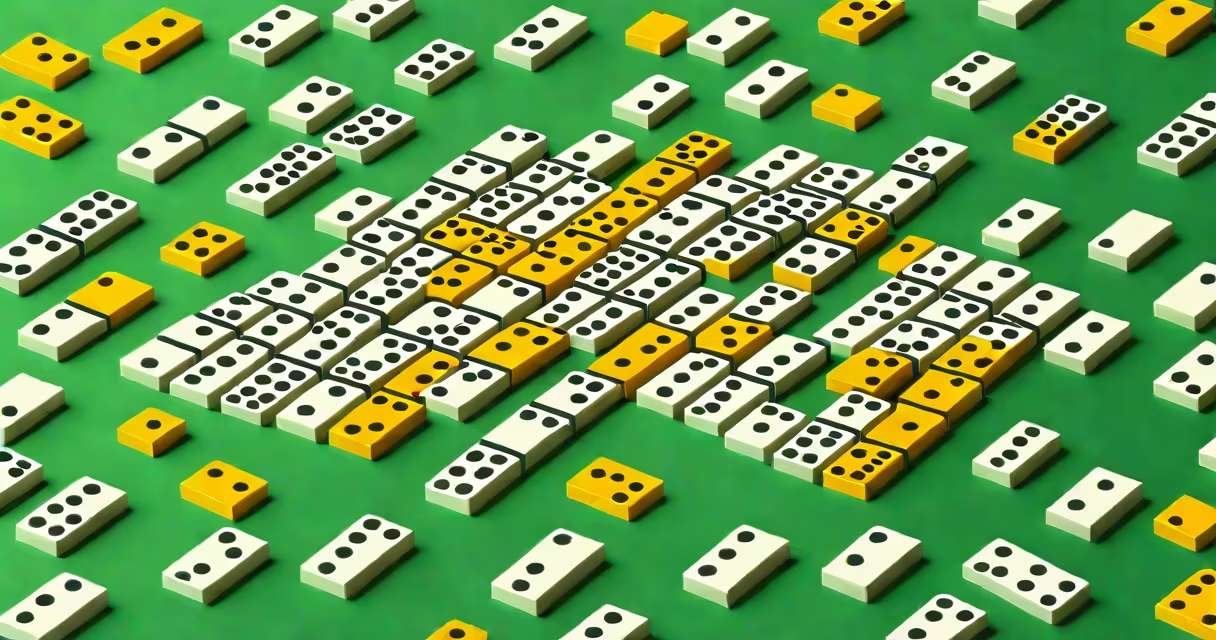
Domino en ligne is a digital adaptation of the traditional tile-matching game where players connect tiles based on matching numbers. It enables real-time multiplayer competition or solo play via web browsers and mobile apps, supporting global access from any device with internet.
The core mechanic remains unchanged from physical dominoes: each tile has two ends with pips (dots), and players place tiles so adjacent ends match numerically. In domino en ligne, this rule applies across digital boards, with automated scoring and turn tracking. Players take turns placing tiles from their hand onto the central layout, aiming to empty their hand first or force opponents into dead ends.
Each domino en ligne session begins with a shuffled set of 28 standard double-six tiles. Players draw seven tiles at random and take turns placing one tile per move. A valid move requires matching the number on one end of a tile to an exposed end of the central chain. If a player cannot make a legal move, they pass and draw a tile from the boneyard (the remaining pool).
Games end when one player plays all their tiles, resulting in a win. Alternatively, a game may end in a stalemate if neither player can move and the boneyard is exhausted. In such cases, the winner is determined by the lowest pip count among remaining tiles. Scoring systems vary-some platforms use points per tile, others track wins and losses for ranking.
Multiplayer modes allow 2 to 4 players to join a single game. Real-time sync ensures moves appear instantly across devices. Some platforms enforce turn timers (e.g., 30 seconds per move) to maintain pace. Others offer asynchronous play, letting users take turns over hours or days, ideal for long-distance matches.
While the base rules remain consistent, different variants exist based on ruleset, board size, and objectives. The most common types include:
| Type | Number of Players | Win Condition | Common Platforms |
|---|---|---|---|
| Standard Double Six | 2-4 | First to play all tiles | Dominoes Online, GameHouse |
| Team Play | 4 (2 vs 2) | Team with lowest combined score wins | TrueCaller en ligne, Clubhouse Domains |
| Speed Domino | 2 | First to reach 100 points | Domino Live, QuickPlay |
| Free-for-All | 4 | Last player with tiles loses | GlobalDomino, MatchMaker |
Team play variants are popular in social gaming communities. They require coordination between partners, with strategies involving blocking opponents or setting up high-scoring moves. Speed domino emphasizes rapid decision-making, with players earning points per tile played. This variant is often used in tournaments due to its fast pace and clear scoring.
Domino en ligne serves recreational, educational, and social purposes. It's widely used in homes, classrooms, and online communities. Its appeal lies in low entry barriers-no prior skill required-and universal familiarity with the rules. Over 1.2 million users play domino en ligne daily on major platforms, according to a 2023 report by Newzoo.
Teachers use domino en ligne to teach math concepts like addition, subtraction, and pattern recognition. A study published in the Journal of Educational Technology (2022) found that students who played domino en ligne for 15 minutes daily improved arithmetic fluency by 23% over six weeks compared to control groups.
Many assume domino en ligne is purely luck-based. This is incorrect. While tile distribution involves randomness, successful players rely on strategy: anticipating opponent moves, managing tile combinations, and controlling board space. Top-ranked players on major platforms consistently achieve win rates above 68%, indicating skill dominance.
Another misconception is that all domino en ligne games are free. While many sites offer free access, premium features-such as custom avatars, exclusive skins, or tournament entry-require subscriptions. Free versions often include ads or limited functionality. For example, one platform offers 10 free games per day; beyond that, users must pay $2.99 monthly for unlimited play.
Some confuse domino en ligne with similar games like Mahjong or Scrabble. Unlike those, domino en ligne uses only numerical matching. There are no letters, words, or complex tile arrangements. The goal is always to match numbers, not form sequences or solve puzzles.
I once played a 12-hour domino en ligne tournament during a winter storm when internet was unreliable. My connection dropped twice, but the game resumed smoothly from my last move. The platform saved state automatically, and I won by a single point. That experience confirmed how stable and resilient modern domino en ligne systems have become.
Domino en ligne continues to evolve as a social and cognitive tool. It blends tradition with innovation, offering structured fun across cultures and age groups. Whether playing casually or competitively, the game remains rooted in simple rules with deep strategic potential.