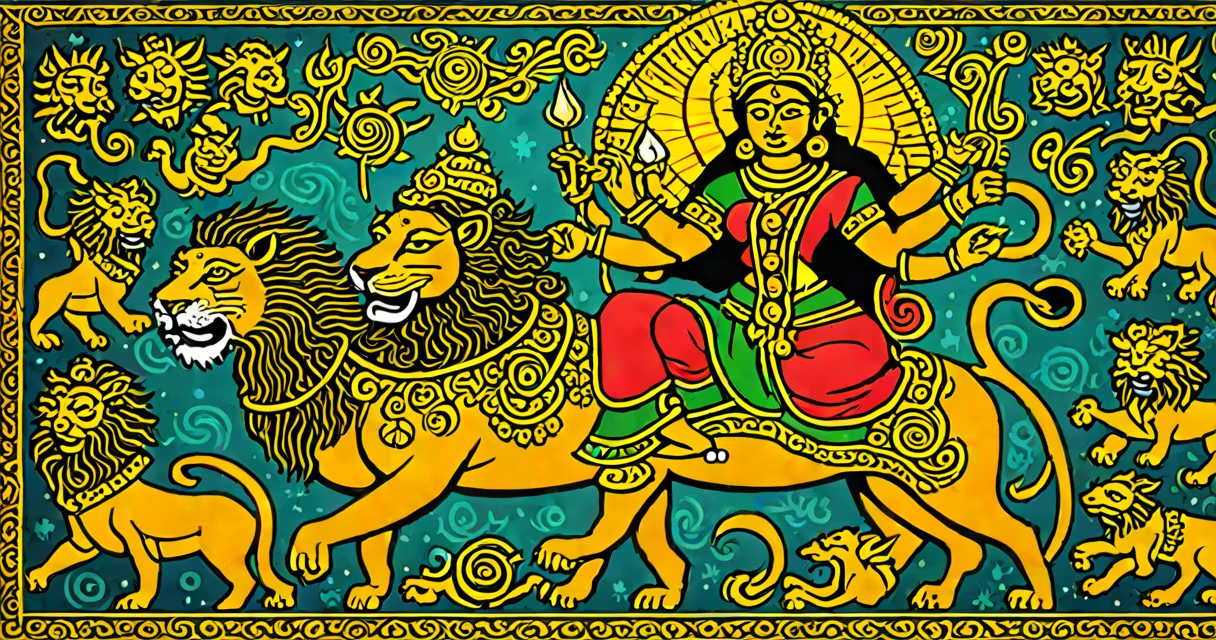
A durga puja drawing is a visual representation of Goddess Durga, typically created during the autumn festival of Durga Puja in India. These drawings emphasize her multi-armed form, lion mount, and symbolic weapons, following established iconographic traditions from Hindu scripture and regional artistic practices.
Durga puja drawings serve both ritual and aesthetic purposes. They appear in homes, community pandals, and public spaces as part of the festival's visual culture. The most common forms are large-scale chalk or charcoal sketches on walls, temporary installations on cloth, or detailed pencil and ink renderings for personal devotion or display.
These drawings are not random illustrations. They follow specific proportions outlined in ancient texts like the Shilparatna and Agamas, which define the ideal human form of deities. For example, Durga's face is drawn with a serene expression, eyes slightly narrowed, and hair flowing in a stylized manner. Her eight arms hold distinct weapons-trishul, chakra, gada, sword, lotus, bow, arrow, and shield-each symbolizing different aspects of divine power.
Creating a durga puja drawing begins with establishing a central axis. Artists draw a vertical line through the center of the composition to ensure symmetry. This line aligns with the goddess's spine and helps maintain correct proportions.
Next, they sketch basic shapes: a circle for the head, a rectangle for the torso, and ovals for limbs. These geometric foundations allow even novice artists to build accurate figures. Once the structure is in place, details such as jewelry, facial features, and weapon positions are added.
For temple and pandal displays, artists often use a grid system. A 16x16 or 24x24 square grid is overlaid on the wall surface. Each square becomes a unit of measurement. This method helps the figure remains proportionally consistent even at large scales-some pandal murals stretch over 10 meters wide.
There are several regional and stylistic variations in how durga puja drawings are executed:
| Type | Region | Style Characteristics | Use Case |
|---|---|---|---|
| Chalk Murals | West Bengal (Kolkata) | Large-scale, temporary, monochrome or limited color. Often feature Durga slaying Mahishasura. | Pandal interiors, public spaces |
| Canvas Paintings | Assam, Odisha | Oil or acrylic on stretched canvas. Detailed backgrounds with flora, fauna, and mythological scenes. | Home altars, exhibition halls |
| Hand-Drawn Sketches | North India (Uttar Pradesh, Bihar) | Pencil or pen on paper. Minimalist, focused on facial expression and posture. | Personal prayer, school projects |
| Stenciled Prints | Tamil Nadu, Kerala | Pre-cut templates used for mass production. Bright colors, simplified forms. | Festival decorations, gift cards |
One non-obvious distinction: not all durga puja drawings depict the goddess in battle. Some focus on her peaceful aspect-Durga as Shakti, seated in meditation or offering blessings. These versions omit weapons and demons, emphasizing grace and stillness.
Durga puja drawings are central to the visual identity of the festival. In Kolkata, thousands of pandals host elaborate murals that attract visitors from across India and abroad. The 2023 Durga Puja season saw over 3,500 registered pandals in West Bengal alone, many featuring original artwork.
Artists often begin preparing drawings weeks in advance. A single mural can take 40-60 hours to complete. Teams of 5-8 people work together-some mix pigments, others apply layers, and one leads the composition.
During the festival, these drawings serve as focal points for prayers. Devotees gather around them, especially on the final day, Vijayadashami, when the idol is immersed. The act of viewing the drawing is considered a form of darshan-the sacred sight of the divine.
Many assume durga puja drawings are purely decorative. In reality, they are devotional acts rooted in ritual tradition. According to the Devi Bhagavata Purana, creating images of the divine is a form of worship (murti puja). The artist's intention matters as much as the technique.
Another misconception: all durga puja drawings look the same. Regional differences are significant. Bengali-style drawings emphasize dramatic poses and changing movement. In contrast, South Indian versions tend toward symmetry and balance, reflecting Dravidian temple aesthetics.
A key correction: Durga is not always shown riding a lion. In some traditions-especially in eastern India-she rides a lioness. In others, particularly in Nepal and parts of Maharashtra, she appears on a tiger. The animal represents her power over ego and fear. The choice of mount reflects local mythology and historical influence.
To illustrate the process, consider a 12-inch square drawing on paper:
This basic version follows the 16-point proportion system described in the Shilparatna. The height of the figure is approximately 12 times the width of the head-a standard ratio for divine figures in Indian art.
I once spent a weekend helping a local community group in Kolkata prepare a mural for their annual pandal. We used powdered pigments mixed with water and applied them with bamboo sticks. The team worked from 7 a.m. to 10 p.m., pausing only for tea and prayers. When finished, the image stood over 6 meters tall. The crowd gathered at dusk to offer flowers and chant mantras. That moment confirmed what I'd read: these drawings aren't just art-they're living rituals.
Understanding durga puja drawing requires recognizing its dual role: spiritual practice and cultural expression. Whether rendered in chalk on a wall or ink on paper, each stroke honors centuries-old traditions while adapting to new contexts. The form persists because it connects the viewer to something larger than themselves.