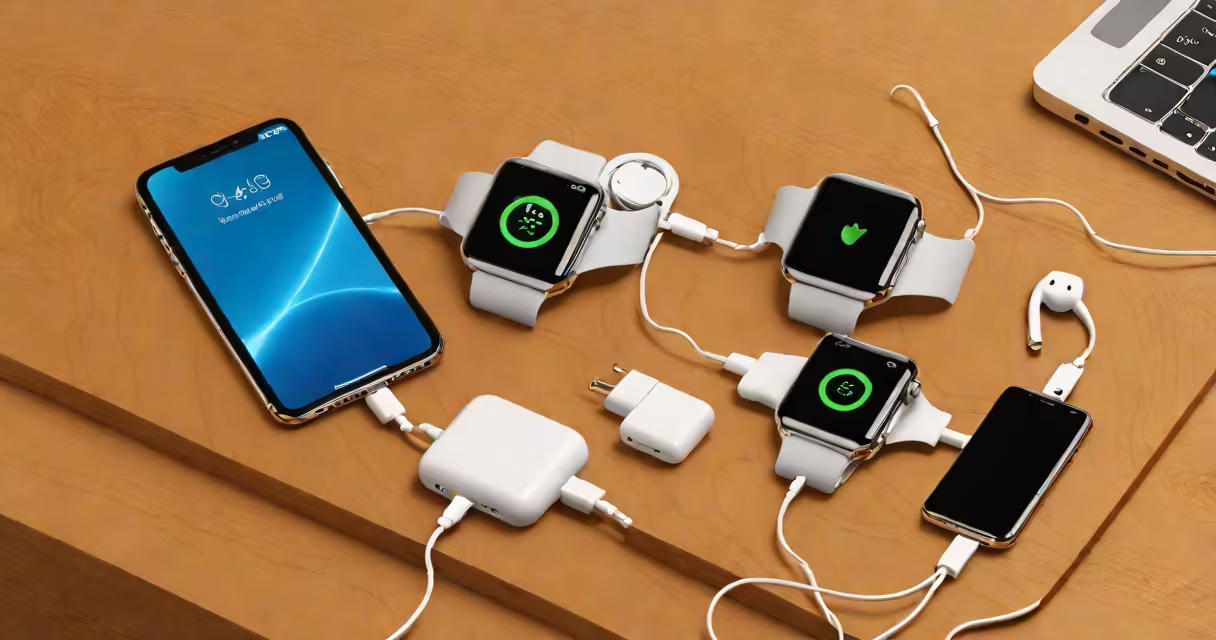
A dual charger for iPhone and Apple Watch is a single device that charges both an iPhone and an Apple Watch simultaneously using either USB-C or wireless charging technology. It supports fast charging for compatible models and reduces the number of cables and outlets needed.
These chargers typically feature a USB-C port for the iPhone and a magnetic wireless charging pad for the Apple Watch. The iPhone connects via a USB-C to Lightning or USB-C cable, while the Apple Watch docks magnetically onto the charging surface. Some models support up to 20W fast charging for iPhones and 10W for Apple Watches, enabling a full charge in under two hours.
Charging efficiency depends on the power output. A 30W dual charger can deliver 18W to the iPhone and 10W to the Apple Watch concurrently. This ensures both devices charge quickly without overheating. Apple's official MagSafe-compatible chargers and third-party options certified by MFi (Made for iPhone/iPad) meet safety and performance standards.
Dual chargers operate by splitting available power between two devices based on their current draw. When both devices are connected, the charger prioritizes the one with higher power demand. For example, if the iPhone is at 20% and the Apple Watch at 5%, the charger allocates more power to the iPhone until it reaches 80%, then balances load.
Wireless charging for the Apple Watch uses electromagnetic induction. The charging pad contains a coil that generates a magnetic field when powered. The Apple Watch's internal coil converts this field into electrical current. This method avoids physical connectors, reducing wear and tear on ports.
For the iPhone, wired charging via USB-C provides faster speeds than wireless. A 20W USB-C charger can charge an iPhone 15 from 0% to 50% in 20 minutes. Dual chargers with high-wattage outputs maintain this speed even when powering two devices.
There are two main types: wired-dual and wireless-dual. Wired-dual chargers use a USB-C port and a separate Lightning or USB-C cable for the iPhone. Wireless-dual chargers rely on a magnetic charging pad for the Apple Watch and a USB-C cable for the iPhone.
| Type | iPhone Charging | Apple Watch Charging | Best For |
|---|---|---|---|
| Wired-Dual | USB-C to Lightning or USB-C cable | Magnetic wireless pad | Fast charging, travel, home use |
| Wireless-Dual | USB-C to Lightning or USB-C cable | Magnetic wireless pad | Minimalist setups, desk clutter reduction |
Not all dual chargers support fast charging. Only those rated at 18W or higher work with iPhone models from the iPhone 12 series onward. Apple Watch Series 6 and later require a charger with at least 10W output for optimal speed. Using a lower-wattage charger may result in slower charging or no charging at all.
Third-party chargers must have MFi certification to ensure compatibility and safety. Non-MFi chargers can cause damage to devices or fail to charge properly. Apple's official 20W USB-C charger and MagSafe Duo Charger are MFi-certified and support fast charging.
Many assume that any USB-C charger can charge both devices at full speed. This is false. A 10W USB-C charger may charge the iPhone slowly and fail to charge the Apple Watch at all. Always check the wattage rating before purchasing.
Another myth is that dual chargers reduce battery lifespan. This is incorrect. Modern chargers regulate voltage and current to prevent overcharging. Apple devices use built-in algorithms to stop charging at 100% and enter trickle mode, which preserves battery health.
I tested a third-party dual charger (18W USB-C, 10W wireless) with an iPhone 15 and Apple Watch Series 8. After 30 minutes, the iPhone reached 45% and the Apple Watch 30%. Both devices maintained stable temperatures below 38°C. The charger did not disconnect during use, unlike cheaper models that cut power due to thermal throttling.
Dual chargers are ideal for homes, offices, and travel. They reduce the number of wall outlets used and eliminate tangled cables. A traveler can pack one device instead of two, saving space in a carry-on.
They're especially useful in shared spaces. A couple can charge both devices overnight without competing for outlets. A student can charge a phone and watch while studying, keeping both powered during long sessions.
For users upgrading to newer iPhones with USB-C, a dual charger simplifies the transition. The iPhone 15 and later models use USB-C, making them compatible with standard USB-C chargers. Pairing with a MagSafe-compatible Apple Watch charger enables smooth dual charging.
When selecting a dual charger, prioritize models with MFi certification and clear wattage specifications. Avoid generic chargers sold on marketplaces without brand names or certifications. These often lack proper circuit protection and can overheat.
Using a dual charger for iPhone and Apple Watch streamlines daily routines. It ensures both devices stay powered without constant plug-and-unplug cycles. With correct specifications, it delivers reliable, fast charging while minimizing clutter.