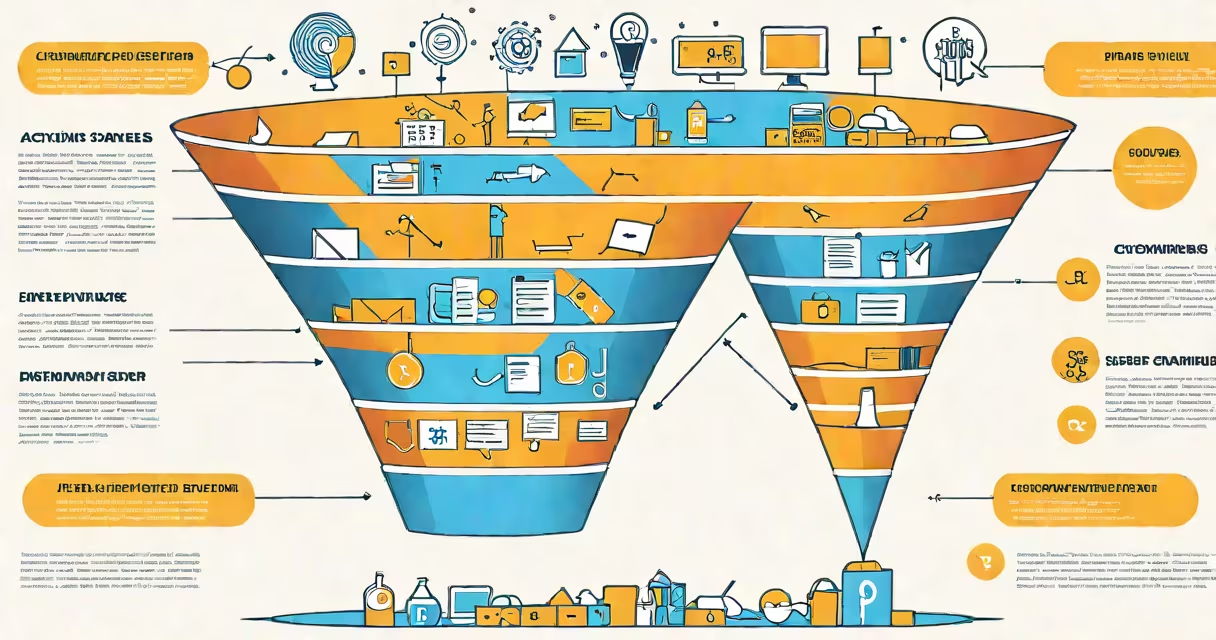
The ecommerce sales funnel is a structured model that outlines the stages a potential customer passes through before making a purchase online. It begins with awareness and ends with conversion, guiding users from initial contact to completed transaction. This structure helps businesses identify drop-off points and improve retention.
Each stage of the funnel corresponds to a specific customer mindset and behavior. At the top, users are unaware of your brand. As they progress, they begin researching, comparing options, and evaluating value. The funnel narrows as interest turns into intent and intent into action. A well-designed funnel reduces friction at each step, increasing the likelihood of conversion.
For example, a customer searching "best running shoes for flat feet" enters the funnel at the awareness stage. They click on a blog post ranking top brands-this is the interest phase. After reading reviews and comparing prices, they land on your product page. If the pricing, images, and trust signals are clear, they proceed to checkout. If not, they abandon the cart. This progression defines the funnel's path.
The funnel operates on the principle that not all visitors will buy. Most enter at the top, but only a fraction reach the bottom. Conversion rates typically decline sharply across stages: 80% of site visitors may view a homepage, but only 2-5% complete a purchase. This natural attrition is expected and measurable.
Businesses use analytics tools like Google Analytics and heatmaps to track user behavior at each stage. For instance, if 60% of users leave after viewing the product image, the issue lies in visual presentation or lack of detail. If 70% abandon the cart during shipping calculation, the problem is likely unclear delivery costs or limited options.
A/B testing is standard practice. One version of a product page might show a single image, while another shows multiple angles, size charts, and video demos. Testing reveals which version increases time-on-page and lowers bounce rate-direct indicators of funnel health.
Most funnels follow four core stages: Awareness, Interest, Decision, and Action. Some models include a post-purchase stage for retention and advocacy.
| Stage | Customer Mindset | Content Type | Conversion Goal |
|---|---|---|---|
| Awareness | Unaware of problem or solution | Blogs, social media, SEO content | Drive traffic, build recognition |
| Interest | Recognizes need, seeks solutions | Product comparisons, email newsletters | Engage, nurture, collect leads |
| Decision | Compares options, weighs cost vs. benefit | Reviews, testimonials, free trials | Overcome objections, trigger purchase |
| Action | Ready to buy, needs frictionless flow | Checkout pages, secure payment systems | Complete transaction, reduce cart abandonment |
Some brands use segmented funnels based on audience type. A B2B ecommerce store selling industrial equipment may have a longer funnel with lead qualification steps. A fashion retailer targeting impulse buyers uses shorter funnels with changing retargeting ads.
One non-obvious distinction: the funnel is not linear. Customers often jump between stages. A user who researches for days may suddenly convert after seeing a limited-time discount. Funnel design must account for this non-linearity through layered touchpoints.
Many teams treat the funnel as a static diagram rather than a living system. They assume a high-performing homepage guarantees conversions. But traffic volume doesn't equal performance. A site with 10,000 daily visitors may see only 100 purchases-a 1% conversion rate. That's low unless the industry benchmark is higher.
Another error is focusing only on the top of the funnel. Businesses pour money into paid ads to drive traffic but neglect the bottom. Without optimized checkout flows, even perfect traffic fails to convert. According to Baymard Institute, 69% of shopping carts are abandoned-often due to hidden fees, complex forms, or lack of guest checkout.
Some confuse the funnel with the customer process. The funnel is a simplified model of conversion paths. The customer process includes emotional states, brand perception, and long-term loyalty. A customer might return after a negative experience if support is excellent-something the funnel alone cannot predict.
I once audited a small skincare brand's funnel using Hotjar and Shopify analytics. Their homepage had high traffic-3,500 visits/month-but only 120 purchases. The funnel showed 80% of users dropped off at the product page.
We discovered that product descriptions lacked ingredient transparency. Users saw "anti-aging serum" but no details on active compounds. We added a comparison table showing key ingredients versus competitors and included a short video of the formulation process.
After implementation, conversion rate rose from 3.4% to 5.9% in six weeks. Cart abandonment dropped 18%. The improvement came not from new traffic, but from better alignment between user expectations and content at the decision stage.
This case illustrates that funnel optimization isn't about flashy features-it's about matching content to intent. A customer seeking anti-aging benefits needs proof, not just aesthetics.
Without a clear funnel, marketing efforts scatter. You might run Instagram ads that drive clicks but fail to convert because the landing page doesn't address the user's question: "Is this safe for sensitive skin?"
Funnel-aware teams prioritize content that guides users forward. A blog post titled "How to Choose a Skincare Routine for Acne-Prone Skin" attracts users in the interest stage. Linking it to a curated product bundle increases relevance and conversion chances.
For brands focused on scalability, the funnel enables automation. Email sequences triggered by behavior-like abandoning a cart-can recover lost sales. According to Klaviyo, automated cart recovery emails achieve a 15-20% open rate and 5-7% conversion rate.
Understanding the ecommerce sales funnel allows you to map customer behavior, diagnose drop-offs, and refine messaging. It's not a one-time setup. It requires ongoing measurement, testing, and iteration.
When designing your funnel, consider both the logical path and the emotional arc. A user doesn't just want a product-they want confidence, clarity, and control. The most effective funnels don't just sell; they guide.