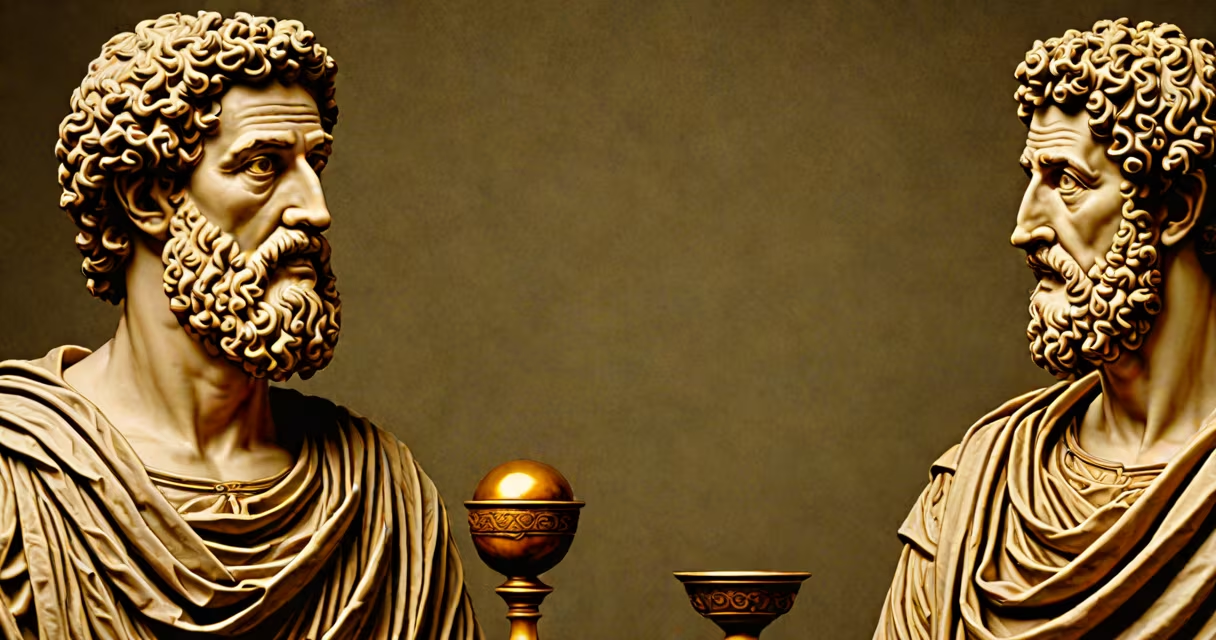
Epictetus and Marcus Aurelius were two of the most consequential figures in Stoic philosophy, each embodying its core principles through lived practice and written reflection. Epictetus, a former slave turned teacher in Rome, emphasized personal agency and inner freedom. Marcus Aurelius, Roman emperor CE, applied Stoic ethics to governance and daily life, recording his insights in *Meditations*. Their work forms the foundation of practical Stoicism.
Epictetus taught that external events are beyond our control, but our judgments about them are not. He structured his lessons around the dichotomy of control: focus only on what you can change-your thoughts, actions, and values. His teachings, preserved in *Discourses* and *Enchiridion*, stress that suffering arises not from events themselves but from how we interpret them. For example, losing a job is neutral; reacting with anger or despair is the source of pain.
Marcus Aurelius, who ruled during military campaigns and plagues, wrote *Meditations* as a private journal. These entries reveal a man using Stoic exercises-such as negative visualization and perspective-taking-to maintain composure. When facing war or illness, he reminded himself: "You could leave life right now. Let whatever you do determine your character." This internal discipline shaped leadership under pressure.
Both men believed that virtue is the highest good and that reason must govern emotion. They rejected pleasure and wealth as indifferent-neither inherently good nor bad-but tools whose value depends on how they're used. A wealthy person may misuse money; a poor person may live virtuously. The key lies in alignment with nature and reason.
Epictetus used dialogic teaching, asking students to reflect on their assumptions. He challenged listeners to ask: "Is this within my power?" If not, accept it. If yes, act responsibly. His method trained mental resilience through constant self-examination. He famously said, "It's not what happens to you, but how you react that matters."
Marcus Aurelius practiced mindfulness through journaling. He wrote in Greek, not for publication, but as a tool for self-correction. Entries often began with "You have the power to..." or "Remember that you are mortal." These weren't poetic flourishes-they were cognitive anchors to prevent emotional drift. He viewed duty not as burden but as sacred obligation.
Epictetus's surviving works come from student notes. Arrian, a student and later governor of Bithynia, recorded his lectures. *Discourses* contains four books of dialogues. *Enchiridion* (meaning "handbook") is a condensed version, likely compiled by Arrian for wider access. These texts emphasize daily practice: reflecting before sleep, reviewing choices, and rehearsing adversity.
Marcus Aurelius's *Meditations* consists of 12 books, written between 161 and 180 CE. He addressed himself directly-"You have the power to choose," "Do not let your mind wander." The language is unpolished, raw, and repetitive, which reflects authenticity. He didn't aim for literary fame. He wrote to stay grounded.
| Aspect | Epictetus | Marcus Aurelius |
|---|---|---|
| Background | Former slave, born c. 50 CE in Hierapolis | Roman emperor, born 121 CE in Lanuvium |
| Primary Texts | *Discourses*, *Enchiridion* | *Meditations* |
| Teaching Method | Oral instruction, dialectic questioning | Private journaling, reflective meditation |
| Focus | Control over perception and action | Inner discipline amid public responsibility |
Modern applications of epictetus and marcus aurelius appear in cognitive behavioral therapy (CBT). The Beck Institute cites their influence on identifying automatic thoughts and reframing distortions. Research shows that people who apply Stoic techniques report lower anxiety and higher emotional regulation (Graziosi et al., 2021).
For example, a manager facing project failure might recall Epictetus's principle: "You cannot control outcomes, only your response." Instead of blaming team members, they assess decisions, adjust plans, and maintain morale. Similarly, Marcus Aurelius's habit of morning reflection-contemplating mortality and impermanence-helps leaders avoid ego-driven decisions.
A 2022 study published in *Journal of Positive Psychology* found that participants practicing daily Stoic journaling for six weeks showed significant increases in psychological resilience and reduced rumination. One subject wrote: "I stopped reacting to emails with panic. I asked: 'Is this within my control?' Most aren't."
Many confuse Stoicism with emotional suppression. This is false. Epictetus and Marcus Aurelius did not advocate ignoring feelings. They taught recognizing emotions as signals, then evaluating them through reason. Anger is natural; acting on it without reflection is not.
Another error: equating Stoicism with passivity. Marcus Aurelius led armies, enacted reforms, and defended borders. He acted decisively. Epictetus advised students to engage with society while remaining detached from outcomes. As he said: "If you want to be happy, be free." Freedom came not from escaping hardship but from mastering perception.
A lesser-known fact: Marcus Aurelius studied under Epictetus indirectly. Though they never met-Epictetus died in 135 CE-Marcus read his works and adopted similar phrasing. The *Meditations* contain echoes of *Enchiridion*: "The impediment to action advances action. What stands in the way becomes the way." This idea appears in both texts, showing lineage.
I once struggled with a failed investment. My initial reaction was shame. I reread Marcus Aurelius's entry from Book 7: "You can endure anything if you see it as part of nature's plan." I paused. I asked: "What can I control?" I revised my budget, updated my strategy, and accepted loss. Within a month, I regained stability. The lesson wasn't about money-it was about mindset.
Epictetus and marcus aurelius offer not abstract ideals but tools for real life. Their teachings survive because they address universal challenges: loss, fear, failure. They don't promise happiness. They offer clarity.
Today, people turn to epictetus and marcus aurelius not for nostalgia but for survival. In times of crisis, their words provide structure. They remind us that we are not victims of circumstance-we are architects of meaning.
Understanding epictetus and marcus aurelius reveals how ancient philosophy remains relevant. Their lives and writings show that self-mastery is not passive resignation but active engagement with reality. The path is clear: observe, evaluate, respond. This is the enduring legacy of Stoicism.