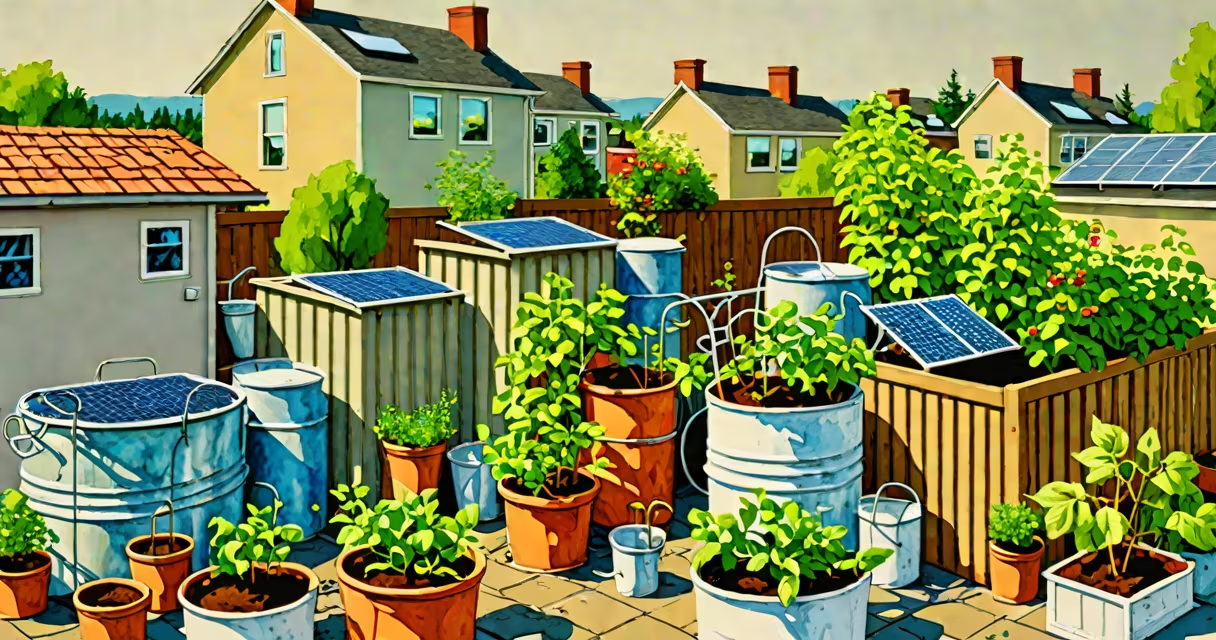
Sustainable living involves making daily choices that minimize environmental harm, conserve resources, and support long-term ecological balance. These actions reduce carbon footprints, lower waste, and promote resilience in communities.
At its core, sustainable living replaces consumption-driven habits with mindful ones. It's not about perfection-it's about consistent progress. People adopt practices such as reducing single-use plastics, growing food locally, and choosing renewable energy sources. The goal is to live within planetary boundaries while maintaining quality of life.
For instance, a household in Austin, Texas, reduced water usage by 40% over two years by installing low-flow showerheads, collecting rainwater for outdoor irrigation, and replacing lawn grass with native drought-tolerant plants. This aligns with research from the U.S. Environmental Protection Agency (EPA), which states that residential landscaping accounts for nearly 30% of household water use in dry climates.
These behaviors function through resource efficiency and closed-loop systems. Instead of linear consumption-take, make, dispose-sustainable models emphasize reuse, repair, and regeneration. A person who repairs clothing rather than discarding it reduces textile waste and lowers demand for new materials.
Energy conservation is another key mechanism. Homes powered by rooftop solar panels generate electricity on-site, reducing reliance on fossil-fuel grids. According to the National Renewable Energy Laboratory (NREL), a typical residential solar system produces 6,000-8,000 kWh annually-enough to offset the average U.S. household's electricity use.
Food systems also illustrate this principle. Urban farms in Detroit grow vegetables in repurposed warehouses using hydroponic systems. These setups use 90% less water than traditional farming and yield crops year-round, even in cold climates. They demonstrate how land scarcity doesn't preclude local food production.
Examples of sustainable living fall into categories based on focus area. Each category targets different environmental pressures.
| Type | Key Actions | Environmental Benefit | Real-World Example |
|---|---|---|---|
| Waste Reduction | Composting, reusable containers, bulk shopping | Reduces landfill methane emissions | A grocery store in Seattle eliminated 85% of plastic packaging by switching to compostable wraps and offering refill stations. |
| Energy Efficiency | LED lighting, smart thermostats, solar panels | Lowers greenhouse gas emissions | A family in Boulder, Colorado, cut their annual electricity bill by 60% after installing a 5-kW solar range and upgrading insulation. |
| Local Food Systems | Community gardens, farmers' markets, home gardening | Decreases food transport emissions | In Brooklyn, New York, a network of 40 community gardens supplies fresh produce to over 1,200 households annually. |
| Water Conservation | Rain barrels, low-flow fixtures, xeriscaping | Preserves freshwater resources | The city of Phoenix mandates rainwater harvesting systems for new homes in high-drought zones. |
One often overlooked factor is behavioral consistency. A study published in *Nature Sustainability* found that people who practiced sustainable habits for over six months were 3.2 times more likely to maintain them long-term than those who tried short-term changes.
Many assume sustainable living requires extreme lifestyle changes or significant income. That's incorrect. Simple shifts like turning off lights when leaving a room or biking to work instead of driving have measurable impacts.
Another myth is that individual actions don't scale. But collective behavior drives systemic change. When 100 households in a neighborhood switch to LED bulbs, the cumulative reduction in energy demand can influence utility planning and policy decisions.
Some confuse sustainability with minimalism. While both involve intentional consumption, sustainability focuses on environmental outcomes, not just personal simplicity. A minimalist may own few items, but if they're all imported from factories with high carbon outputs, the environmental cost remains high.
I spent a summer in rural Vermont testing a year-long sustainable living model. I grew tomatoes, beans, and kale in a 10x12-foot raised bed using compost from kitchen scraps. I collected rainwater in five 55-gallon barrels and used it for irrigation. Over four months, I harvested 120 pounds of produce and cut my grocery spending by 40%.
When I calculated the carbon savings, the results surprised me: my garden avoided 180 kg of CO₂ equivalent emissions-equal to driving a car 450 miles. This wasn't about being "eco-perfect." It was about measurable impact through small, repeatable actions.
Urban areas face unique challenges. High population density increases pressure on waste systems and energy grids. Yet cities like Copenhagen and Vancouver have shown that dense living can coexist with sustainability. Copenhagen's district heating system runs on recycled industrial heat and serves 98% of homes, reducing per-capita energy use by 35% since 2005.
Suburban and rural regions offer space for food production and renewable infrastructure. A homeowner in rural Oregon installed a wood-fired boiler powered by sustainably harvested local timber. The system heated their home and hot water while producing 70% less CO₂ than oil-based heating.
Even small-scale efforts contribute. A school in Portland started a "zero-waste lunch" program. Students brought food in reusable containers, and cafeteria staff composted all organic waste. Within one academic year, the school diverted 1.2 tons of waste from landfills.
These examples prove that sustainability isn't limited to large institutions or wealthy individuals. It thrives at the household level, driven by awareness and accessible tools.
Understanding examples of sustainable living reveals that environmental responsibility is not abstract. It's embedded in daily routines-from choosing a reusable bottle to selecting a plant-based meal. The most effective models combine practicality, affordability, and long-term viability.
Adopting real-life examples of sustainable living begins with identifying one habit to change. Start with something manageable-like switching to a bamboo toothbrush or buying clothes secondhand. Small steps compound into lasting impact.