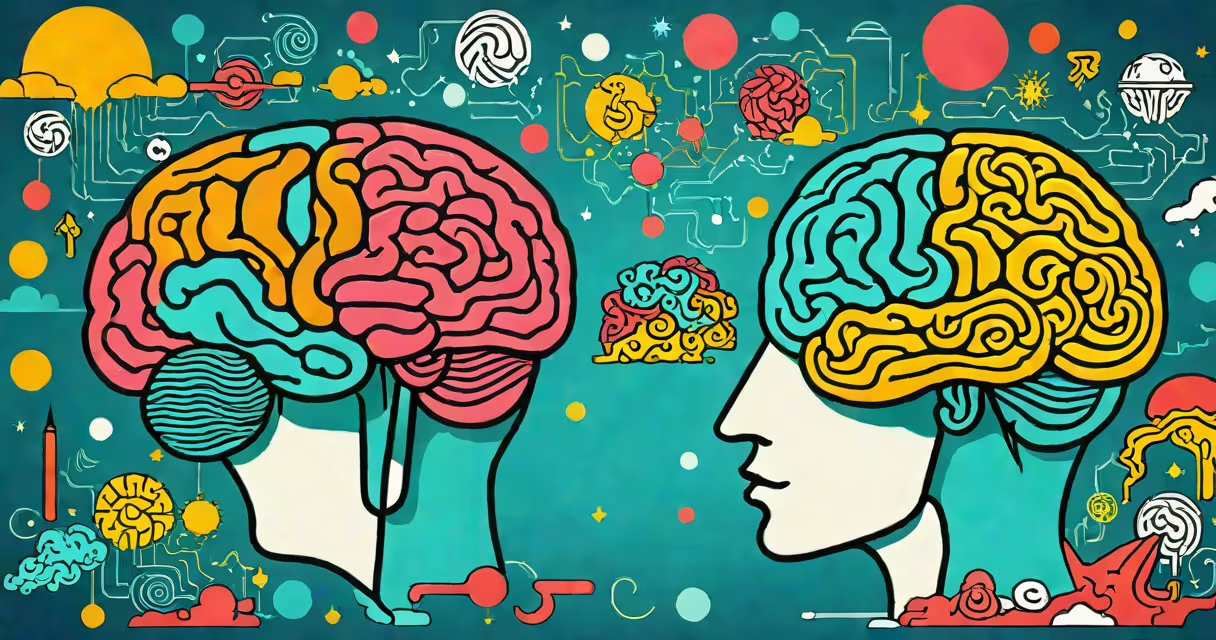
The conscious mind handles deliberate thought, the subconscious stores habits and emotions, and the unconscious manages automatic processes like breathing and reflexes. These three levels of mental activity operate simultaneously, shaping decisions, behaviors, and perceptions without always being noticed.
The conscious mind focuses on immediate tasks: solving math problems, choosing what to wear, or reading a sentence. It's limited in capacity-research shows it can hold about four items at once (Psychology Today). When you're learning a new skill, like riding a bike, your conscious mind is fully engaged.
The subconscious mind operates below awareness. It stores memories, emotional associations, and learned patterns. It influences decisions through habit-like reaching for your phone when bored, even without thinking. This layer processes vast amounts of sensory input silently, filtering what reaches your attention.
The unconscious mind controls bodily functions beyond voluntary control: heart rate, digestion, and reflexes. It also governs instinctual reactions. When you flinch at a sudden loud noise, that's an unconscious response. The brain acts before you register the event.
Neuroscience identifies distinct brain regions linked to each level. The conscious mind relies heavily on the prefrontal cortex-the area responsible for planning, reasoning, and self-monitoring. Damage here impairs decision-making and social judgment, as seen in patients with frontal lobe injuries.
The subconscious connects to the limbic system, especially the amygdala and hippocampus. These structures process emotion and memory. For example, a person who survived a car crash may feel anxiety in traffic long after recovery, because the subconscious associates driving with danger.
The unconscious involves deeper brainstem and basal ganglia activity. These areas regulate autonomic functions. They also support procedural memory-how we perform skills like typing or playing piano without thinking.
People often confuse the subconscious with the unconscious. The subconscious holds stored experiences and beliefs. The unconscious handles automatic, non-intentional actions. A common error is blaming "unconscious bias" for all snap judgments, but many biases stem from subconscious associations shaped by culture and repetition.
Consider this example: You walk into a room and instantly dislike someone. You can't explain why. Your conscious mind searches for reasons-"They're dressed oddly"-but the real cause lies in the subconscious. Maybe their posture reminds you of a past authority figure who was harsh. That recognition triggers discomfort before you're aware of it.
Another example: A pianist performs a complex piece flawlessly during a recital. They didn't think about each note. Their fingers moved automatically. This is the subconscious at work-muscle memory formed through repetition. But if they make a mistake, the conscious mind steps in to correct it. The two systems interact constantly.
| Mental Level | Primary Function | Example | Duration of Control |
|---|---|---|---|
| Conscious | Intentional focus, reasoning | Writing a sentence while correcting grammar | Short-term, task-specific |
| Subconscious | Habit formation, emotional memory | Automatically turning left at a familiar intersection | Long-term, recurring |
| Unconscious | Autonomic regulation, reflexes | Swallowing saliva without noticing | Constant, involuntary |
One non-obvious distinction: the subconscious can be accessed through guided imagery or hypnosis, but the unconscious cannot. You can't consciously recall an unconscious process like heartbeat regulation-even if you try to focus on it.
A key correction: many self-help books claim you can "reprogram" your subconscious overnight. That's inaccurate. The subconscious changes slowly through consistent repetition, not quick affirmations. Research from the National Institutes of Health confirms that behavioral change requires repeated exposure over weeks, not hours.
I once watched a friend fail a job interview despite preparing thoroughly. He later admitted he'd felt uneasy during the meeting. His conscious mind had rehearsed answers, but his subconscious picked up subtle cues-slight eye contact avoidance, tense tone-and flagged them as threats. His body responded with stress hormones before he realized he was anxious.
This is a classic interaction: conscious effort meets subconscious evaluation. The conscious mind believed he was ready. The subconscious detected mismatched signals and triggered unease. Only after reflecting did he recognize the pattern.
Another example: a chef tastes a dish and says, "It's missing something." They don't know what. The conscious mind can't name the ingredient. But the subconscious recognizes a flavor imbalance-perhaps too much salt, or a missing umami note. After adjusting, the dish feels complete. The unconscious mind guided the correction, but the conscious mind validated it.
Understanding the roles of conscious, subconscious, and unconscious mind helps clarify why people act in ways they don't fully understand. The conscious mind makes choices. The subconscious shapes preferences. The unconscious maintains life functions.
Recognizing these layers prevents misattribution. If you react strongly to a comment, ask whether the trigger came from a conscious evaluation or a subconscious memory. If you forget where you parked, it's likely a temporary failure in conscious retrieval-not a breakdown in the unconscious.