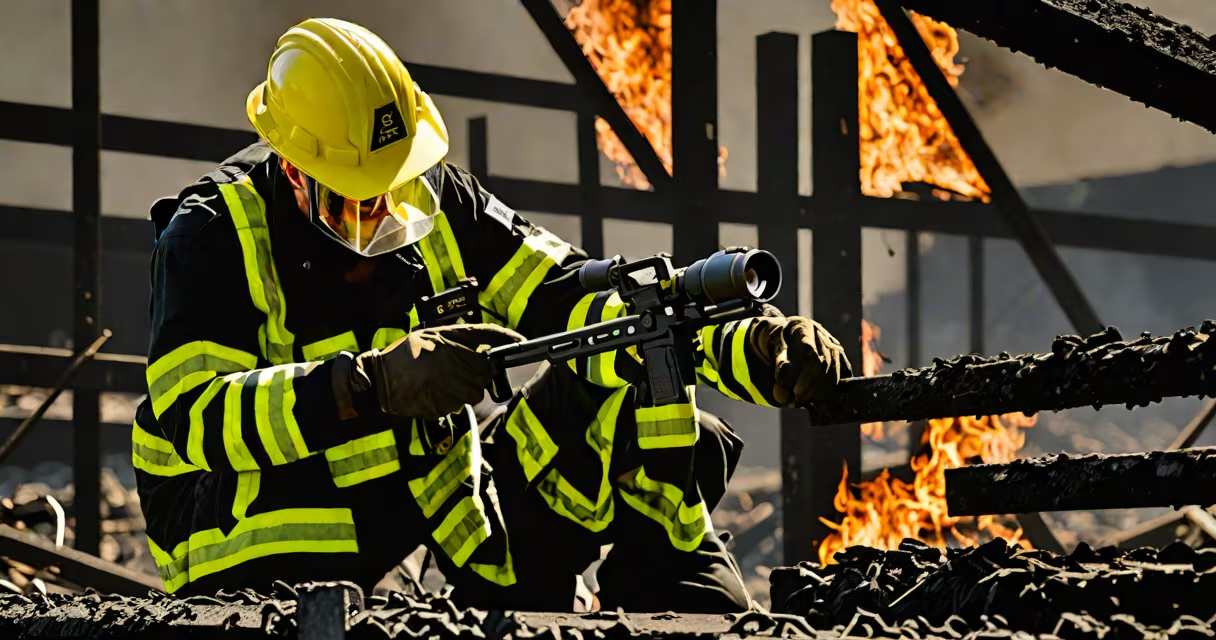
Fire investigation forensic science is the systematic application of scientific principles to determine the origin, cause, and spread of fires, particularly those involving human involvement. It integrates engineering, chemistry, and pathology to reconstruct events from physical evidence left behind after a fire. This discipline is essential in distinguishing accidental fires from intentional ones, especially in cases of suspected arson.
Investigators begin by securing the scene and documenting all visible damage. They then collect samples of debris, ash, and residue for lab testing. Gas chromatography-mass spectrometry (GC-MS) identifies traces of flammable liquids-common accelerants such as gasoline, kerosene, or alcohol-used to start intentional fires. The National Fire Protection Association (NFPA) 921 standard provides the structure for consistent methodology across U.S. investigations.
Not all fires leave clear signs. Some burns mimic accidental ignition due to electrical faults or spontaneous combustion. A trained forensic fire investigator uses thermal imaging, time-of-flight measurements, and material decomposition rates to differentiate between them. For example, a fire that spreads rapidly upward through a wall may indicate the use of an accelerant, while a slow, horizontal progression suggests a faulty heater or overloaded outlet.
Each fire scene presents unique challenges. Investigators follow a structured process: scene preservation, preliminary survey, detailed documentation, sample collection, laboratory analysis, and report compilation. The goal is to establish a timeline of events based on physical evidence rather than assumptions.
Thermal patterns in charred materials reveal heat direction and intensity. V-shaped burn marks pointing toward a specific location often indicate the fire's origin. However, this rule has exceptions-water damage, ventilation changes, or fuel placement can distort patterns. A 2016 study published in the Journal of Fire Sciences showed that 18% of misidentified origins stemmed from improper interpretation of burn geometry.
When accelerants are detected, investigators cross-reference the chemical signature with known substances. A single drop of gasoline residue can be identified through GC-MS, even after extensive charring. The FBI's Laboratory Division maintains a database of over 1,200 common accelerants and their combustion profiles, which supports nationwide consistency in findings.
Forensic fire investigation relies on multiple types of physical evidence. The table below outlines key categories, their typical sources, and analytical methods.
| Evidence Type | Common Source | Analysis Method |
|---|---|---|
| Burn patterns | Wall surfaces, flooring, furniture | Visual inspection, thermal modeling |
| Residue samples | Charred wood, metal fragments, debris | GC-MS, infrared spectroscopy |
| Electrical components | Wiring, outlets, switches | Microscopic examination, current flow tests |
| Human remains | Victims near ignition point | Postmortem toxicology, tissue analysis |
One non-obvious fact: smoke residue can reveal the sequence of fire spread. Smoke deposits form layers based on airflow and temperature gradients. By analyzing the thickness and composition of soot deposits on vertical surfaces, investigators can estimate how long it took for flames to reach certain areas. This method was critical in identifying the delayed ignition in the 2008 New York City apartment fire that led to a conviction.
Fire investigation forensic science is applied in criminal cases, insurance claims, workplace safety reviews, and public policy development. Law enforcement agencies use it to build cases against arsonists. Insurance companies rely on it to validate or deny claims involving property loss.
The U.S. Department of Justice reports that approximately 10% of reported structure fires are classified as suspicious annually. Of those, about 60% result in charges after forensic analysis confirms intentional ignition. In 2021, the Bureau of Alcohol, Tobacco, Firearms and Explosives (ATF) closed 1,423 arson-related investigations using forensic fire science techniques.
I once observed a team reconstruct a warehouse fire during a training exercise. The initial assumption was faulty wiring. But after collecting samples from beneath a collapsed beam, GC-MS revealed trace levels of diesel fuel. Further analysis showed the fuel had been poured in a ring around a storage container. That detail alone shifted the entire case act.
Many assume that fire investigators can determine the cause simply by looking at the damage. This is incorrect. Visual assessment alone leads to errors. The NFPA 921 explicitly warns against relying solely on burn patterns, stating that "misinterpretation of fire behavior is the leading cause of erroneous conclusions."
Another misconception is that all accelerants leave visible stains. In reality, many volatile substances evaporate completely during combustion. Only residual compounds remain, detectable only through advanced instrumentation. A 2019 report by the National Institute of Standards and Technology (NIST) confirmed that 34% of accelerant detections in controlled burns were missed by untrained observers.
Some confuse fire investigation with general forensics. While both involve evidence analysis, fire investigation focuses specifically on thermal dynamics, material degradation, and fluid movement under high heat. It requires specialized training in pyrolysis, flame propagation, and explosive vapor dispersion-areas not covered in standard forensic science curricula.