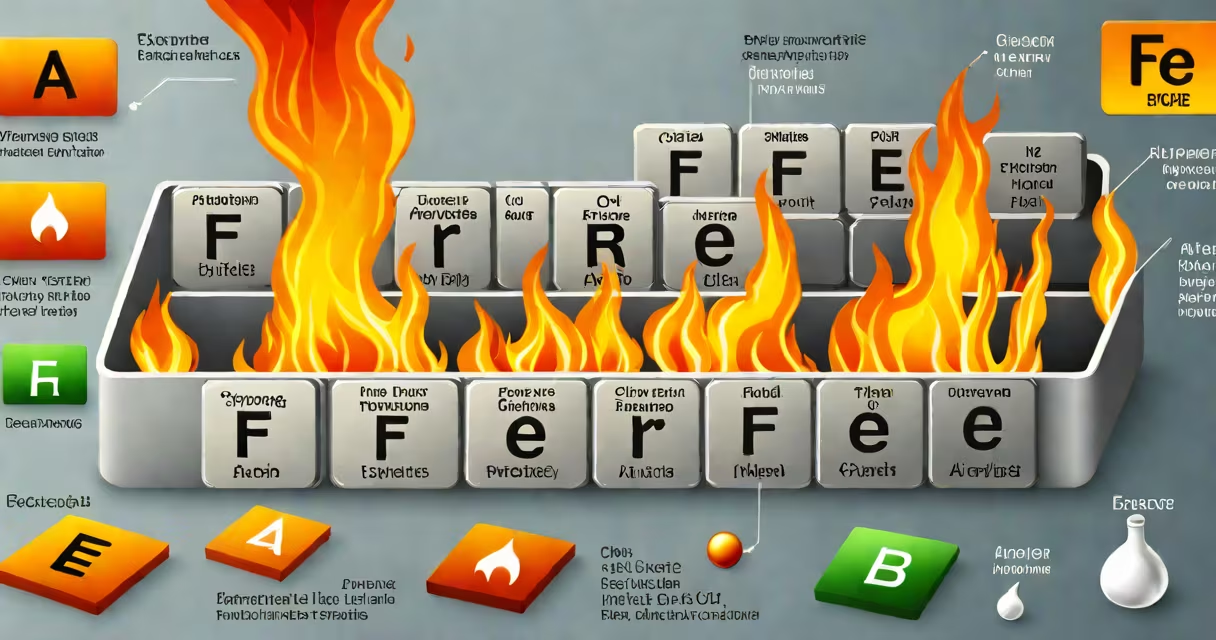
The fire elements periodic table lists elements that readily undergo combustion or sustain flames under standard conditions. These elements release energy as heat and light when reacting with oxygen, forming oxides and producing visible fire. The core group includes hydrogen, carbon, sulfur, and several metals like magnesium and sodium.
Combustion requires a fuel, oxidizer (usually oxygen), and sufficient activation energy. On the periodic table, elements that serve as fuels are typically nonmetals or highly reactive metals. Their electron configurations allow them to donate or share electrons rapidly during oxidation. This process releases thermal and radiant energy-visible as flame.
Hydrogen (H), atomic number 1, burns with a pale blue flame and produces water vapor. Carbon (C), atomic number 6, forms CO₂ when burned completely and is central to fossil fuel combustion. Sulfur (S), atomic number 16, burns with a bright blue-violet flame and emits SO₂ gas. These three are foundational to fire chemistry and appear in nearly all natural and artificial flames.
When a fire element reacts with oxygen, it undergoes exothermic oxidation. The reaction releases energy because the bonds formed in the product (like CO₂ or H₂O) are stronger than those broken in the reactants. This net energy release powers the flame's visible glow and heat output.
For example, burning methane (CH₄) involves carbon and hydrogen-both fire elements. The balanced equation is:
CH₄ + 2O₂ → CO₂ + 2H₂O + energy (heat and light)Each molecule of methane consumed releases about 802 kJ of energy. This is why hydrocarbon fuels like gasoline and propane generate intense, sustained flames. The presence of carbon and hydrogen in organic compounds makes them ideal fire-supporting materials.
Reactive metals such as magnesium (Mg) burn with extreme brightness. Magnesium ribbon ignites in air with a blinding white flame, producing magnesium oxide (MgO). This reaction is so energetic that it can be seen from over 100 meters away in darkness. The high surface area of thin ribbon increases reaction rate, making it a classic classroom demonstration of fire elements in action.
Fire elements fall into distinct categories based on their position and behavior on the periodic table. The most common are nonmetals in Groups 14-16 and alkali/alkaline earth metals in Groups 1-2.
| Element Group | Examples | Flame Characteristics | Common Sources |
|---|---|---|---|
| Nonmetals (Group 14-16) | Carbon (C), Sulfur (S), Phosphorus (P) | Blue, yellow, or green flames; often smoky | Wood, coal, gasoline, matches |
| Alkali Metals (Group 1) | Lithium (Li), Sodium (Na), Potassium (K) | Distinctive colors: crimson, yellow, lilac | Sodium in street lamps, lithium in batteries |
| Alkaline Earth Metals (Group 2) | Magnesium (Mg), Calcium (Ca) | Intense white light; high luminosity | Flares, fireworks, magnesium ribbon |
Phosphorus is especially notable. White phosphorus ignites spontaneously in air at around 30°C. It's stored underwater to prevent accidental combustion. Its reaction with oxygen produces dense white smoke and a faint greenish flame-used historically in incendiary devices.
A lesser-known fact: not all flames come from combustion. Some involve physical processes. For example, the blue flame of a Bunsen burner results from complete combustion of natural gas (methane). But the flame color changes to yellow when air intake is restricted-indicating incomplete combustion and soot formation. This shows that flame appearance depends on both the fuel and oxygen availability.
Fire elements are essential in energy production, industrial processes, and everyday applications. Carbon and hydrogen dominate fossil fuel use-coal, oil, and natural gas. Together, they supply over 80% of global primary energy, according to the International Energy Agency (IEA).
In manufacturing, magnesium is used in flares and pyrotechnics due to its high energy density. A single gram of magnesium releases about 24.7 kJ of energy when burned-more than twice the energy per gram of wood. This makes it ideal for emergency signaling and stage effects.
Another application is in rocket propellants. Aluminum powder (Al) is mixed with ammonium perchlorate (NH₄ClO₄) in solid rocket boosters. Aluminum burns rapidly, producing aluminum oxide and releasing large amounts of heat. NASA reports that this combination generates thrust exceeding 1.2 million pounds-force per engine.
Fire elements also play roles in safety and detection. Sodium vapor lamps emit a characteristic yellow-orange light due to the emission spectrum of excited sodium atoms. This light is highly visible in fog and low-light conditions, making it common in street lighting. The specific wavelength (589 nm) is a direct result of electron transitions in sodium-a phenomenon linked to its reactivity.
Many assume all metals burn brightly. Not true. Iron (Fe) rusts slowly in air but doesn't sustain a flame. Its oxidation is too slow to produce visible fire. Only certain metals-especially those with low ionization energies-ignite readily.
Also, people often confuse "flammable" with "combustible." Flammable materials ignite below 100°F (37.8°C), while combustible materials require higher temperatures. Methanol (CH₃OH), for example, has a flash point of 12°C-making it flammable. But diesel fuel has a flash point of 52°C-classifying it as combustible, not flammable.
A critical error is assuming oxygen is a fire element. Oxygen supports combustion but is not a fuel. It's an oxidizer. On the periodic table, oxygen (O) is a nonmetal in Group 16. It enables fire but doesn't burn itself. Without oxygen, even the most reactive elements cannot sustain flame.
During a lab experiment, I once lit a piece of magnesium ribbon in a fume hood. The flame was so intense it triggered the room's automatic fire alarm. The light lasted less than 10 seconds but illuminated the entire space. This demonstrated how concentrated energy release from a fire element can be-even from a small sample.
Only 12 elements are consistently involved in visible, sustained combustion under normal conditions. These include hydrogen, carbon, sulfur, phosphorus, and metals like lithium, sodium, potassium, magnesium, calcium, and aluminum. They form the basis of fire chemistry.
Understanding fire elements helps explain everything from kitchen stoves to spacecraft propulsion. The periodic table organizes these elements by reactivity, electron configuration, and position-making it possible to predict which ones will burn and how intensely.
Fire elements periodic table is not just a list-it's a map of energy release, reactivity, and transformation. Knowing which elements ignite and why reveals the science behind one of humanity's oldest tools: fire.