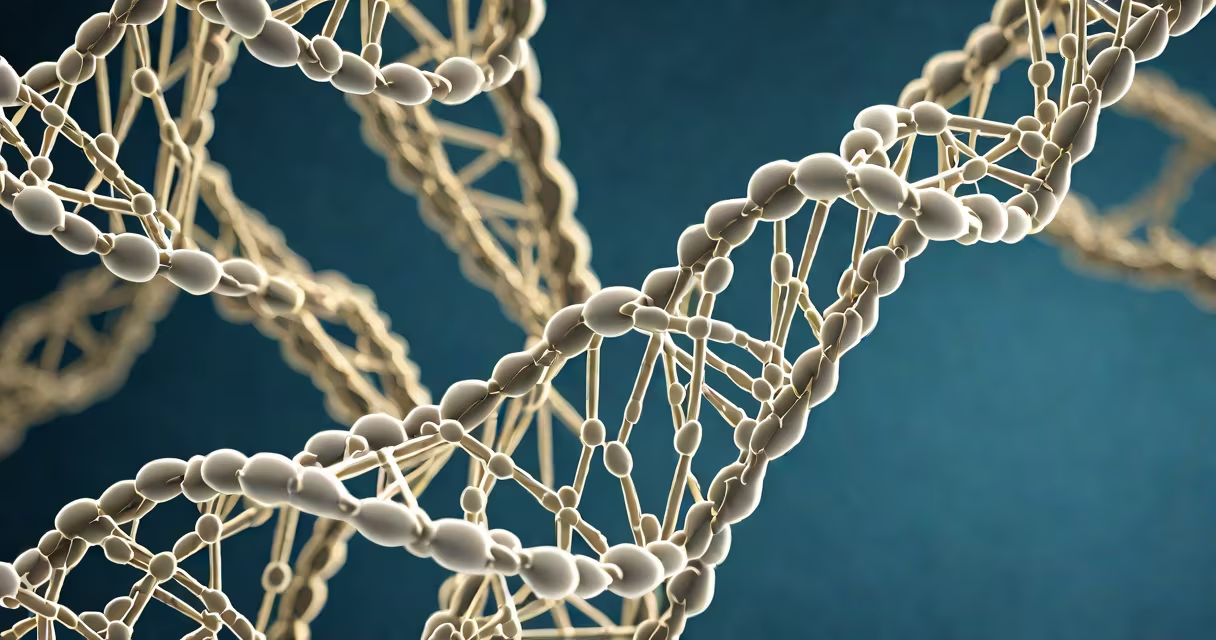
Nucleic acids are biomolecules that store and transmit genetic information essential for life. They consist of long chains of nucleotides, each containing a sugar, phosphate group, and nitrogenous base. The two primary types-DNA and RNA-work together to direct cellular activities, from protein production to inheritance.
DNA (deoxyribonucleic acid) holds the master blueprint for an organism's traits. Its sequence of four bases-adenine (A), thymine (T), cytosine (C), and guanine (G)-encodes instructions for building proteins. This information remains stable across cell divisions and is passed. RNA (ribonucleic acid) acts as a messenger and functional molecule, translating DNA instructions into working proteins.
Each nucleotide in a nucleic acid chain connects via phosphodiester bonds between the sugar of one unit and the phosphate of the next. This creates a sugar-phosphate core with bases projecting inward. In DNA, two strands twist into a double helix, held together by hydrogen bonds between complementary bases: A pairs with T, and C pairs with G. This pairing ensures accurate replication during cell division.
The function of nucleic acids begins with replication. Before a cell divides, its DNA unwinds and each strand serves as a template for synthesizing a new complementary strand. This semi-conservative process ensures both daughter cells receive identical genetic material. Errors are rare-about one mistake per billion nucleotides-thanks to proofreading enzymes like DNA polymerase.
Transcription follows replication. In the nucleus, RNA polymerase binds to a gene's promoter region and copies the DNA sequence into a single-stranded mRNA molecule. The mRNA sequence mirrors the coding strand of DNA, except thymine (T) is replaced by uracil (U). For example, a DNA segment reading 5'-ATGCCGTA-3' becomes 5'-AUGCCGUA-3' in mRNA.
Translation occurs in the cytoplasm at ribosomes. Transfer RNA (tRNA) molecules carry amino acids based on codons-three-base sequences in mRNA. The genetic code is universal: AUG always codes for methionine and serves as the start signal. A stop codon (UAA, UAG, UGA) ends translation. A 100-amino-acid protein requires about 300 nucleotides in mRNA.
There are two major classes of nucleic acids: DNA and RNA. DNA stores hereditary information in most organisms. It is typically double-stranded and located in the nucleus (in eukaryotes) or nucleoid (in prokaryotes). RNA is usually single-stranded and performs diverse roles in gene expression.
| Type | Structure | Key Function | Base Pairing |
|---|---|---|---|
| DNA | Double helix | Long-term genetic storage | A-T, C-G |
| mRNA | Single strand | Carries code | A-U, C-G |
| tRNA | Folded cloverleaf | Delivers amino acids during translation | Anticodon pairs with codon |
| rRNA | Part of ribosome complex | Catalyzes peptide bond formation | Forms active site in ribosome |
Some viruses use RNA as their genetic material. Retroviruses like HIV reverse-transcribe their RNA into DNA using the enzyme reverse transcriptase. This DNA integrates into the host genome and replicates with the host's DNA. This mechanism enables persistent infections and complicates treatment.
Non-coding RNAs also play important roles. MicroRNAs (miRNAs) regulate gene expression by binding to mRNA and blocking translation or promoting degradation. A single miRNA can target dozens of mRNAs, fine-tuning protein levels. These molecules are involved in development, immune response, and disease progression.
Many assume DNA directly builds proteins. This is incorrect. DNA provides the instructions, but proteins are synthesized from RNA. The central dogma of molecular biology-DNA → RNA → protein-remains valid across all domains of life.
Another misconception is that all DNA codes for proteins. Only about 1-2% of human DNA contains genes for proteins. The rest includes regulatory sequences, repetitive elements, and non-functional remnants. Despite being called "junk DNA," much of this non-coding DNA influences gene activity and chromosomal stability.
Even more surprising: some nucleic acids act as catalysts. Ribozymes are RNA molecules that catalyze chemical reactions. The ribosome itself is a ribozyme-the rRNA component performs peptidyl transferase activity, forming peptide bonds. This discovery challenged the idea that only proteins could be enzymes and supports the RNA world hypothesis, suggesting life began with self-replicating RNA.
CRISPR-Cas9 uses synthetic guide RNA to target specific DNA sequences. The guide RNA aims to match a 20-nucleotide segment of the genome. When paired with the Cas9 enzyme, it cuts the DNA at that location. Cells then repair the break using a provided DNA template, allowing precise edits.
In 2017, researchers used CRISPR to correct a mutation causing hypertrophic cardiomyopathy in human embryos. The edit restored normal heart muscle function in mouse models. This application demonstrates how understanding the function of nucleic acids enables targeted medical interventions.
I once observed a PCR experiment in a university lab. After amplifying a 500-base-pair fragment from a blood sample, we ran the product on a gel. The band appeared at the expected size, confirming successful amplification. Seeing the DNA bands under UV light reinforced how nucleic acids' physical properties allow detection and analysis.
Understanding the function of nucleic acids is foundational to genetics, medicine, and biotechnology. From diagnosing inherited disorders to engineering crops, this knowledge drives innovation. The function of nucleic acids underpins every living system,.